

Seeking traction
Bahrain’s construction industry has been hit by the political unrest gripping the nation, but social housing and infrastructure demands give the industry reason for hope.
01 January 2012
SOCIAL housing, industrial infrastructure and some top-quality hotel projects could provide the much-needed impetus to Bahrain’s construction sector, which has suffered a great deal over the past couple of years due to various factors.
The global economic downturn prompted a wait-and-watch approach over 2010 and this has now given way to despondence as there seems to be no immediate solution in sight for the political stalemate that has held the sector hostage.
The political unrest continues to have a serious impact on Bahrain’s economy even as efforts are being made to retain investor confidence in the country. The construction sector along with hospitality and real estate are among the sectors that have been the hardest hit, both by the unrest and the wider global economic downturn.
Bahrain’s construction and engineering sector – which employs a quarter of the nation’s population, between 250,000 and 300,000 expats and Bahrainis – has been dogged with problems, given that new projects have been few and far between, ongoing ones continuing to suffer delays and payments not being made.
It is now up to the public sector to drive the construction industry forward – and this it aims to do by addressing the huge housing shortage that the nation faces and putting some of the much-needed infrastructure in place. The government has allocated a budget of BD180 million ($477 million) for social housing projects in 2012, which is expected to spur growth in the construction sector, said experts at a recent high-level business forum.
Senior delegates at Bahrain Outlook 2012 pointed out that the housing sector will be also supported by funding offered by the GCC countries and additional money from the surplus in the 2011 budget. To help it offset the costs of the unrest and fund infrastructure and housing, GCC states have pledged to give Bahrain $10 billion over 10 years, which should help ease the financial burden on the country.
According to CB Richard Ellis, a global leader in real estate services, although the political crisis did dampen the country’s short-term economic outlook, the government’s firm stance in pushing through reforms is likely to limit the prolonged effects.
In July, Bahrain was removed from ‘Credit Watch Negative’ by Standard & Poors which cited ‘the diminished near term political tensions and our expectation that increased public spending will lift economic growth next year’ in its statement on Bahrain.
Apart from social housing, the manufacturing sector will offer opportunities for the construction industry as Bahrain continues to attract a number of international companies to set up base in its industrial city at Hidd. In addition, there are a number of major projects in the oil and gas sector – where a total of $15 billion will be invested in boosting production. These include a $6 billion upgrade of the Bapco refinery and a $350-million Saudi-Bahraini crude oil pipeline refurbishment scheme.
This apart, Bahrain will see at least three five-star hotels coming up over the next year, providing a confidence booster to the nation’s hospitality sector. Other key projects include the recently announced media city, the much-awaited Qatar-Bahrain Causeway and Bahrain International Airport expansion.
Housing
One of the key issues that the government has prioritised is housing, a sector which has been plagued by chronic shortages with a waiting list of 52,500 families. Bahrain’s Ministry of Housing just last month (December) allotted 2,500 properties to applicants, thus bringing down the waiting list to 50,000, according to Sami Juma Mandeel, the director of housing projects, construction and maintenance at the ministry.
These projects are estimated to cost BD85 million ($225 million) to complete. In addition, the government also announced the names of 530 beneficiaries, who would collectively be given loans totalling BD6.5 million ($17.2 million).
Another 3,000 units are expected to be contracted directly this year by the Ministry of Housing. Mandeel indicated that the annual housing allotment is BD180 million ($477.5 million), which would allow the construction of 6,000 houses and land is available for construction of 30,000 homes.
According to an implementation plan approved by the cabinet and the Economic Development Board, some 25,000 units are expected to be handed over until 2017. About 91 plots of land will be allotted in Al Dair and Samaheej, 500 in eastern Hidd, and between 600 and 800 in east Sitra in 2012. Currently, work is going on an initial scheme for Dar Kulaib housing project, while 400 plots will be allocated in North Town in the first quarter of 2012.
Real estate consultant Cluttons points out, however, that a major hurdle is the scarcity of land and high land cost. “There is a disconnect between what developers and the Ministry of Housing are able to feasibly provide – medium-rise apartment buildings – and what the mass population want – private villas,” says the Cluttons report.
Looking into the future of housing in the country, Mandeel said the waiting list could be brought down considerably with a paradigm shift in attitudes. “It is time the housing sector in Bahrain went vertical, moving into towers that are very spacious and meeting the needs of the home owners,” he adds.
In the short to medium term, the government will increasingly resort to public-private partnerships to develop homes in three new cities, at North Town, East Hidd and East Sitra. The three projects together are intended to provide approximately 23,000 units by the end of 2016 at an estimated cost of BD2.5 billion ($6.6 billion). According to Housing Minister Basim bin Yacob Alhamer, preliminary work on providing access roads to North Town is now under way with work on the houses to begin shortly.
Roads
Despite the unrest, work on crucial road works has continued virtually undeterred with projects such as the BD50 million ($132.6 million) Isa Town flyover completed on schedule last September. Construction of the project, which came to a temporary halt after original contractor Sungwon Corporation was axed in February 2010, was later re-tendered and awarded to Nass Corporation.
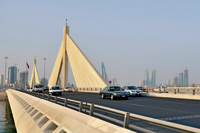
Another key project is the North Manama Causeway and the King Faisal Highway upgrade, which is making remarkable progress.
The North Manama Causeway consists of the following elements:
• Upgrade of the two junctions of Al Fateh/King Faisal Highway, and Al Fateh/Sheikh Hamad Causeway into a two-level grade-separated junctions. This is achieved via the construction of an elevated 1.42-km-long segmental flyover providing three to four lanes of dual carriageway;
• Improvement of the at-grade movements at the two junctions of Al Fateh/King Faisal Highway, and Al Fateh/Sheikh Hamad Causeway. This is achieved via the reconstruction of 1.6 km of roads along Al Fateh Highway, Sheikh Hamad Causeway, and King Faisal Highway;
• Construction of a new signallised traffic junction for entry/exit into the Manama Lagoon area, halfway between the two junctions of Al Fateh/King Faisal Highway and Al Fateh/Sheikh Hamad Causeway;
• Construction of new 2.42 km of roads along Al Fateh Highway and the eastern and northern sides of the Bahrain Bay;
• Construction of a new 238-m-long curved left turn flyover to provide a two-lane single carriageway access to the Bahrain Bay from the North Manama Causeway;
• Construction of a new 51.4-m-long single-span bridge to provide three-lane dual carriageway across an architectural canal along the northern side of the Bahrain Bay.
Some sections of the causeway are due for completion this month with the entire project targeted for completion in July 2013.
Other major road projects include the BD25-million ($66.3 million) Mina Salman Interchange, which has been awarded to the Indian company Afcons Infrastructure and a three-level flyover, underpass and new traffic signals on Sheikh Jaber Bin Al Sabah Highway to replace the Nuwaidrat and Alba roundabouts. The BD36-million ($95.4 million) project, which will be tendered shortly, is part of a nationwide plan to ease the country’s traffic flow and will also form part of the international road link between Bahrain and Qatar connecting to the proposed $3 billion Bahrain-Qatar Friendship Bridge, which has suffered innumerable delays.
Industry
The government’s efforts to sustain business activity and investor confidence – including the suspension of labour fees levied by the Labour Market Regulatory Authority on foreign employees – have seen a number of manufacturing facilities setting up operations in the country.
The latest venture to enter the market is the Mumbai-based polyester film company JBF, which is looking to invest $200 million in a plant in Salman Industrial City in Hidd. It will have a production capacity of 90,000 tonnes of polyester film in the first phase, which could be expanded and diversified at a later stage.
Manufacturing grew by three per cent over the year up to June, according to the Bahrain Economic Quarterly. The IMF forecasts Bahrain’s economy to grow by 1.5 per cent in 2011, with growth increasing to 3.6 per cent this year.
According to Cluttons’ Bahrain property market update, Q3 2011, the country is relying heavily on the manufacturing sector for future growth. The Salman Industrial City – comprising Bahrain Industrial Investment Park (BIIP), Bahrain Investment Wharf (BIW) and Bahrain Logistics Zone (BLZ) – has been the focus of progress and new growth, thanks to its location with direct access to the new Khalifa Bin Salman Port and the Bahrain International Airport as well as a direct and uninterrupted dual carriageway road link to the Saudi Causeway.
A particular attraction of the kingdom is its ‘Business Friendly Bahrain’ policy, which allows 100 per cent foreign corporate ownership without sponsorship. Progress of the industrial and logistics sectors will, however, be dependent on a return to political stability trusted by the international community, says the report.
Nearly BD5 billion ($13.3 billion) will be invested at BIIP where a total of 71 projects are expected to be operational within the next few years, according to Industry and Commerce Minister Dr Hassan Fakhro. Of these, 23 projects are under construction and 20 more projects are in the pre-construction stage.
Approximately 75 per cent of the serviced plots at BIIP have been taken up, with over 50 per cent of the attracted businesses being international. BASF and Siemens have started major operations there with further commitments from German RMA Pipeline Equipment, French minerals company Imerys and CPIC, the largest manufacturer of fibreglass in China, which is planning to set up a 45,000 sq m facility.
Dr Fakhro said land for industrial investment in the country might be increased from over six million sq m to 10 million sq m in the coming years to keep up with demand. As such, the government is planning another industrial city, which might be constructed on the east coast of Sitra. The proposed island city is expected to cover 100 sq km. Studies on Phase One of the project have already been completed by the Ministry of Industry and Commerce. This will be followed by studies for Phases Two and Three.
Also in the industrial sector, Asry, one of the Middle East’s largest shipyards, inaugurated its new 1,380-m quay wall expansion as part of its 35th anniversary celebrations last month (December). The new quay wall was designed by the UK’s Royal Haskoning and built by Bahrain’s Nass Contracting. The project is part of a $188-million expansion programme, which includes a 200,000-sq-m hard-standing offshore fabrication area, with load out quay (see separate report).
Bahrain Airport
Last June, Bahrain Airport Company (BAC), 100 per cent owned by Bahrain Mumtalakat Holding Company, formally launched the Bahrain International Airport (BIA) expansion project, which will boost capacity by 50 per cent from the current nine million passengers to 13.5 million.
The developer has been in the process of acquiring land for the expansion project.
Dar Al Handasah will lead the BD4.4 million ($11.7 million) design phase of the expansion project which is expected to take nine months to complete and will also supervise the construction of the extension as part of its contract. The expanded Bahrain International Airport is expected to be complete by 2015.
The airport will increase its footprint by an additional 40,000 sq m, including more than 3,000 sq m of new retail facilities. It will also create four to five additional contact gates, nine remote gates and 40 more check-in counters as well as an enlarged transfer facility, amongst several other capacity improvements and value-added facilities.
Commercial & Residential
Bahrain Bay is among the few projects that have not been significantly delayed in the present scenario. The project has seen a number of third-party developers start work on site. In April this year, Al Baraka Banking Group awarded the construction contract for its headquarters at the waterfront development to Arabtec Construction Company. This was followed in October by a construction contract for the Four Seasons hotel to Belgian company Six Construct. Work on the project started late last year and the hotel is due to be ready by April 2014 (see separate report).
Another mega development is Diyar Al Muharraq, where Kooheji Contractors has been contracted to build six mock-up villas by the developer Kuwait Finance House-Bahrain (KFH-Bahrain). This project is considered to be one of the largest residential projects undertaken by the private sector in Bahrain, where between 2,500 and 3,000 housing units. The overall project is planned to be developed in several phases.
Work on a BD200-million ($530 million) revamp of the Manama Central Market is set to start within 24 months, it has been announced. The project includes a new central market, which will be named the Capital Trade Centre. The development is expected to include business, residential, shopping and leisure spaces. Four 28-storey office and shopping towers, car parking, a five-star hotel, heritage village and a park are also part of the plan.
To address the demand for building materials in the country, the General Organisation of Sea Ports (GOP) has plans to develop a Buildings Material Terminal (BMT) at the Mina Salman Port (MSP), Bahrain’s former main container and general cargo terminal. Currently, Bahrain imports its building materials from neighbouring countries in small vessels or barges.
With the development of the bulk building materials terminal, which enjoys a deeper draught at 10 m, a larger market for construction materials is expected to be established.
Other major plans on the drawing boards include a media city and a major exhibition centre.
Conclusion
The fact that Bahrain has succeeded in enticing international manufacturers to set up operations in the country indicates the appeal of its business environment. And although, project financing will be difficult and the real estate sector is expected to remain depressed, the construction sector can hope for opportunities afforded by social housing and infrastructure developments, which the government is under pressure to pursue in an effort to deliver on its promises.
- Seeking traction
- Bahrain projects at a Glance
- Major milestone
- Asry opens repair quay in $188m expansion
- BFCC puts sewage plant on firm footing
- Reynaers promotes new brand signature
- Paschal takes on regional challenges
- Installux sets sights on new markets
