

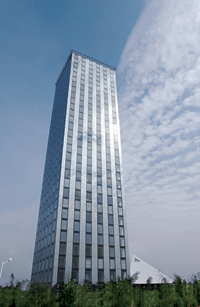
The T30 ... built in a record 15 days.
Green tower shape of things to come
Erecting a 30-storey building structure in just 15 days or 360 hours is undoubtedly a remarkable feat. However, what needs to be answered is how sustainable and safe is such a structure and can the technology be used in the Gulf region. ABDULAZIZ KHATTAK finds out.
01 February 2012
A 30-storey five-star was completed within a record 15 days in the Hunan Province of China last December, by Broad Group, a Chinese construction company which specialises in sustainable architecture.
Termed as the T30, the steel structure that houses the Ark Hotel has been built using pre-fabricated modules. Apart from the astounding speed at which the building was erected, the structure boasts a number of highly-sophisticated features that push the boundaries of construction technology while providing the benefits of lower cost, higher energy efficiency, superior indoor air quality and environment friendliness.
In an exclusive interview with Gulf Construction, Juliet Jiang, senior vice-president of Broad Group, which owns the Broad Sustainable Building (BSB) technology, says the technology is far superior to traditional building methods.
 |
|
Jiang. |
Compared with a traditional five-star hotel, the T30 structure offers a host of advantages, she says. As it comprises pre-fabricated modules, the T30 has a design life of 600 years, requiring inspection and maintenance once every 60 years, compared to the 60-year life span of a similar building constructed the traditional way. The steel structure in the T30 is cold galvanised against corrosion while the traditional building uses anti-corrosion painting only. Similarly, the interior wall partitions used in the T30 is made of fibre cement with a life span of 60 years compared to the gypsum in a traditional building with a 10-year life span. For water supply, the T30 has copper pipes against steel pipes used traditionally, according to the company.
The BSB building boasts higher ceiling heights and longer clear spans. What’s more, even the load-bearing structure can be inspected. Although it requires a lead time of about 40 days, it can be constructed well within 30 days and foundation work is similar to that done for conventional buildings, according to the company.
The T30 hotel has used uses six times less cement (1,620 tonnes) compared to a traditional structure of the same size (12,000 tonnes). Since the building structure is a steel one, the T30 has used 1,231 tonnes of steel compared to about 1,000 tonnes used in a traditional building. Meanwhile, to make the T30 earthquake resistant, a special structure of diagonal steel bracing has been used.
Jiang claims that BSBs can overcome the housing crunch in the Middle East and is currently looking for franchises to transfer its technologies so that factories can be set up locally. She also recommends high-rises for the region because the higher the building, the lower the cost because of economies of scale.
 |
|
Prefabricated elements ... installation on site. |
Commenting on the compatibility of BSB technology with the region’s harsh hot climate, she says: “Broad Group originated from the Broad non-electric air-conditioning business, of which we have been the world’s number one manufacturer and seller since 1996. We have considered the Middle East climate and it is no problem.”
The T30 has been built to withstand earthquakes of up to magnitude nine, as tested by the China Academy of Building Research, which claims this is five times more quake-resistant than conventional buildings.
Other innovative features include automatic shutters in the curtain-wall; electricity generated by elevators either when ascending empty or descending fully loaded. This apart, the building also includes a high level of automation such as automatic switch off of lights when occupants leave the room and of air-conditioning and fresh air intake two hours after the facility is vacated.
A BSB structure is claimed to be sustainable in terms of no less than 10 aspects: earthquake resistance, energy conservation, material saving, durability, recyclability of construction materials, no construction waste, recycling of sewage to produce biogas, no dust during construction, no harmful materials, and complete air filtration.
“We have managed to control these 10 crucial aspects – something that was previously considered inconceivable – and this has been achieved while keeping construction costs down. The cost of BSBs is 10 to 30 per cent lower than that of conventional buildings because they are factory made,” says Jiang. “For instance, the cost for the 30-storey T30 hotel was $1,000 per sq m and this includes everything inside.”
 |
Energy efficient
All BSBs adopt at least 30 different energy-saving technologies including thick thermal insulation of the exterior wall and roof, multi-paned windows, external solar shading, heat recovery fresh air, LED lighting and water-saving toilets. The BSB utilises 15 to 25-cm-thick thermal insulation and four-paned windows. This keeps the heating load of BSBs during winter at only 10 to 20 W per sq m (including wall, window and fresh air load); and cooling load during summer is only 20 to 30 W per sq m (including people, electrical appliances and fresh air load), says the company.
“About 70 per cent of energy saved by BSBs comes from thermal insulation,” says Jiang.
Another significant energy-saving technology of the BSB comes from the Broad-invented heat recovery fresh air system, which recovers 70 to 90 per cent of energy and ensures the freshness of the indoor air of BSBs with little energy loss, she adds.
Air purification
BSBs feature air quality detectors in each room, allowing residents to check indoor particulate matter (PM0.3, PM2.5 and PM10), formaldehyde and carbon dioxide levels any time and compare these with outdoor PM levels.
While there have been deliberations whether countries can afford to install such detectors in each city, BSB installs these detectors as a standard in every room, according to Jiang. “It’s definitely a revolution in miniaturisation technology by Broad that has lowered cost through groundbreaking research and development. It’s as profound as putting a computer the size of a room some decades ago into a small mobile phone today,” she comments.
 |
Another challenge buildings face is achieving ‘super filtration’, which entails 100 per cent filtration of outdoor PM10 and PM2.5, and 99.8 per cent filtration of outdoor PM0.3. At present, only IT chip assembly lines and surgical operating rooms around the world use this kind of technology, which is even more costly than the building itself, Jiang points out.
“But Broad has successfully invented a low-cost super-filtration technology and integrated it into the heat recovery fresh air machine. It is a combined system with three-stage filters. The first stage adopts the traditional coarse filter, collecting big particles; the second stage utilises Broad-invented ‘electrostatic cleaner’, following the principle of positive attracts negative to filtrate 98 per cent of the PM; and the remaining 1.8 per cent of PM is filtrated by expensive ‘Hepa filters’.
“People who know Broad technology will no longer be surprised when we promise that indoor air in BSBs is 20 times purer than outdoor air,” says Jiang.
She adds that the BSB marks a quantum leap in technology in terms of the scope of the revolution, innovation, integration of resources, volume of data, architecture and impact on real estate.
“BSB is creating history. While people were amazed just watching a three-minute video of a high-rise being erected in no time, what most of them were still not aware of is the more amazing figures hidden behind the building in the video,” she points out.
Amongst the features and advantages of BSBs compared with conventional buildings are:
• 9-magnitude earthquake resistance;
• Material consumption is 60 to 80 per cent less;
• Five times more energy efficient;
• Creates 20 times purer air;
• 10 to 30 per cent lower in cost;
• Construction speed is remarkably faster with zero injury during the construction process;
• Building styles are more diversified;
• Only one per cent construction waste is produced;
• Interior and exterior wall surfaces are smooth;
• The risk of fire is eliminated during construction as no welding is involved;
• No dust on site; and
• Indoor flooring is installed quickly with less material, producing a robust system.
Also, a 100-m-high skyscraper can withstand Force 10 winds.
Broad began developing sustainable buildings after the Wenchuan Earthquake in 2008. One year later, the company conducted hundreds of tests, leading to the invention of the steel structure, using diagonal bracing and lightweight combination technology.
By last December, BSB had built a total of 12 BSBs in Changsha, Xiangyin, Shanghai and Zhejiang provinces in China and Mexico; and has established two franchise partners in Ningxia and Fujian. Negotiations are under way with another 10 Chinese and international potential partners.
Jiang has her ambitions set high and envisions a future where one in every three buildings built across the world will be a BSB structure.
