

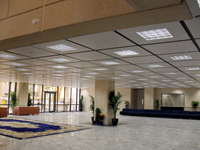
The King Saud University ... high-spec metal ceilings used.
SAS proposition makes sound sense
Although comfort is primarily associated with heating and cooling solutions, privacy and acoustics are essential considerations for occupants. Here ANDREW JACKSON from SAS International* looks at acoustic considerations and how the interior fit-out can provide optimal solutions.
01 February 2012
WHILE businesses invest a lot of time and money to create an ideal environment for the comfort of their staff, the change in the working environment to cater for open-plan spaces, flexible working, new technology through to team working is among the factors that have impacted on noise levels in commercial office spaces in recent years.
Requirements for different areas of usage in an office will place demands on acoustic performance. Areas that may need consideration to provide the right levels of acoustic control include meeting spaces, reception areas and even storage rooms. Internal factors that can affect sound levels in an office include background noise from phones or conversation. Building services will provide a source of noise and, as sound travels, noise leakage can occur from room to room.
Occupant comfort, particularly acoustics, is becoming more important in the design and performance of offices. Productivity of staff is directly affected if this issue is not considered at an early design stage.
Specifying the right materials for the fit-out that meet aesthetic and performance criteria is key to addressing the acoustic issue.
When hard, sound-reflecting surfaces are used for ceilings, they can reflect any noise, causing it to travel long distances and creating nuisance where multiple reflections converge. Such poor acoustic conditions can be alleviated by installing high-performance, sound-absorbing ceilings.
Although acoustic performance has long been cited as a core benefit of alternative ceiling finishes, metal ceiling systems can offer equally strong acoustic performance through the use of perforations and/or the inclusion of acoustic pads. Room-to-room attenuation can be achieved using a metal ceiling manufactured to 49 dB.
SAS International’s System 150 metal suspended ceiling solution was specified for the interior fit-out of the Aldar headquarters building in Abu Dhabi, UAE. As a Category A office development attracting major international clients, aesthetics, occupant comfort and durability were all key considerations for specification. The suspended ceiling makes a significant contribution to acoustic comfort within the office areas, while acoustic flexibility for future tenants was considered to suit individual space-planning requirements.
Acoustics in education
Acoustic comfort is arguably the most important requirement of an educational facility, as being able to understand what a teacher is saying is essential to student learning. Education projects are designed to utilise a variety of different environments invariably with different acoustic demands. The problem of noise in schools has steadily increased with contributing factors including changes in teaching practices, the use of electrical equipment and increasing class sizes.
In the Middle East, the air-conditioning equipment that is essential for providing a comfortable internal climate for pupils can also have a massive effect on the acoustic comfort, unless carefully selected.
SAS International supplied high-specification acoustic metal ceilings to numerous buildings at King Saud University in Riyadh, Saudi Arabia. The metal ceiling system incorporates perforations in the surface area and is coupled with the inclusion of acoustic pads, which alleviates reverberation time in the space. The reflective surfaces in the university were the main reason these high-specification acoustic metal ceiling solutions were specified.
Long-term value
Metal ceiling systems not only answer aesthetic and acoustic requirements, they allows ease of access to the ceiling void for essential ongoing maintenance for services, providing flexibility and simplicity to facilitate necessary maintenance – which is essential in a commercial environment as it limits downtime and disruption to business and staff.
These ceilings have a lifespan in excess of 25 years with only basic maintenance, providing the durability and longevity that many clients are increasingly demanding.
Good acoustics are essential to ensure the correct levels of privacy, speech intelligibility and sound quality are maintained throughout the building, and as a result will improve personal well-being. Acoustic ceiling systems can make a significant contribution to a comfortable environment to learn and work in.
* SAS International is a leading designer and UK manufacturer of leading interior fit-out solutions, including acoustic and fire-performance led products, for both the public and private sector. Its range of products includes suspended acoustic metal ceilings and architectural metalwork.
- Wonders of wood resonate at library
- Gulf Depot promotes waterproof panels
- SAS proposition makes sound sense
