

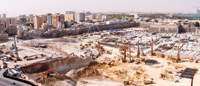
Msheireb Downtown, Doha ... a key urban regeneration project.
Fifa fever
As the wealthiest nation in the world, Qatar has achieved an enviable status. It continues to build on its strengths, with its oil and gas revenues ensuring that it has the financial muscle to build world-class infrastructure befitting a host country of the coveted Fifa World Cup.
01 March 2012
BLESSED with massive natural gas reserves and ample oil revenues, and a high profile international standing as the host of the coveted 2022 World Cup, Qatar has what it takes to keep its construction sector busy over the next decade – at the very least.
The nation has just been ranked as the world’s wealthiest country in a new list compiled by US magazine Forbes, with an estimated gross domestic product (GDP) per capita of more than $88,000.
Various estimates have been put forward to put a price tag to Qatar’s anticipated spending in the run up to the World Cup. QNB Capital expects the country to launch projects worth a staggering $185 billion while other industry experts expect the bill to range between $106 billion and $220 billion. Significant investments will also be made in the oil and gas sector, heavy industry, electricity generation and water desalination, social infrastructure and transportation links.
According to a senior government official, the government could spend about $150 billion on infrastructure projects over the next five to six years. Yousef Hussein Kamal, Minister of Economy and Finance, said spending on the oil and gas sector would reach $40 billion in the same period.
The Qatari government has reportedly allocated 40 per cent of its budget between now and 2016 to infrastructure projects. The investments include $11 billion on the New Doha International Airport, $5.5 billion on a deepwater seaport and $1 billion for a transport corridor in the capital, Doha, in addition to $20 billion on roads and $25 billion on metro and railway. Stadium construction for the World Cup alone should cost just under $4 billion, with the first venue to be built by 2015.
The 2011/12 budget has allocated around $16 billion for projects in infrastructure, education, youth welfare, and healthcare, substantiating the government’s commitment to spending and economic stimulus, which is also expected to shore up private sector confidence.
While much of the world has struggled over the past few years, Qatar has sustained double-digit growth rates, which has also reflected positively on real estate development. For instance, state-owned property developers Barwa Real Estate and Qatar Diar are set to spend QR100 billion ($27.5 billion) by 2016 on commercial and residential projects, according to a national development strategy unveiled a year ago for the country of 1.7 million people.
However given the massive volume of infrastructure that needs to be put in place to host the World Cup, the pace of progress over the past year has been relatively slow. Nevertheless, the nation is now gearing up to launch its World Cup programme and started the year on the right note by appointing British engineering firm WS Atkins to set up a Central Planning Office (CPO) to co-ordinate its multi-billion-dollar infrastructure expansion plans.
The CPO, reporting to the Minister of Municipality and Urban Planning, will oversee all major project work in Qatar as investment in the country’s infrastructure accelerates ahead of the Fifa World Cup finals – not to mention the 2020 Olympic Games, in the event the nation emerges triumphant in its bid. Doha is among five cities bidding for the 2020 Games. Bidding for a second consecutive time, the country is hoping to bring the Olympics to the Middle East for the first time.
The deal with Atkins was followed by the appointment last month of the US firm CH2M Hill to manage Qatar’s World Cup programme and oversee the construction of sports facilities in the country. The management contract, originally slated to be awarded late last year, will oversee coordination with government agencies on large infrastructure projects, including the construction of nine new stadiums and upgrade of three existing ones.
“Over the next six months we will be working together to develop our road map, which will provide us with delivery timelines for the projects that will occupy us in the coming 10 years,” Qatar 2022 Supreme Committee technical director Yasir Al Jamal said.
Rail
Qatar will also fast-track its QR150-billion (over $40 billion) rail programme to ensure completion of key phases in time for the World Cup.
 |
|
Lusail stadium in Doha ... iconic. |
The programme has gained momentum with the launch of the first tenders by the Qatar Railways Company (QRail) for enabling works on its metro. Next on the project’s timeline are four tunnelling RFP (request for proposal) contracts, each worth $2 billion to $3 billion, which are expected to be issued next month to allow work to be awarded in October, according to Geoff Mee, deputy chief executive officer.
The initial packages include one each for the Msheireb station – which is expected to be the busiest on the network – and Education City station (see Regional News).
Qatar announced in October last year, it will spend QR150 billion (over $40 billion) on three metro and railway projects, including Wasel and Western Gulf projects, as part of a $200-billion integrated Gulf plan.
Other metro and rail projects will connect Qatari cities with each other.
The project envisages the construction of a high-speed long-distance rail link, a driverless four-line metro service for Doha, freight lines and an overground rail system. The first phase of the Doha Metro will connect Messaieed in the south with Al Khor in the North.
Meanwhile, QRail signed last month a QR1.95 billion ($535.4 million) contract with Qatari Diar Vinci Construction (QDVC) for the new phase of works on the Lusail Light Rail Transit system. The transport system will serve the new city of Lusail, which stretches over 37 sq km of waterfront. Organised into 19 mixed-use districts, Lusail will eventually accommodate 200,000 residents and as many daily workers and visitors.
Roads & bridges
No progress has been made on the much-awaited Qatar-Bahrain Causeway, which has been under redesign to allow for a railway bridge. However, the project is expected to go ahead as part of the infrastructure to be readied in time for the World Cup.
Meanwhile in the roads sector, WS Atkins won a five-year contract worth more than $100 million to upgrade roads and drainage systems in Doha.
The contract for the Doha West area was awarded by Ashghal, the Public Works Authority of Qatar and is one of four packages of work which covers the whole of Qatar. Atkins is currently working on several highways projects across the country, including the concept design of the pivotal Khalifa, Rayyan and Al Bustan roads.
Another key contract award worth $296 million went to Samsung C&T Corporation, which will help build infrastructure for Lusail, a new 35-sq km city 22 km north of the capital.
The contract, awarded by Lusail Real Estate Development Company, requires Samsung to build 10.7 km of roads in 30 months. The latest deal follows hot on the heels of Samsung winning another contract last November worth $89.5 million to build bridges connecting islands in Lusail, which is believed to have helped it net the second order.
Last November, Ashghal awarded a major design contract to Hyder Group for the northern area of the city of Doha. Under the five-year engineering services contract worth $80 million, Hyder is responsible for undertaking all the consultancy and engineering services with regard to local roads and drainage projects.
Other major road projects include the Doha Expressway. Parsons has secured packages 7 and 13 of the project, which have a total value of $1 billion.
Airport
Interior fit-out works are currently under way at the New Doha International Airport, which is shaping up as one of the most luxurious terminals in the world. Under a $252.9-million deal awarded late last year, the Dubai-based interior fit-out specialist Depa – whose portfolio includes the Burj Khalifa – is responsible for the fit-out of 27 lounges in the airport.
The $11-billion Doha airport will eventually cover 2,200 hectares and be one of the world’s largest airports.
The new airport is expected to become operational on December 12 this year, according to a report in the local Arabic daily Al Sharq. It is designed to handle 50 million passengers a year by the time it is fully completed in 2015. Interiors will include a bamboo forest and pools to provide “sensory refreshment for travellers”.
Residential & Commercial
Qatar is pressing ahead with its ambitious urban regeneration plan for downtown Doha. Remarkable progress has been made on the QR20-billion ($5.5 billion) Msheireb Downtown Doha over the past year with superstructure works on the first stage of Phase One (Phase 1A) almost half-way complete. Construction is now under way on a number of components including the National Archive, Amiri Guard, Heritage Quarter, Cultural Forum, and the Diwan Annex buildings.
Over the course of this year, the construction sector can expect Msheireb Properties, its developer, to release a number of contracts for the main buildings on the other phases of the flagship development.
The 31-hectare Msheireb project site is immediately adjacent to the Amiri Diwan, Qatar’s seat of government and ruler’s palace. The development is being constructed in five phases and will include hotels, retail space, residential, government and cultural buildings (see separate report).
Meanwhile, state-owned property developer Barwa Real Estate is spearheading the development of various real estate projects ranging from financial districts to shopping complexes and to workers accommodation.
One such project is the Barwa Al Sadd, being built at a cost of QR2.4-billion ($659 million), which is receiving its finishing touches for handover later this year. Other major projects include the Barwa Commercial Avenue, an iconic mixed-use development project stretching over 8 km, the QR2-billion ($549 million) Barwa Al Baraha, one of the largest workers’ accommodation cities in the region and the QR7-billion ($1.92 billion) Barwa City (see separate report).
On the downside, with the euphoria created by the World Cup 2022, analysts polled by Reuters last month feared that Qatar may be overextending itself in real estate with the building boom threatening a glut in the property market. Rents and prices are falling, analysts say. A review by consultant Jones Lang LaSalle in November showed that office space vacancies were around 20 per cent in the capital, and would continue to increase as new supply appeared.
The picture in the residential sector appears similar. The International Monetary Fund predicted rents would stay depressed for some time.
Hotels
Qatar’s hotel sector will grow by nearly 80 per cent if all the properties in its development pipeline open for business, according to STR Global’s Middle East/Africa hotel development pipeline report. Qatar has 6,604 rooms in its total active pipeline. If they are all built and opened, they will add 78.3 per cent growth to the current number of rooms open in the state, it says.
Similar figures (6,859) have also been cited by Viability Management Consultants, a Dubai-based specialist hotel and real estate consultancy, which indicates that a total of 27 new hotels have been planned by the country. Among the latest hotels to open its doors in Qatar is the InterContinental Residence Suites Doha, marking the InterContinental Hotels Group’s first foray into residence suites.
Several new hotels are scheduled to open this year, including the St Regis Doha, the Radisson Blu Doha and the City Centre Rotana Doha.
Conclusion
Qatar has traditionally adopted a cautious approach in its building plans and gauging by the studied pace at which it is unrolling its World Cup infrastructure, the country is well aware that meticulous planning is essential prior to the launch of projects to ensure that its infrastructure can cope with the building boom. This building bonanza can be attributed to the nation’s ambitious drive to diversify away from energy resources and become a finance, trading and tourism hub. Qatar’s successful bid to host the 2022 World Cup is part of this strategy.
Given the commitment Qatar has made in hosting this prestigious event, the construction sector has much reason to be optimistic about the future as the country ramps up infrastructure work in the next few years. The real estate sector, however, requires to keep the nation’s long-term needs in perspective to ensure the viability of projects.
- Fifa fever
- Qatar Projects at glance
- Serene and sustainable
- Ready for release
- Paint sector buoyed by World Cup fever
- Sandvik improves quarry productivity
