

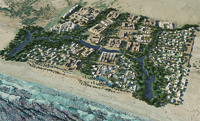
The TMC will be a sustainable city.
TMC set to boost health tourism
Planned to be built over 800,000 sq m in Salalah, the TMC is Oman’s first major project of its kind that aims to tap into the growing health tourism sector.
01 March 2012
APEX Medical Group (AMG), part of the Saudi conglomerate Al Joaib Holding, has embarked on setting up Oman’s first integrated health tourism complex (TMC) over a massive 800,000 sq m area in the idyllic city of Salalah.
Following the recent completion of the masterplan by Atkins, the company has now achieved a further milestone on the landmark development with the conclusion of the market, operational, regulatory and financial feasibility study for the TMC. The study was conducted by a consortium comprising Kane Healthcare Consulting Group and Ernst and Young as the financial adviser and Atkins as the masterplanner.
The medical city project represents the largest private healthcare infrastructure development opportunity in Oman. With a spectacular location and intelligent design, it is poised to become a first-rate healthcare centre for both the local community and the international health tourism market.
Located in eastern Salalah on land donated by Oman’s Ministry of Tourism, the complex will initially spread over an area of 500,000 sq m, with a government-approved expansion plan to cover 800,000 sq m in the future. It will provide much more than traditional hospital facilities, creating a destination that inspires and motivates people towards a healthier and happier lifestyle in the 21st century, according to its developer.
“The strategic vision of the project is to create a high-quality sustainable healthcare-led mixed-use development that functions as a vibrant, sustainable and self-sufficient community and places Oman as a preferred destination for medical tourism on the globe,” says Dr Abdulla Aljoaib, president of AMG.
Once complete, the TMC will comprise a multispecialty 530-bed tertiary-care hospital, the region’s first transplant and dialysis centre of excellence, and other centres of excellence for rehabilitation and medical and diagnostics. The complex will be integrated with a healthcare resort, a wellness centre, a four-star medical hotel, a neighbourhood mall and recreational facilities, patient and staff accommodation and an education complex consisting of a medical and nursing college and a research and development centre.
The TMC site is approximately a 15-minute drive from the Salalah International Airport, which is undergoing an expansion that is slated for completion in 2014. The expansion will allow the airport to handle up to six million passengers annually. The site is already linked up to the various utility services such as power, gas, water and telecommunications.
Advanced information and communications technology (ICT) will be used to integrate all components of the medical city.
Atkins’ task in creating the overall strategic masterplan for the project was to create a “world-class medical city” and a destination that will be memorable and dynamic and recognised as a place for healing and wellness. It also aims to create a world-class medical education and research and development facility in partnership with internationally known and recognised institutions as well as a cohesive and well-planned sustainable urban environment. Its design concept combines traditional Omani vernacular with contemporary design. The transplant hospital will be the heart of the city, providing patients with the most advanced methods of healthcare.
Ray Phillips, Atkins’ design director for the project, says: “This is an important and exciting project for the region, which will create world-class medical facilities in an environment that supports and promotes rehabilitation and healthy living.”
Atkins has already proven its capability in delivering sophisticated levels of engineering necessary in healthcare building and mechanical, electrical and plumbing (MEP) design in projects worldwide.
Dr Aljoaib says the completion of the feasibility study by the consortium has laid the foundation for “building an enduring institution from the ground up”.
Dr Naeema Aziz, the feasibility consortium leader and the TMC project director, says the study was conducted by a consortium to bring together the collective expertised of professionals who have years of practical experience in the Middle East and with other healthcare systems around the world, and have been leaders and pioneers in starting new hospitals and medical schools and in nurturing healthcare systems on various continents.
She adds that while many public and private hospital promoters and developers across the GCC usually make decisions on developing projects based on financial feasibility and concentrate primarily on bricks and mortar issues, “the APG has taken a new approach by utilising the integrated expertise of this consortium to conduct a comprehensive feasibility that lays the foundation for building design and construction that will start soon”.
Dr Aziz says all components of TMC will be developed according to the national and international regulations and the promoters are seeking strategic partners/affiliates for the different components of the project to utilise their expertise.
The proposed medical city aims to establish itself as a preferred destination for health tourists from all over the world and particularly the region. “Within the GCC itself, many governments are sending patients abroad at great expense, often to the US or to Europe. This is mainly due to the lack of medical expertise and the appropriate facilities within their home countries. This high-class medical city will provide the services that patients currently seek outside the GCC,” says Dr Aziz.
The sustainability goals for TMC have been drawn based on the ‘One Planet Living’ programme – internationally recognised as a framework for addressing sustainability in development projects – which focuses on carbon and waste reduction, sustainable transport, and local and sustainable materials.
The TMC is in line with the five-year tourism development plans of the Ministry of Tourism and is strongly supported by the Oman government including the Ministry of Health (MOH) for being the first healthcare infrastructure development project in Oman by a private investor.
Ashar Nazim, director and head of islamic financial services at Ernst and Young in Bahrain, says: “Aside from the fact that the project will bring pioneering medical and surgical facilities to the Middle East, the most exciting and challenging aspect is the sponsor’s desire to make it fully compliant with medical ethics and in accordance with the dictates of Islam by setting up a Waqf (trust) for providing free treatment and education to poor and needy families.”
AMG’s parent firm Al Joaib Holding is a major Saudi group with a diversified portfolio of businesses in Saudi Arabia, the GCC and the US that spans engineering, contracting, industrial trading, retail, oil service, investments, real estate development and hospitality.
Dr Aljoaib, founder and president of AMG and president of Al Joaib Holding, and Dr Mohammad Al Sofayan, deputy chairman of the liver transplantation department at King Faisal Specialist Hospital (KFSH) in Riyadh, Saudi Arabia, are the promoters of the TMC project. Their group consists of an exceptional group of medical/healthcare experts, engineers, and business management professionals.
Dr Al Sofayan is a world-renowned transplant surgeon who has performed over 300 livers transplants. He is one of the founders of the Living Related Liver Transplantation Programme at KFSH.
- TMC set to boost health tourism
- Leister helps seal hospital against leaks
- BASF sets Rheocrete record in Abu Dhabi
