

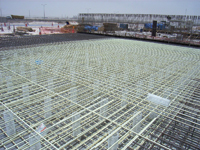
Schoeck ComBAR reinforcement used in the Qatalum project and the ComBAR thermal anchor (below).
ComBAR ‘perfect’ choice for smelters
Due to its non-metallic and non-conducting nature, structural engineers saw Schoeck’s ComBAR as the perfect choice for the aluminium smelter at Saudi Arabia’s Ras Az Zawr Minerals Industrial City.
01 March 2012
SCHOECK ComBAR is finding increasing applications in the industrial construction sector, particularly in erecting aluminium smelters where the fact that it is non-metallic and does not conduct electricity has been a key criterion in its selection for these developments.
In fact, its successful application on a smelter in Qatar prompted structural engineers to specify ComBAR for the concrete foundations of the aluminium smelter in Saudi Arabia.
The complex, which forms a key component in Saudi Arabia’s long-term development plan, is being developed by the Saudi Arab mining company Ma’aden at the Ras Az Zawr Minerals Industrial City, 90 km north of Jubail Industrial City on the Arabian Gulf coast. The site will house an alumina refinery and a rolling mill.
Its proximity to the kingdom’s oil and gas production facilities and to shipment facilities at Ras Tanura, the world’s largest oil export terminal, provides extensive opportunities for future development.
 |
The glassfibre reinforcement ComBAR, supplied by the German building components manufacturer Schoeck Bauteile and its UAE subsidiary Schoeck Middle East, has been installed in the concrete foundations of the rectifier areas of the aluminium smelter to avoid problems frequently encountered in smelters with conventional carbon steel reinforcement, says Christoph Spitz, managing director, Schoeck Middle East.
“As one of the cornerstones to the industrial project at Ras Az Zawr Minerals Industrial City, the aluminium smelter is integral to the entire process and desired end goals. With that in mind, the base infrastructure of the plant was needed to be developed to ensure minimum downtime over its upcoming years of operation as well as unprecedented levels of safety,” he says.
While numerous experts were contracted to ensure quality and productivity levels of the highest standards, iLF Consulting Engineers and Schoeck were commissioned for foundation level design support and consultancy.
Explaining the reason why ComBAR was selected for the project, Spitz says aluminium smelters require large amounts of energy, approximately 13 to 15 kW-hours per kg of metal.
 |
|
Spitz ... quality focus. |
“The aluminium electrolysis operates with high-voltage direct electric current. The alternating current coming from the power plant at Ras Az Zawr will, therefore, be converted to direct current in the rectifier area of the smelter. The reactor coils required for this process are run at very high voltages. Any ferromagnetic metal elements within the magnetic clearance contour of the reactors would either inhibit their operation or build up heat due to induction currents coming from the reactor coils,” he says. “This is especially true for the closed rectangular loops formed by steel reinforcing bars placed crosswise in the foundation slabs of the reactors.
“Until recently, the only available solution to this problem was positioning the reactor coils sufficiently far above their foundations to ensure that the steel reinforcement is located outside the magnetic tolerance zone. To do so, the reactors were installed on tall and complex non-metallic support structures.
“But with the development of high-strength glassfibre reinforcement, a far more economical and technically simpler solution is now available for the rectifier areas of aluminium smelters. The foundation slabs for the reactor coils are simply reinforced with glassfibre reinforcement. As this is non-metallic and does not conduct electric currents, the problem of induction currents in the reinforcement and the resulting heating up is eliminated.”
Schoeck ComBAR is a high-strength, durable glassfibre reinforcement. The material is non-corroding, resistant to chemical attack, non-magnetisable, electrically insulating and has high thermal insulation properties. The tensile strength is nearly three times as high as that of steel reinforcement, Spitz claims.
He says the characteristic and design values of the tensile strength for the structural design of reinforced concrete structures, such as the foundations for reactor coils, was determined for a service life of 100 years in chemically aggressive environments and climatic conditions prevalent in the Middle East (high humidity, high temperatures).
“It offers all the benefits of steel in terms of design, tensile strength and bond properties, and is also much lighter and easier to handle. It is, therefore, in many situations an economical alternative to complex structural solutions involving steel and stainless-steel reinforcing bars,” he says.
ComBAR was specified to be installed in the slabs and foundations for the rectifiers at the Raz As Zawr aluminium smelter by the Switzerland-based iLF, the structural engineer on the project, which had previously designed the foundation slab for the rectifier area of the Qatalum smelter in Qatar. Based on its positive experience on that project, it recommended the installation of ComBAR to the owners of the Saudi Arabian project.
Overall, 80 km of 12- and 16-mm core diameter ComBAR bars were installed at the smelter. Nearly 9,000 ComBAR bent bars and thousands of 450-mm-long plastic lattice tube rebar spacers were also supplied to the project. Reinforcement drawings were prepared by iLF with the assistance of engineers from Schoeck. ComBAR was specified in the bid documents.
The material was delivered from the warehouse of the Schoeck Middle East in Dubai and from the Schoeck plant in Germany. Renowned construction company Nasser S Al Hajri Construction installed the ComBAR bars at the site.
The Ras Az Zawr site consists of integrated chemical and fertiliser facilities, infrastructure related to the phosphate industry and an alumina refinery, smelter and rolling mill. Bauxite ore will be transported to the site by rail, where it will be refined to produce alumina. This, in turn, will be processed in the smelter to produce aluminium. The smelter alone covers an area of 1,066 hectares. To operate the smelter, a joint power and desalination plant will be built generating 2,400 MW of electricity and 1,025 million cu m of water per day. The aluminium complex alone will use 1,350 MW of electricity and 25,000 cu m of water per day.
The $4-billion smelter will be constructed as two high-amperage potlines utilising Pechiney AP technology and will produce 740,000 tonnes of aluminium per year. Most of the aluminium will be exported, while at least 250,000 tonnes will feed the adjacent rolling mill. The smelter will include a carbon plant for anode production, ingot cast house, material handling, and support facilities. The first production from the aluminium smelter and the rolling mill is expected in 2013.
As an international supplier to the building industry, Schoeck develops, produces and markets innovative components for structural applications with additional thermal and acoustic benefits. With a focus on innovative solutions, Schoeck developed ComBAR as an alternative to steel reinforcement. ComBAR opens up entirely new possibilities in reinforced concrete construction, especially in projects where steel rebar does not meet the technical requirements. This is especially true in harsh environments as they are encountered in the Middle East.
“For this reason, ComBAR was the preferred choice for the reinforcement of the slabs and the foundations in the rectifier areas at the Ras Az Zawr aluminium smelter, where a non-metallic and at the same time non-corroding reinforcing material was called for,” says Spitz.
 |
|
The Schoeck SLD allows horizontal movement and transfers vertical forces at the same time. |
Schoeck Middle East was established in early 2010 to better serve customers and owners in the UAE and the entire Middle East. It is a fully-owned subsidiary of the Germany-based Schoeck, which has grown to become Europe’s leading supplier of innovative structural load-bearing insulation products since its inception in 1962. In addition, the company is well known for its highly sophisticated reinforcement technology products including punching shear reinforcement, shear dowels, in addition to ComBAR.
The Middle East operation is now expanding the range of reinforcement engineering products it offers with the introduction of the punching shear reinforcement Schoeck Bole, which easily and safely supports punctual loads in reinforced concrete slabs; and the shear force dowel SLD, which permits horizontal movements and transfers vertical forces. Both products have been established on the European market for years and are approved by the German Institute for Construction Technology (DIBt).
“Frame construction is catching on,” continues Spitz. “Flexible floor plans and the possibility of maximising on space are important criteria for modern building design. Simple formwork without downstand beam or column heads makes this method economical in terms of both costs and time.”
The supporting structure of these buildings mainly comprises stiffening cores and thin flat slabs, which are supported on individual columns. This type of support for flat slabs presents a challenge, because in this case, the whole slab load (dead- plus live-load) is passed into the relatively small area of the column support. This can lead to the flat slab being punched in this spot. The punching shear reinforcement Schoeck Bole is used to avoid this failure.
“This punching shear reinforcement comprises several double-headed studs, which are connected into one element by welded spacer bars. These elements are placed around the column, thus preventing the punching cone from breaking out. This solution increases the load capacity compared to flat slabs without shear reinforcement by up to 90 per cent and compared to conventional stirrups up to 25 per cent,” explains Spitz.
Turning to the other latest innovation of the company, he says the shear dowel Schoeck SLD provides an economical solution to facilitating horizontal movement while transferring the vertical loads in expansive buildings.
He explains: “In long buildings, expansion joints must be planned in order to avoid high tension resulting from thermal expansion and concrete shrinking. Since the building sections are free to move horizontally near these joints, restraints are avoided. However, to avoid different settling or to make the bearing of slabs possible, the building sections must be connected to one another vertically. Conventional solutions involve reinforced concrete corbels, double walls or columns. The shear dowel Schoeck SLD is the less expensive and more straightforward alternative. Here, horizontal movement is permitted and vertical forces are transferred at the same time.
“The shear dowel from Schoeck consists of a sleeve and a dowel part, which are set in concrete in the building sections adjacent to the joint. Then the dowel is inserted into the sleeve, thus transferring the vertical loads. Inside the round sleeve, the dowel can move in the horizontal direction. Both components are made of stainless steel and thus will not corrode.”
The system has a particularly high load-bearing strength since the loads are transferred efficiently into the concrete, and blowout of the concrete edge is avoided. The company also offers a solution that can be used to provide up to class F90 fire resistance, he adds.
