

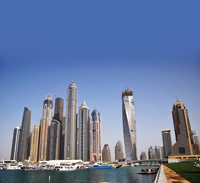
The Dubai Marina area.
Buzz is back
Dubai might still be reeling from its real estate crunch, but it has an ambitious comeback plan. The emirate is now focusing on establishing itself as a regional hub for business, transit trade, logistics and tourism to boost its economy.
01 April 2012
IS DUBAI out of the woods? There are ample signs that the worst is over for the debt-laden emirate, which has now embarked on a new phase of economic development driven by trade and tourism. Growing visitor numbers and the return of vibrancy on the streets, which over the past two years have been shrouded by doom and gloom, spell that Dubai is back again.
The fact that the emirate is seeing the rise of the world’s tallest hotel tower as well as the world’s tallest residential tower is sufficient sign that confidence is returning. What’s more, Dubai has just launched a project which will see the construction of its first dedicated opera house (see separate report) as well as one of the region’s biggest and most luxurious hotels and entertainment developments.
While understandably the pace of growth will be slow and it will be sometime before projects are taken off the backburner, the focus over the next year will be on infrastructure developments to cope with Dubai’s strong tourism potential that’s now central to its economic diversification plans. Key projects that will be pursued include the multi-billion-dollar expansion of Dubai International Airport, road and railway developments and large-scale power and water projects.
Dubai’s property sector, however, has been hard hit by the global economic downturn that began in 2008 and was brought to its knees in 2009 by the emirate’s debt crisis. With property prices having slumped by as much as 60 per cent and billions of dollars worth of projects put on hold or cancelled, it will be long before the real estate sector gets back on its feet again.
Dubai’s property sector will see up to 16,000 new units come on the market this year, the head of its real estate watchdog said, adding further pressure to an already oversupplied sector. Supply in 2012 will be higher than in 2011 when about 10,700 new units were introduced, he said.
 |
|
Habtoor Palace ... upcoming $1.33-billion hotel. |
“Another 15,000 to 16,000 (units) are coming in 2012,” Marwan bin Ghalitha, chief executive of Real Estate Regulatory Authority (Rera) said. “Most of this supply will be from master developers. “About 62 projects were completed last year. I am sure the supply from these projects is coming in 2012.”
To revive and support the real estate market in the emirate, the Dubai Land Department (DLD) has introduced two initiatives, Tayseer and Tanmia. Tayseer aims to support certain projects in Dubai through the arrangement of financing via local banks. Tanmia — an initiative by Real Estate Investment, and Promotion and Management Centre (REIPMC) under DLD — aims to reduce the number of incomplete projects, revitalise stalled projects and improve Dubai’s appeal for investment.
Dubai is now focusing on establishing itself as a regional hub for business, transit trade, logistics and tourism. Tourism, trade and manufacturing are each expected to grow by six per cent this year and drive the economy, which is expected to grow between 4.1 and five per cent this year, according to official estimates.
As voiced by Sheikh Ahmed bin Saeed Al Maktoum, chairman of the Dubai Supreme Fiscal Committee, at the Dubai Economic Outlook 2012 conference in February, diversification holds the key to the success of the emirate. “In spite of the difficulties Dubai has experienced, particularly in 2009 and early 2010, its strategy of creating new opportunities through diversification has succeeded in bringing about economic prosperity and stability,” he said.
Economic activity and prosperity has traditionally been centred on the trade, logistics and tourism sectors. “We see these sectors firmly in the driving seat once again, supported by an unrivalled infrastructure, global enterprises and growing reputation as an international destination. Together, trade, logistics, transportation and tourism accounted for almost 60 per cent of Dubai’s GDP in 2011,” Sheikh Ahmed added.
Hence, the construction sector can look forward to opportunities in the building of infrastructural projects such as airports, roads and utilities.
Airport
Early this year, Arabtec Construction secured a Dh561-million ($152 million) contract from Dubai Aviation City Corporation (DACC) to carry out expansion work at Dubai International Airport. The project is part of a major expansion estimated to cost a total of Dh28.8 billion ($7.8 billion) and involving extension of an existing terminal and construction of a new concourse.
Arabtec Construction, the construction arm of Arabtec Holding, the UAE’s largest construction company, said the project, spanning 25 months will include structural work, mechanical, engineering and plumbing (MEP), special airport systems, finishes, and site work for Terminal Two’s expansion.
According to the expansion plan, Dubai Airports will expand Terminal Two and build the new Concourse Four, which will be connected to Terminal One for check-in and baggage services. The project is in addition to the completion of Concourse Three, the A380 facility dedicated for use by Emirates airline, which will take Dubai International’s capacity from 60 million to 75 million when it opens next year.
Airspace expansion programme is expected to boost capacity to 90 million passengers per year by 2018.
Once construction is completed at Dubai International, work on Phase Two of Dubai World Central (DWC) is expected to intensify during 2018-2023, with the initial iteration allowing for 80 million passengers per year to facilitate the eventual relocation of the Emirates hub.
Roads & railway
Major road projects have been in progress over the past including the First Interchange and the Rashid Hospital Tunnels (see UAE Focus).
The Dh617-million ($168 million) First Interchange – popularly known as Defence Roundabout – on Shaikh Zayed Road has now opened to traffic with a capacity to handle more than 16,000 vehicles an hour. Work on the Roads and Transport Authority (RTA) project was launched in late 2006 and was initially scheduled to be opened in 2009. But changes were made to the initial blueprint and the completion date extended.
Among other major RTA projects is a paving project to be completed in four years at a cost of up to Dh1 billion ($272 million). The first phase of the project, will include five areas in Sha’abiyat Hatta, while the second phase, which will start in 2013, will cover the second Al Muhaisna area along with Al Barsha Two.
Another key project being developed by UAE’s Ministry of Public Works is the upgrade of five interchanges on Emirates Road between Dubai and Ajman at a cost of Dh1 billion ($272 million). Divided into three phases, the project is expected to cut down travel times between Dubai and Ajman via Sharjah to just 10 minutes.
The work includes adding two more lanes in both directions of the Emirates Road in Sharjah, as well as renovating five existing interchanges.
Power & water
Dubai is expected to launch work on its first-ever independent power plant (IPP) this year. At least four consortia have submitted bids to develop the 1,500 MW Hassyan One IPP, in Jebel Ali, which will also produce 120 million gallons per day of desalinated water when complete.
The lowest bidder is reported to be a consortium led by Marubeni and including Abu Dhabi National Energy Company of the UAE and SK E&S Company of South Korea.
Another noteworthy project in this sector is a solar park launched by the Supreme Council of Energy (SCE) for Dubai. The Mohammed bin Rashid Al Maktoum Solar Park, a key project that will be managed and operated by Dubai Electricity and Water Authority (Dewa), is the first utility-scale production capacity park of its kind in the region and a prelude to the introduction of projects using renewable energy in electricity production in Dubai, the SCE said (see UAE Focus).
Residential & commercial
Two striking developments in this sector are the towering JW Marriott Marquis Dubai, which is expected to open its doors later this year as the tallest dedicated hotel building in the world at 355 m and the Princess Tower, which now stakes claim to being the tallest residential tower at 414 m (see separate reports).
These two landmarks and several of others – Dubai’s Real Estate Regulatory Agency indicates a figure of 220 projects that are progressing – do point to the fact that work is ongoing on a number of developments, albeit at a slow pace.
In addition, several developers have made the bold decision to move ahead with their projects. For instance, Al Habtoor Group has launched Habtoor Palace, which will be one of the region’s biggest and most luxurious hotels and entertainment developments that will occupy the prominent location on Sheikh Zayed Road now occupied by the 34-year-old Metropolitan Hotel. The Metropolitan Hotel is expected to be demolished in June to make way for the new undertaking.
The new $1.33-billion hotel and theatre complex will comprise three luxurious hotels with over 1,600 rooms and suites housed in two elegant towers rising from a grand five-storey podium. The construction of the project is to commence shortly, with completion expected within 48 months.
Al Habtoor also announced last October that it is relaunching its luxurious 324-room hotel on the Palm Jumeirah Island. The group has partnered with Hilton Worldwide to manage the Dh1-billion ($272 million) hotel, which will be the first luxury resort by the Waldorf Astoria Hotels & Resorts brand in Dubai.
Further good news came from Dubai Maritime City (DMC), when it launched the Dh2.5-billion ($681 million) mixed-use Business District in January this year.
In step with the launch, five new projects have been planned to be built in the Business District. They are Swift Development’s Swiftships Towers, which are office high-rises; Iris Mist Hotel Apartments & Residences by Sheth Developers, a budget hotel; Kensington Krystal by Kensington Global; Sanali Global’s Sanali Aquamarine Residential Apartments; and a six-star hotel by Dubai Investments Real Estate.
Project mobilisation and commencement of construction is expected towards the end of this year.
Meanwhile, Diamond Developers intends to develop what will be Dubai’s first sustainable city – a revolutionary project that will be completed through four phases. The first will be completed in 2013 with each of the three remaining stages finalised over consecutive years. The project will be ready in 2016.
The city is expected to meet the highest standards of sustainability requirements, including optimal use of land, according to Faris Saeed, chairman of Diamond Developers and a member of the Dubai Real Estate Community founded by the Dubai Land Department.
The city will harness solar energy, and will treat and recycle waste and sewage water for irrigation. It will also adopt several initiatives to reduce carbon emissions by more than 75 per cent and will be free of waste due to a fully integrated waste treatment system.
Infrastructure and landscaping works will commence during the second half of this year on an area of 8 million sq ft, and the built-up area will not exceed 5 million sq ft.
Among other developments, work on the Jebel Ali Free Zone Authority (Jafza) Convention Centre, one of the most prestigious projects in the Jebel Ali Free Zone, is fast nearing completion. The $354-million complex will house 1,274 offices in its 35-storey twin office towers; a 320-room four-star business hotel and a convention centre with associated facilities (see separate report).
- Buzz is back
- Heights of hospitality
- A Princess is born
- Jewel of Jebel Ali
- Culture Club
- Paschal systems shape up key projects
- MAF Dalkia expands services
- Dubai projects at a glance
