

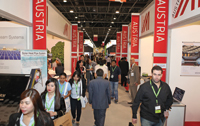
Well attended ... more than 43,000 professionals visited Project Qatar 2011.
Expo opens doors to Qatar bonanza
More than 2,000 exhibitors will be out in force at this month’s Project Qatar, looking to cash in on a $185-billion boom that’s currently under way in the country.
01 April 2012
HAVING surpassed all expectations in 2011 with important growth rates on all levels, Project Qatar returns for the ninth time this month with more than 2,000 local and international exhibitors from 48 countries having confirmed their participation.
This year, the international trade fair for construction, building and environment technology is also introducing two concurrent events – Qatar Stone Tech, the international stone and stone technology show, and Heavy Max, the international show for heavy machinery.
Now in its ninth edition, Project Qatar is being organised by International Fairs and Promotions (IFP) Qatar at the Doha Exhibition Centre between April 30 and May 3. The event will host a total of 23 national pavilions with some countries such as Ireland, Taiwan, Sweden, Luxembourg and Malaysia taking part for the first time. The fair will also be supported by more than 20 international commercial agencies from Europe and Asia.
The large participation necessitated an expansion in the exhibition space, that has reached 62,000 sq m, compared to 52,000 sq m last year, an increase of more than 15 per cent. The event is also supported by around 40 international trade associations and governmental entities.
“After breaking all records of size and business conducted in 2011, Project Qatar will be even bigger in 2012,” says IFP Qatar’s Michel Gebrael, project manager of Project Qatar. “The last edition of the show witnessed actually an overwhelming response both in terms of participation and attendance: The show hosted 1,750 exhibitors, including 1,200 international exhibitors coming from 42 countries – spread over 52,000 sq m of exhibition area – and was visited by around 43,000 professionals. This year’s edition will see the participation of 2,083 exhibitors.
“In addition, we are expecting higher numbers of high-calibre visitors who will have the chance to explore the latest innovations in the construction and its related sectors,” Gebrael adds.
IFP expects further companies to sign up for the show in a bid to tap the business opportunities offered by the country, which is hosting the Fifa World Cup 2022.
 |
|
Project Qatar 2011 ... spread over 52,000 sq m of space. |
“By winning the bid to host the Fifa World Cup in 2022, Qatar has become a land of opportunities for anyone involved in the construction sector. Official estimates put the planned spending on World Cup infrastructure, hotels and stadiums at about $50 billion,” he says.
By 2022, Qatar will witness the completion of several large-scale projects:
• Qatar’s $36-billion railroad plans will be ready;
• The number of hotels will rise to 240, with more than 90,000 rooms;
• Twelve eco-friendly stadiums will be ready to seat over half a million people;
• The $4-billion Qatar-Bahrain causeway will be completed; and
• More than $20 billion will be spent on building and expanding roads.
“With the population in Qatar estimated to reach four million people by 2020, there will be significant demand for infrastructure and real estate across all sectors,” adds Gebrael.
According to him, Qatar’s ongoing construction projects are valued at more than $185 billion. Infrastructure attracts 34 per cent of total investments, while the rest is mainly earmarked for projects in the oil and gas, power and electricity, and logistics and transportation sectors, he says.
Gebrael says major projects in Qatar are backed by the government and rising oil prices in 2011-12 ensure that projects in the construction sector are strongly supported. “Qatar is witnessing significant investments spilling over into its construction market. Around $60 billion to $70 billion are expected to be spent in hotel, leisure, tourism, sports, recreational and infrastructure projects. This represents an opportunity for global investors and companies involved with construction, property and infrastructure development to assess the potential in investing within this highly stable economy,” he says.
Furthermore, the country is expected to witness a 92 per cent increase in the supply of high-rise commercial office towers in the medium term. The market will also see an addition of 197,000 sq m of retail space by the year-end, an increase of 34 per cent.
Gebrael indicates that the effects of the economic downturn on Qatar were minimal, adding the construction sector did suffer a decline in 2009 but this was temporary and even non-existent in resilient countries like Qatar. He says the industry in the region started recovering in 2010 due to the huge public expenditure on infrastructure and the rising oil and gas prices especially, in Saudi Arabia, the UAE and Qatar. “In general, the construction sector remains very promising in the region for the next 10, 20 years,” he says.
In an effort to meet the construction market needs in Qatar and the region while helping specialised companies to maximise on the event, the organisers decided to organise two specialist shows that will run concurrently with Project Qatar.
“We had to add the two concurrent related shows, as we had to organise the rush of specialised companies to the show in a professional context and increase the exhibition return on investment,” says Gebrael.
Qatar Stone Tech will showcase cutting-edge products and equipment needed in the construction market, namely marble finished products, granite, natural stones as well as a variety of other stone blocks and finished products. Heavy Max 2012 will cover the technology of heavy machinery, plants, including tractors, loaders and lifting appliances and conveyors. “The international fair for heavy machinery is an ideal platform to meet the needs of huge commercial and industrial projects, as well as infrastructure and housing projects in construction machinery,” says a spokesman for IFP.
The event’s previous editions proved to be successful to an extent that it has become a destination of choice for all international companies that seek to establish business in Qatar. “The importance of the exhibition is reflected in the step taken by some national chambers of commerce to financially support and bear the expenditures connected to the participation of companies from their countries,” he comments.
“In the eight editions of Project Qatar series, between its debut in 2004 and the last chapter in 2011, around 5,000 Qatari regional and international companies from 50 countries have participated in the shows; while exhibition spaces have expanded at an average rate of 20 per cent per annum,” says Gebrael.
The shows succeeded in securing major deals for many participants, during and long after the shows were over, he adds.
In 2011, 1,750 firms including 1,200 international firms from 42 countries exhibited at Project Qatar, thus registering a record increase of 73 per cent in the number of exhibitors over the previous year and occupying 52,000 sq m of space (68 per cent growth). National pavilions were hosted by countries like Cyprus, Egypt, France, Germany, Greece, Italy, Korea, Kuwait, Lebanon, Malaysia, the Netherlands, Saudi Arabia, Singapore, Switzerland, Turkey, the UAE, the UK and the US.
More than 43,000 professionals from Qatar, the GCC, and other Middle East countries visited the event, including professionals from the private and public sectors, government officials, key decision-makers and project managers.
About 60 per cent of exhibitors signed deals or entered negotiations during Project Qatar 2011, according to IFP. Some 85 per cent of exhibitors said they had a positive experience at the show, while 94 per cent of exhibitors were satisfied.
Commenting on Project Qatar 2011, Mustafa Gulec, official commercial counsellor, Embassy of Turkey in Qatar, said: “It is very important for Turkish companies to participate in Project Qatar since it is an essential channel to gain access to this important region. We are using various instruments to access this market and Project Qatar is one of the main instruments.”
Turkey was the second biggest participating country at last year’s event.
Local firm H Deco, which participated for the third consecutive year at Project Qatar, said each edition has been better than the previous one. “Our participation allowed us to take advantage of the market in Qatar and the potential it holds. It also allows us to increase the awareness for our activities and products and to negotiate deals and sponsorships,” a spokesman said.
