

Boom is back
Economic cities, skyscrapers, housing, education, railways and new infrastructure are all part of Saudi Arabia’s ambitious development plan.
01 May 2012
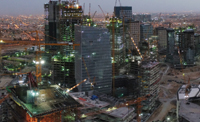
AMBITIOUS, awe-inspiring and all-encompassing: This probably sums up the scale of construction projects unleashed by Saudi Arabia over the past year, thanks to its windfall oil revenues.
A massive thrust on infrastructure in line with the kingdom’s $400-billion-plus development plan – bolstered further by surging private sector confidence in the nation – has raised the potential offered by its construction market to unprecedented levels.
Opportunities abound in almost every segment of the market, right from huge petrochemical complexes and industrial and economic cities to the construction of the world’s tallest skyscraper – the Kingdom Tower – and residential compounds and to railways, airports, schools and hospitals.
The pervading air of optimism will spur private sector investment in Saudi Arabia, which is now setting up a sustainable foundation for the success of the iconic projects that are taking shape in the country, through a comprehensive infrastructure base.
Most striking among these developments are the $21.2-billion expansion of the Grand Mosque in Makkah, the $20-billion Kingdom City in Jeddah with its kilometre-high Kingdom Tower (see separate report), the $26-billion King Abdullah Economic City and other economic cities and the $10-billion King Abdullah Financial District in Riyadh (see separate report).
 |
|
Haramain High Speed Railway’s Makkah station. |
The infrastructure focus is all-encompassing covering the nation’s aviation sector, where key contracts have been awarded recently for the expansion of King Abdul Aziz International Airport in Jeddah and the Madinah Airport; the railway sector, with major contracts having been awarded on the 450-km Haramain High Speed Railway and the North-South Railway; and mega power projects and road developments.
In addition, Saudi Arabia is making concerted efforts to address its social housing problems with some $67 billon set aside for the construction of 500,000 housing units.
“Saudi Arabia is indeed leading the Gulf in terms of infrastructure and real estate projects worth SR1.5 trillion ($400 billion) over the next five years,” said Khaled Al Aboodi, the chief executive officer of Islamic Corporation for the Development of the Private Sector, at a recent summit.
“The infrastructure and real estate sectors in Saudi Arabia contribute more than 10 per cent of gross domestic product (GDP) and are among the fastest growing and most dynamic sectors in the Middle East,” he said.
According to a Citigroup report, Saudi Arabia has $750 billion worth of new projects in the pipeline, making up 31 per cent of the entire regional market while Standard Chartered, another leading bank, cites $159 billion as the investment that Saudi Arabia has committed for infrastructural development for 2012.
Government spending on non-oil infrastructure projects is likely to be seven per cent higher than last year, Standard Chartered says in its Global Focus –2012 – The Year Ahead report.
Saudi Arabia is expected to spend $83.6 billion on infrastructure and other constructions projects this year, in addition to the $67 billon set aside for the construction of housing units. This apart, the 2012 budget allocates $45 billion to the education sector for the construction of 742 new schools, renovation of 2,000 others and setting up of 40 new colleges; and $23.1 billion for healthcare involving the construction of 17 new hospitals, in addition to the 130 others under construction. Infrastructure spending includes $9.4 billion for transport, the expansion of a number of the airports in the kingdom, and the construction of close to 4,000 km of roads, the report says.
Meanwhile, the country’s largest bank, National Commercial Bank (NCB), has given a vote of confidence to the construction sector, indicating that due to a record public spending in 2011, the value of awarded construction projects in the country has reached an all-time high.
The total value of awarded contracts jumped by 155 per cent to SR270 billion ($72 billion) during 2011, surpassing the previous record of SR207 billion ($55.2 billon) for 2009, the NCB report says. In the second half of 2011, the value of awarded contracts reached an impressive SR188.2 billion ($50.1 billion), which was higher than the total value of awarded contracts during all of 2010.
A breakdown reveals that the transportation, power and industrial sectors were the main growth drivers in 2011, contributing approximately 48 per cent of the total value of awarded contracts.
The value of contracts awarded in Saudi Arabia during the first quarter of this year stood at SR52.2 billion ($13.9 billion), a slight increase compared to the same period last year when the value of stood at approximately SR49.7 billion ($13.25 billion), says the bank. NCB’s Construction Contracts Index (CCI) reached 349.03 points by the end of the first quarter of 2012. According to the bank, sectors such as education, roads, healthcare and urban development, alone accounted for more than SR15 billion ($3.9 billion) or 30 per cent of the total value of the awarded contracts (see charts).
It expects the construction sector to continue to make a significant contribution to the kingdom’s economy, based on the kingdom’s first quarter performance.
Contract awards in January were valued at approximately SR11.9 billion ($3.17 billion), led by the power and transportation sectors; the value of contract awards in February jumped to approximately SR17.2 billion ($4.58 billion), dominated by the residential real estate and power sectors; and value of contract awards in March further increased to SR23.2 billion ($6.18 billion) led by the industrial and urban development sectors.
The Eastern Province of Saudi Arabia commanded the largest share of awarded contracts during the first quarter with an overwhelming 36 per cent of the total value, thanks to mega projects in the petrochemical and industrial sectors in this region. The Makkah region’s 22 per cent share was mainly attributed to the government’s emphasis on urban development in Jeddah as well as the continued focus on developing affordable housing options for its citizens.
Makkah and Madinah continue to be the focus of public and private sector investment. Makkah last summer launched a massive expansion of the Grand Mosque at a cost of SR80 billion ($21.2 billion). The project is intended to boost capacity of the mosque – which underwent significant expansion in the mid-1980s – to around two million worshippers at a time, from its current capacity of 770,000. Another key project that has made remarkable headway over the past year is the $11.2-billion Haramain High Speed Railway, which is designed to facilitate the movement of pilgrims between the holy cities. Significant progress is also being made on a host of private sector developments including the Jabal Omar development, which aims to accommodate a total of 100,000 pilgrims (see separate report).
Power
Saudi Arabia is forging ahead with energy projects including the $100-billion King Abdullah City of Atomic and Renewable Energy (Kacare). The Kacare, set up to advise on the energy mix, has recommended that the kingdom should try to build nearly 41 GW of solar capacity, enough to meet a third of expected peak power demand in 2032, while nearly a sixth of installed capacity should come from nuclear and about half from oil and gas.
The country has a further 15 projects worth nearly $9 billion currently under way, or due to begin this year. Among the projects in the pipeline are a 1,700 MW independent power plant (IPP) planned by the Saudi Electricity Company (SEC). The Rabigh IPP2 plant will use fuel oil and is the fourth of five planned IPPs that will add a total of around 11,000 MW of capacity. The other three are under construction and include the 1,200 MW Rabigh IPP1.
SEC has a $80-billion investment plan to increase its power generation capacity by 30,000 MW by 2018 to meet power demand that is rising by around eight per cent a year.
In February, several contracts worth SR3.5 billion ($933 million) were awarded by the Saudi Industrial Property Authority (Modon) and SEC. The majority of the work for Modon, valued at SR1 billion ($266.646 million), focused on the construction of transmission plants and expanding distribution networks.
SEC awarded contracts worth SR2.5 billion ($666.28 million) in February, including a SR940 million ($250 million) deal to ABB for the construction of substations in various regions across the country.
Roads & Railways
Construction work on the Haramain railway is on track and the project is expected to start operations in two years, according to Saudi Transport Minister Jabara Al Seraisry, who is also the chairman of the Saudi Railways Organisation (SRO).
Construction work is under way on the railway stations and an additional station at Abyar Ali in Madinah is expected be constructed after the five originally-planned stations – at Jeddah city, King Abdul Aziz International Airport in Jeddah, King Abdullah Economic City in Rabigh, Makkah and Madinah – have been built.
The Haramain project aims to ease congestion on the road linking the two holy cities during the Haj and umrah pilgrimages, and reduce the duration of the trip.
The rail line will connect Makkah with Madinah via Jeddah and King Abdullah Economic City. It will also connect to the Landbridge project – which was recently given the go-ahead – and the North-South line, linking Saudi population centres with industrial zones and the new economic cities.
SRO is planning to invite contractors to implement the Landbridge project that will link the kingdom’s east and west coasts with a railway line, bringing about a dramatic change in the region’s transport system. The $7-billion project, which will be financed by the state-owned Public Investment Fund, involves the construction of a new 950-km line between Riyadh and Jeddah and another 115-km track between Dammam and Jubail and expansion of the current Riyadh-Dammam Railway. A number of contracts were announced in January by the SRO to develop the North-South Railway project. These include a SR1.57-billion ($418.64 million) deal to Al-Rashid Trading & Contracting to establish five passenger stations; a SR496-million ($132.259 million) contract awarded to Yabi Markazi Company for the operation and maintenance of locomotives, carriages and the railway track; and a SR272-million ($72.52 million) deal to Sulaiman Al-Qudaibi and Sons to establish 36 maintenance workshops.
Social Housing
A consortium of contractors is negotiating with the Saudi Arabian government to bid for the construction of 500,000 homes in the country. A taskforce comprising Hyundai Engineering & Construction Company, SK Construction Company, Kyungnam Enterprise, and state-run property developer LH Corp are making a detailed estimate of the project’s cost and size, the Land Ministry said.
According to the NCB, the residential real estate sector was the main driver of the construction industry in February, accounting for 26 per cent or SR4.5 billion ($1.19 billion) of the total value of awarded contracts during the month. The Ministry of Housing awarded a SR638-million ($170 million) contract to Mohammed Ali Al Swailem Group (Masco) for the development of 1,236 residential units in the Al Dawadmi area in Riyadh. Another key contract was awarded to Al Khayalah Al Arabia Group by Wahat Makkah to construct a housing project in Umm Al Joud in Makkah, comprising more than 7,000 residential units along with amenities such as schools, malls and hospitals. The SR1.5-billion ($399.97 million) project is expected to be completed by the first quarter of 2016.
Education
Saudi Arabia has embarked on the second phase of the university campus projects worth SR81.5 billion ($21.73 billion), with King Abdullah having laid the foundation for this phase while inaugurating the first phase of the project in different regions.
The education sector has been an important source of business for a number of contractors in the kingdom. The landmark Princess Nora University was a key development that has kept the construction sector busy over the past couple of years. This year, expansion work on the campuses of institutions such as the King Faisal University, the University City of Dammam and King Saud University have been providing ample opportunities for the industry (see page 204).
According to the NCB, the education sector accounted for SR1.5 billion ($399.97 million) worth of contracts awarded in February with the Ministry of Higher Education signing several contracts for the expansion of existing universities and the construction work on new school projects.
Among these, a SR731-million ($194.919 million) contract was awarded to Al Ayuni Investment and Contracting Company to execute infrastructure works for the Jizan University by the third quarter of 2014.
Another contract involved the implementation of the third phase of the King Khalid University campus in Abha under a contract valued at SR655 million ($174.65 million).
Industrial
Among the largest contracts in this sector this year was a SR5.6-billion ($1.49 billion) deal awarded by Maaden and Alcoa to Hyundai E&C for Phase Two of construction of an alumina refinery in Ras Al Khair. Another significant contract valued at SR3.4 billion ($906.62 million) was awarded by Sadara Chemical Company to Dow Chemical Company to construct a polyethylene package at the new Jubail Petrochemical Complex. Sadara Chemical Company has also awarded Foster Wheeler a SR1.9-billion ($506.64 million) engineering, procurement and construction management (EPCM) to develop a propylene oxide unit. The project is expected to be completed by the first quarter of 2015.
Link to NCB Construction contracts index
Link to Saudi Arabia selected awarded Contracts during the First Quarter of 2012
Link to Saudi Contracts awards by year and sector
- Big league
- Global growth
- Customer focused
- Production boost
- Decade of success
- Playing safe
- High profile
- Expansion drive
- Crowning glory
- Growing portfolio
- Positive outlook
- Wired for success
- Surging demand
- Record sales
- High reputation
- Jeddah focus
- Watertight solutions
- Meeting demand
- Best market
- Full capacity
- Well stocked
- Job well done
- STP success
- Floor show
- Conference call
- Premier player
- Tool time
- Firing ahead
- Preferred choice
- Higher calling
- Partner in progress
- Goals set
- Hospitality boom
- Quantum leap
- Saudi Arabia project at a glance
- Boom is back
- Saudi Arabia: a key regional market
- Financially focused
- Green giant
- Ring road reliever
- Pilgrim’s paradise
- Maintenance magnet
