

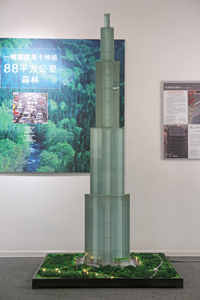
Sky City ... planned to be the world’s tallest.
Tallest tower in 90 days: BSB
BSB surprised the world last December when it erected a 30-storey building in 15 days. This time it has caught everyone’s attention by claiming it will build the tallest building in the world in just 90 days.
01 July 2012
AFTER setting a world record last December for erecting a 30-storey hotel building in just 15 days, Broad Sustainable Building Company (BSB) of China has set its ambitions even higher this time with a seemly impossible plan to build the world’s tallest building in just 90 days using its innovative construction technique (see Gulf Construction, February 2012).
Named Sky City, the 220-storey, 838-m-high skyscraper aims to snatch the coveted title from Burj Khalifa in Dubai, UAE – which took five years to see completion – and will beat the current record holder by 10 m.
The Hunan-based company has planned the estimated $628-million project for its home province by the Xiangjiang riverside in Changsha City. A spokesman for the company says the building will be erected using BSB modular technology featuring 95 per cent factory prefabrication and a five-storey per day construction cycle. About 200,000 tonnes of steel will be consumed and 104 lifts installed at Sky City, which will involve a gross building area of one million sq m.
Work on the project, to be carried out by BSB, is expected to start in November with completion planned for January next year.
Juliet Jiang, senior vice-president of Broad Group, the parent company of BSB, says: “The project was initiated in April and is awaiting the final approval by the government. Agreements were signed on June 5 between BSB and its partners. The official plans will be announced in August.”
Outlining the objectives behind the project, Jiang says: “Firstly, it is in line with the Chinese government’s policy to achieve ‘four savings’ – energy, material, water and land savings – and environment-friendliness – when implementing construction projects. Secondly, it provides a roadmap for Chinese urbanisation. Thirdly, it can enhance the lives of ordinary people. And finally, it will help perfect the BSB technology.”
She continues: “We are not just erecting a landmark but developing and expanding on a type of practical building that involves medium costs and ultra-low energy consumption, which would shape the urban lifestyle of the future.”
 |
|
The 30-storey hotel building ... erected in just 15 days. |
The building, which will primarily be residential in nature, will be able to house more than 31,400 people. According to a breakdown of the space allocation, 83 per cent will be for residential purposes housing 17,400 people; five per cent for a hotel (1,000 people); and three per cent each for a school (4,600), hospital (1,400), offices (2,000) and shops and restaurants (5,000).
While safety is definitely a concern in skyscrapers especially in earthquake-prone China, Jiang says Sky City will be designed to resist earthquakes of magnitude 9 – far exceeding the local Changsha standard of magnitude 6.
She says this striking seismic resistance can be attributed to four factors – the building’s trapezoidal pyramid solid structure, the fact that it is designed by renowned architects, the model has been subjected to testing, and it is factory produced under strict quality control.
Furthermore, the building will have a fireproof steel structure with fire resistance up to three hours, Jiang says, adding that there will be 10 fire escape routes to ensure evacuation within 15 minutes.
In terms of environment-friendliness, Jiang says Sky City will use five to 10 times less land due to the increased building height and decreased traffic requirements.
She claims it will consume one-fifth of the energy used by conventional buildings, using BSB’s technologies such as 15-cm-thick thermal insulation, four-paned windows, fresh air heat recovery, non-electric air-conditioning, among other aspects. Similarly, electricity consumption will be six times less than that of conventional buildings with LED lighting and self-power-generating lifts.
Another advantage for residents will be pure air inside the building. Jiang says. “Air quality indoors at Sky City will be 20 times purer than in the outdoor environment. This will be achieved using BSB’s unique fresh air machine featuring three-stage air purification and air exchange that is programmed at seven times per hour.”
Broad began developing sustainable buildings after the Wenchuan Earthquake in 2008. One year later, the company conducted hundreds of tests, leading to the invention of the steel structure, diagonal bracing and lightweight combination technology. By December last year, BSB had built a total of 12 BSBs in Changsha, Xiangyin, Shanghai and Zhejiang provinces in China and Mexico; and has established two franchise partners in Ningxia and Fujian. Negotiations are under way with another 10 Chinese and international potential partners. BSB is renowned for its eye-opening construction efficiency. Its portfolio includes assembling a 15-storey building in six days in June 2010, and erecting a 30-storey hotel in 360 hours in December 2011.
