

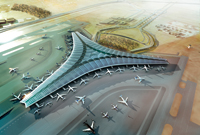
A perspective of Kuwait’s new airport terminal ... $6-billion spending plan.
GCC expansions driven by demand
The Gulf’s aviation industry is flying high with growth rates in double digits. The region has now embarked on ambitious plans to invest heavily in its airport infrastructure to meet future demands.
01 July 2012
THE current decade will go down in the annals of the Gulf region as the most dynamic for its transport infrastructure sector with a myriad of road, rail, airport and even port projects being put forward and actively pursued.
The aviation segment in particular has been the most vibrant over the recent past; for instance, in the first five months of this year alone it accounted for the bulk of contracts, valued at $5 billion, awarded in the region’s transportation sector.
Strategically positioned between the East and West, airports in the Gulf have been witnessing surging numbers of business, leisure and transit passengers.
The Middle East saw the biggest rise in international passenger growth in 2011, recording an 11.9 per cent year-on-year increase followed by Europe with 9.5 per cent rise and Latin America at nine per cent rise, according to the International Civil Aviation Organization (ICAO). Given these figures and the fact that GCC airports are running at an average 92 per cent passenger capacity utilisation – with Saudi Arabia operating at 130 per cent capacity – as per statistics released by the Centre for Asia Pacific Aviation (CAPA), the need to expand is obviously pressing.
The GCC states have ambitions not only to boost capacities but also to set up airport cities, plans for which have been pioneered in the region by Dubai with Dubai World Central (DWC) aviation and logistics hub.
 |
|
DWC ... Phase Two to cater to 80 million travellers. |
In line with these plans, major airport projects have been launched over the past year along with other key developments across the Gulf, where an estimated investment of $90 billion is envisaged over the next few years.
Each and every Gulf state now has plans in hand or under way to expand its airport infrastructure. Among the largest projects to take off is the award of a much-awaited contract – estimated at $3 billion – to construct the Midfield Terminal Complex as part of the expansion of Abu Dhabi International Airport in the UAE.
Meanwhile, the most anticipated event of the year in the aviation industry is the much-delayed launch of the showpiece New Doha International Airport in Qatar, which is scheduled for a memorable opening date of 12.12.12. Qatar Airways CEO Akbar Al Baker told media during the Arabian Travel Market (April 30 to May 3) in Dubai, UAE, that the date was slated for NDIA’s launch, although full operations are most likely to start from early next year.
Bahrain
Bahrain, which has been mulling ambitious plans to set up an airport city, has indicated that the country’s international airport is to undergo a major 10-year revamp under a massive development plan that will be completed in two phases.
The airport will undergo comprehensive maintenance work during Phase One. It will then be expanded to boost capacity to keep pace with the country’s current needs. The capacity is expected to increase by 50 per cent from the current nine million passengers a year to 13.5 million.
The second phase of the estimated $4.7-billion programme includes a new state-of-the-art terminal to be built as part of the decade-long strategy.
Kuwait
Kuwait is planning to spend $6 billion to expand the capacity of its international airport to 13 million passengers by 2016, according to Fawaz Al Farah, head of the civil aviation directorate.
The current capacity at the passenger terminal, which was built in 1980, is around seven million passengers a year and is expected to eventually increase to 25 million by 2025, he added.
Design and consultancy tenders for the expansion of the terminal to 710,000 sq m – estimated to cost of $3 billion – are expected to be issued soon. The rest of the funds will be spent on widening runways, building a new control tower and a cargo village, Al Farah said.
Tenders for the construction work on the project are expected to be issued in the middle of next year.
Oman
The sultanate’s international airports in Muscat and Salalah are both in the midst of an expansion, which will enable them to handle 12 million and one million passengers per year by 2014, respectively.
A new cargo terminal, positioned amid the two parallel runways, is also being developed at Muscat International Airport. This new facility will boost the airport’s current capacity of 100,000 tonnes to 260,000 tonnes of cargo per year initially, which will be increased to 500,000 tonnes. Salalah airport will have a cargo terminal to handle 100,000 tonnes of cargo per year, following the expansion.
In addition, Oman is also building four new airports at Adam, Sohar, Duqm and Ras Al Hadd.
Qatar
Interior fit-out works are under way at the New Doha International Airport (NDIA), which is shaping up as one of the most luxurious transportation facilities in the world. Located 4 km west of the existing international airport, the $14-billion NDIA airport will eventually cover 2,200 hectares and be one of the world’s largest airports. It has been designed to accommodate the Airbus A380 superjumbo and will initially handle 12.5 million passengers. After its ultimate development in 2015, the airport will accommodate 50 million passengers, two million tonnes of cargo and 320,000 movements a year. Among the recent contracts for the project was a $133-million deal awarded in March for the supply of security scanning systems.
Delays in the completion of the new state-of-the-art facility led to the expansion of Doha International Airport following which the old arrivals hall has become Terminal B.
 |
|
The MRO facility for SAEI at Jeddah airport. |
Saudi Arabia
In line with its plans to invest $53.33 billion in its aviation sector over the next five years, the kingdom has given the go-ahead for two key airport projects at Jeddah and Madinah over the past year, both serving the rising numbers of pilgrims that visit Makkah and Madinah during the pilgrimage seasons.
The $7.2-billion expansion and development of King Abdulaziz International Airport (KAIA) in Jeddah, the gateway for pilgrims headed to Makkah, will raise the airport’s annual capacity to 30 million passengers from 17 million by 2014. The expansion, being carried out by Saudi Binladin Group, involves the construction of a 670,000-sq-m terminal with 94 aircraft bays, an 8,200-capacity car-park and what is expected to be the world’s tallest control tower, at 133 m high. Designed to accommodate the world’s largest aircraft, including the A380s, the airport is expected to see its annual capacity rise to 80 million passengers by 2035.
Meanwhile, a $800-million contract was awarded in April to a consortium of Turkey’s TAV, the UAE/Australian Habtoor Leighton Group, and the local Al Rajhi Holding for the construction of an aircraft maintenance, repair and operation (MRO) facility for Saudia Aerospace Engineering Industries (SAEI) at Jeddah airport.
TAV was also part of the winning Tibah consortium that has secured the PPP (public-private partnership) deal from the General Authority of Civil Aviation (Gaca) for the revamp of Prince Mohammad Bin Abdulaziz International Airport in Madinah. The first phase of the project, valued at $1 billion, will double the airport’s capacity from four million to eight million passengers per year, through the construction of a new terminal building and the renovation of the runway, apron and taxiway systems. The project will see the airport’s passenger handling capacity eventually increase to 12 million passengers a year at a total cost of $2.4 billion.
Gaca intends to transform the kingdom’s three main international airports in Jeddah, Riyadh, and Dammam into ‘airport cities’, featuring adjacent hotels, services and amenities, and develop international airports in Makkah and King Abdullah Economic City.
The airport in Riyadh – King Khaled International Airport – is also the focus of a major expansion that will increase its annual capacity from 14 to 25 million passengers at an estimated cost of $2.6 billion.
The expansion includes the construction of Terminal Five, which will be completed by November 2013, according to the Arab News. The authority has also invited design and project management proposals for the expansion of terminals Three and Four, the newspaper said. Preliminary studies and design work for the development and expansion have been completed and construction work is due to begin in November.
In addition, Gaca has launched a $5.4-billion programme to upgrade its 22 domestic airports across the country and develop five new airports by 2020. New domestic airports are planned for Hail, Taif, Jizan, Qassim and Al Jouf.
Gaca is currently overhauling domestic airports in Abha, Al Wajih, Arar, Qurayyat, Al Qasim, Hail, Najran, and Taif. The Abha airport project, due to be launched this year, involves a massive expansion which will take its capacity to five million passengers per annum. The expansion of Qurayyat airport, on the Saudi Jordanian border, is scheduled for completion by the year-end.
UAE
By 2020, the UAE is expected to have a capacity to handle a whopping 250 million passengers a year. Dubai will see a massive expansion in capacity, with the Dubai International Airport (DIA) expected to have a capacity of 90 million and the new Al Maktoum International Airport at DWC targeting 80 million passengers.
Dubai is spending well over $7.6 billion on the expansion of DIA. The fourth phase of expansion will increase the airport’s capacity to over 90 million passengers annually when Concourse Four is completed. Concourse Three at DIA is due to be operational later this year.
With plans to transfer Emirates’ operations to DWC postponed until 2025, DIA has been the focus of the emirate’s capacity expansion drive. In the meantime, DWC is expected to be more of a cargo and logistics facility in the medium term. Phase Two of DWC, which involves passenger handling capacity at Al Maktoum International Airport, is expected to be launched in 2018, to cater to 80 million travellers.
Some $6.8 billion is being invested in expanding Abu Dhabi International Airport, which will enable it to handle 47 million passengers a year by 2017. The capital city’s airport consists of three terminals with a joint handling capacity of around 12.5 million passengers annually.
An estimated $3-billion contract was secured by consortium of TAV Construction, Arabtec Holding and Athens-based Consolidated Contractors Company (CCC) for Abu Dhabi’s Midfield Terminal Complex recently.
The new terminal will be around 700,000 sq m in size and is a key aspect of the expansion programme for Abu Dhabi International Airport (see Page 49).
Meanwhile, Sharjah and Fujairah also intend to expand their airport facilities and are looking at spending $136 million and $43.6 million, respectively on such plans.
Conclusion
A dramatic increase in both business and tourism travel is driving airport expansion across the GCC. These plans, which involve the procurement of the most sophisticated technologies available worldwide, are being fast-tracked and carried out in phases to keep pace with the growth in passenger numbers. Hence, the aviation sector offers construction and technology suppliers with ample opportunities for growth – opportunities the world’s leading aviation companies intend to tap, as seen by their significant presence at the Airport Show last month (May 31 to June 2) in Dubai (see Events).
- GCC expansions driven by demand
- TAV boosts portfolio with string of deals
- SAS balances function with aesthetics
- Dorma offers classy security solutions
- Bahra to supply cables worth $80m to KAIA
