

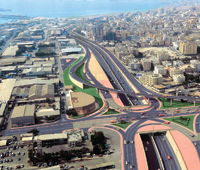
Mina Salman interchange project in Bahrain ... awarded to Afcons Infrastructure.
Gulf lures key Indian players
Indian firms that are well established in the region are building on their presence and securing some of the larger projects in the Middle East, while others are tapping the wide opportunities offered by the buoyant market, says KUMAR RAMESH of Frost & Sullivan*.
01 July 2012
THE Middle East’s construction sector, which has undergone a rough phase from late 2008 until early 2011, is now gaining momentum, as stimulus packages aimed at a balanced and diversified economic base are becoming the primary focus of regional governments. A steady stream of investments in construction and infrastructure development has been witnessed in the past year, which has once again shifted the attention of global investors, including Indian construction companies, towards the region.
The engineering, procurement, and construction (EPC) contracting environment in the Middle East is dynamic and incessantly evolving and developing. There are remarkable opportunities in this region and the increased number of South Korean, Chinese, and Indian players winning major contracts stand testimony to this fact. There are abundant opportunities for EPC companies in public infrastructure, transportation (rail, ports and airports), oil and gas (upstream and downstream), and water.
Infrastructure spending in transport and utilities is expected to strengthen in line with increasing demand for such facilities and several Indian companies, which have been active in the region working on civil and engineering construction projects, continue to make further inroads in the market.
Shapoorji Pallonji and Company (SP) is one of the best examples of an Indian company’s success in the Middle East. It has offices in four out of six GCC countries including the UAE, Saudi Arabia, Kuwait and Qatar. Currently, the company’s Saudi Arabian operation is executing two packages of a prestigious development in the King Abdullah Financial District in Riyadh where it is providing landscaping, external cladding, mechanical, electrical and plumbing (MEP), testing and commissioning, along with structural and finishing works.
 |
Huge funds have also been invested in construction activities in the energy and transportation sectors in this region. Larsen & Toubro (L&T) has been successful in garnering benefits of the increased construction activities in these two sectors. The company, which specialises in providing engineering and consultancy services for onshore cross-country hydrocarbon pipeline projects, also covers design and engineering services. Apart from construction activities, L&T is also engaged in manufacturing. As part of its organisational strategy to fortify its position in the Middle East, L&T has recently started a manufacturing facility at Dammam in Saudi Arabia, under a joint venture with the Yusuf bin Ahmed Kanoo Group for low- and medium-voltage switchboards and related systems solutions as well as allied products. It has also started operations at the Jebel Ali Free Zone in Dubai, UAE for providing systems integration solutions in the electrical and automation sector to augment support to its operation base in India.
Uhde India is a premier Indian engineering company for EPC management (EPCM)/EPC-LSTK (lump sum turnkey) and implementation of chemical and industrial plants. Since 1998, the company has been active in the GCC providing engineering services to Qatar Vinyl Company. It also provides various services including engineering, procurement, supplies, construction supervision, commissioning supervision, LSTK, front-end engineering design and project management consultancy, among other services. The company has seen wide success across the Middle East and North Africa (Mena) region with many prestigious projects in Saudi Arabia, Egypt, Morocco, Algeria, Oman, Iran, Kuwait, Jordan, Turkey, and the UAE.
Similarly, there are other major Indian construction companies and EPC contractors such as Afcons Infrastructure that have set their eyes on the Middle East’s construction and infrastructure development market. With the Middle East being a highly attractive destination, these companies are eager to tap into the huge opportunities available here. Indian companies that have a strong domestic portfolio and sufficient financial backing are also vying for larger opportunities.
However, the burgeoning avenues for Indian companies in the Middle East present some challenges as well. These include the existing knowledge gap to understand the best business model in the region, difficulties in comprehending the regulatory and environmental norms, issues in deploying latest technologies and solutions to deliver projects efficiently while competing with global giants, and managing project financing in the Middle East region. With the expansion of economic activities in the Middle East, the strengths of Indian companies surely need to be leveraged to capitalise on these mammoth opportunities in the Arabian Peninsula.
• KUMAR RAMESH is industry manager, Environment and Building Technologies Practice, South Asia, Middle East and North Africa, at Frost & Sullivan. The company enables clients to achieve best-in-class positions in growth, innovation and leadership. It provides disciplined research and best practice models to drive the generation, evaluation and implementation of powerful growth strategies. Frost & Sullivan leverages over 50 years of experience in partnering with Global 1000 companies, emerging businesses and the investment community from more than 40 offices on six continents.
