

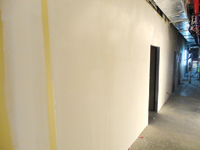
The new GypFine range ... smooth, hardwearing internal surface.
Gypsum plasters offer fine finish
With the launch of its new range finishing plasters, Gyproc Middle East has made it easy to achieve the high-quality flawless wall and ceiling finishes demanded by today’s prestigious building interiors, says MICHAEL MONAGHAN, company business development manager – plasters.
01 July 2012
WHILST buildings today are getting ever more complex and sophisticated, contractors are now coming under increasing pressure to build faster and at a lower cost.
Something has to give, and while structural integrity must remain paramount, it can be the structural finish quality that suffers. Transforming rough internal finishes into high quality modern building interiors has, therefore, become something of a science – which is where modern finishing systems come into their own.
Gypsum-based plasters are one of the oldest finishing solutions around – dating back to the times of the Pharaohs in ancient Egypt – and are today still the preferred finishing option for homes, commercial buildings, hospitals and schools throughout Europe and in many other parts of the world.
In the UAE, however, painter-applied putties or stuccos are currently the more popular finishing method, and the many benefits of plaster finishes have yet to be fully recognised.
Drawbacks of putties
Ready-mixed putties are popular because of their low skill requirement, ease of application and ability to achieve an acceptable finish for many non-critical building applications. However, their thin coat structure – typical application thickness is just 190 microns, or about 0.2 mm – and the application technique mean it can be difficult to achieve a smooth and blemish-free finish without multiple coats. Even then, the finish achieved is often unsatisfactory for critical light areas and other demanding applications, for instance where dark coloured paints are used.
The unique properties of gypsum make it an ideal base for modern finishing plasters. When mixed with water, gypsum plasters become pliable and exhibit a strong bond that will adhere to a range of backgrounds. They are easy to apply and provide excellent coverage. They harden in two stages, setting first by a chemical process before they dry out. This unique property of gypsum plasters means that, unlike sand and cement renders and lime-based plasters, they do not shrink and crack as they dry, leaving a smooth, high-quality even surface for decoration.
 |
A typical application thickness of 2 mm means that just two coats will build to a thickness of 4 mm – more than enough to cover any minor imperfections in the underlying background.
GypFine range
Gyproc’s parent group, Saint-Gobain, is a world leader in gypsum technology and manufactures plasters in many countries around the world. Gyproc has, therefore, been able to call on a wealth of expertise in plaster formulation when developing its new GypFine range.
It has combined this with local knowledge of building and finishing techniques to develop plasters that are not only ideal for the extremes of temperature and humidity encountered in the UAE but are also easy to apply using the techniques and skills already available in the local market.
Like all Saint-Gobain finishing plasters, the new GypFine range of plasters dry to a hard, resilient, scuff-resistant finish, providing a smooth hardwearing internal surface for the life of the building.
One of the key differences, however, is that GypFine plasters have been specially formulated with an easy-sand surface, so any small imperfections still present when the plaster has set can be quickly sanded down to leave a perfectly flat, even finish. This property of GypFine plasters means that the level of skill required for application is not as critical and, therefore, excellent finished results can be achieved by semi-skilled tradesmen, such as painters and dryliners, as well as fully qualified plasterers.
In addition, the thicker 2-mm coat thickness means that in general just two applications are required to achieve the required level of finish, particularly in critical light areas, unlike putties or stuccos, for which several applications may be needed to achieve an acceptable finish. This reduces both time and cost on site, as well as enabling more efficient work scheduling and easier management of follow-on trades.
GypFine plasters also dry white, reducing the number of paint coats required and providing a perfect base for a wide range of different colour finishes. The plasters will accept decoration with most paint finishes and wall coverings, as well as ceramic tiles – which can be applied once the plaster has dried.
The new GypFine finishing plasters range incorporates three different formulations. GypFine-Ultra Skim has been specially formulated to provide a high-quality finish to both plasterboard and masonry backgrounds and, therefore, gives maximum versatility and speed, particularly where a mix of backgrounds is involved. For jobs involving large areas of jointed plasterboard, GypFine-Board Skim is the preferred finish. GypFine-Multi Skim, a plaster for finishing over backgrounds such as sand and cement render, gypsum basecoats and fair face concrete, completes the current range.
GypFine-Ultra Skim, which gives the plasterer high versatility, is expected to provide the preferred solution where its ability to be applied on various backgrounds will reduce mixing, cut waste and save valuable time when faced with both plasterboard and masonry backgrounds. It is also especially formulated to remove the need for a primer coat prior to decoration, saving further time and cost on the job.
Meanwhile, GypFine-Board Skim has been designed specifically for application to low-medium suction plasterboard backgrounds. It is applied once all board joints have been filled and reinforced, and is formulated to exhibit a strong, permanent bond to plasterboard linings, and will not crack or break away as it sets. It is, therefore, ideal for jobs involving large expanses of plasterboard wall and ceiling.
GypFine-Multi Skim has been designed for finishing over a range of backgrounds from high-suction dry or damp gypsum undercoat plasters to low-suction masonry and rendered surfaces. It is not suitable for finishing plasterboards.
As already stated, GypFine plasters do not require a high level of skill to apply – although obviously, the more experienced the applicator, the quicker the plaster will be mixed and applied, and the less sanding will be needed to achieve the required level of finish.
For contractors undertaking larger contracts, requiring high volumes of plaster finishing, Gyproc has developed a new training module covering skimming with GypFine finishing plasters. This one-day specialist training module is designed to familiarise installers with the new range, and get them up to speed quickly through best practice training on background preparation, mixing, application and finishing. The course can be booked by completing an online form at www.gyproc.ae/page/sitetraining.
Gyproc is convinced that once contractors have tried the new GypFine plasters, they won’t want to go back to their old finishing methods. It offers to set up demonstrations on site for both contractors and clients, can arrange for free samples for contractors to try so that they can appreciate the many benefits that the plasters bring.
