

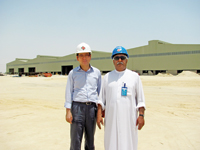
Seo with Al Khonaini, managing director of GPC (right).
GPC selects the best for upcoming factory
01 August 2012
LEADING Saudi companies have joined hands with a German veteran in the steel pipes business to launch a new SR660-million ($176 million) facility for the production of longitudinal submerged arc welded (LSAW) steel pipes in Jubail, Saudi Arabia.
The new joint venture, known as Global Pipe Company (GPC), will be the first manufacturer in the Middle East – and one of the few worldwide – to offer line pipes with heavy wall thicknesses of up to 50.8 mm (two inches), claims a spokesman for GPC.
The state-of-the-art factory, which is expected to be commissioned in October, has been set up as a joint venture between Erndtebrucker Eisenwerk (EEW) of Germany and its Saudi partners Saudi Steel Pipe Company (SSP), Ahmed Al Khonaini, and Pan Gulf Holding (PGH).
“There is a symbolic reason why all these stakeholders came together for the project. They are popular leaders of all the important functions in the steel pipes production business,” says Kwang Woo Seo, GPC’s general manager.
He says GPC brings together the extensive global technical know-how of EEW Germany which has 75 years of experience behind it in the pipes business. It has five factories around the world – two in Germany (including the main factory), and one factory each in Korea, Malaysia and Brazil.
“But EEW had no investment in the Middle East, which is a strong market. So GPC is a good choice. As for the company, not only is it an investor in the GPC project, it is also providing essential technical support back-up as well,” Seo adds.
In addition, EEW has been exporting to the region and is well-versed in the requirements of the region, he says.
And with the Saudi partners come their industrial expertise and know-how of the local market, says Seo. SSP is a pioneer in the steel pipes business with 33 years of experience for ERW (electric resistance welded) pipe and is very well known. Similarly, Ahmed Al Khonaini is a businessman of repute with businesses in the Eastern region, especially in Jubail.
“He also owns a pipes coating business. And since more than 75 per cent of pipes have to be coated, Al Khonaini was a natural partner,” says Seo.
Meanwhile, PGH is known for trading in steel products, and is also an exclusive agent of EEW in Saudi Arabia.
The GPC production facility is being fitted with some of the most advanced machinery and systems procured from Germany and elsewhere in Europe. It will be equipped with a sophisticated testing laboratory to ensure that the quality of its products is on par with international standards.
“We have acquired the best machinery for the project and that is why the capital investment is high. Machinery has been brought in mostly from Germany due to their high standard and reliability. Some have also been acquired from Austria and Holland,” comments Seo.
GPC has set its sights on becoming the leader in producing LSAW pipes that meet the needs of a diverse range of industrial applications and market demands, serving the oil and gas sector as well as offshore and structural applications.
Seo says: “GPC has many competitive edges, one of them being the ability to produce thickness of material up to two inches (50.8 mm) for the oil and gas industry.”
He says Saudi Aramco has been importing its entire demand of more than one-inch material thickness from abroad since a long time. And even though GPC’s capacity is limited, it can meet a large portion of local demand for heavy wall thickness of line pipes.
Equipped with state-of-the-art technology, systems and modern manufacturing facilities, GPC will have an annual production capacity of 200,000 tonnes of pipe products which will enjoy a region-wide market and will be backed by a well-qualified team and strong partnership with world-class manufacturers.
GPC will specialise in producing large-diameter heavy wall thickness pipes in three major categories: LSAW line pipes and LSAW process pipes – both of which boast a diameter of up to 62 inches and wall thickness of up to 50.8 mm (two inches) – and LSAW structural tubulars that are offered with diameters of up to 200 inches and heavy wall thickness of up to 130 mm.
The facility will have a capacity to produce 170,000 tpy of line pipes and 30,000 tpy of structural tubulars. The line pipes, which will meet API 5L up to X100 specifications, are designed for the transmission of oil, gas and water, thanks to their high strength and heavy wall thickness and are offered in lengths of up to 13.2 m. Structural tubular products, conforming to API 2B, ASTM A671/A672, are suitable for a wide range of applications ranging from offshore platforms to machinery and civil construction applications such as pipes and are available with a maximum assembled length of 36 m.
Initially, the company will produce regular LSAW process pipes with heat-treated types to be introduced at a later stage, says Seo, adding that process pipes are generally used in the petrochemical industry.
The company will play a key role in import substitution as it will help meet Saudi Arabia’s domestic demand for LSAW pipes that have hitherto been imported into the region. In addition, customers can benefit from reduced lead times for these large-diameter pipes. GPC enjoys proximity to a large local potential customer base that includes Saudi Aramco, Saudi Basic Industries Company (Sabic), Abu Dhabi National Oil Company (Adnoc), Qatar Petroleum (QP), Kuwait Oil Company (KOC), and Petroleum Development Oman (PDO).
“Backed by the technical support from EEW Germany, our integrated production procedures focus on quality to ensure customer satisfaction. We have the tools to guarantee the best products and services to enable us to serve our customers with the highest quality, performance and timely delivery,” Seo says.
About future plans, he says GPC might export and an expansion of the factory for this purpose might be carried out in the next phase, depending on the demand.
With regard to the business scene in Saudi Arabia, Seo says he’s very positive. “While the rest of the world is facing a financial crunch, Saudi Arabia has remained totally insulated from any such problem. The Saudi government is focusing on infrastructure projects, and as long as it maintains oil prices at a certain cut-off value, things will remain good. In all of this development, the use of steel pipes is mandatory in every aspect.”
- Bahrain group meets market demands
- GPC selects the best for upcoming factory
- SVCP to up capacity by 10pc in major revamp
- T Nagadi expands to meet demand
- Leister helps tackle PVC welding challenge
