

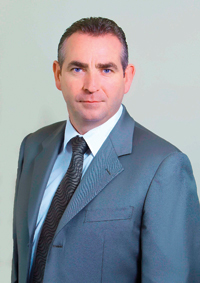
Forde ... solutions.
CommScope caters to complex networks
01 August 2012
ALL buildings today require an effective IT and communications infrastructure and this is a field of construction that is expanding in size and complexity, claims CommScope, one of the largest IT and communications infrastructure providers in the Middle East.
“Convergence of building management systems, security, HVAC (heating, ventilation and air-conditioning) and fire life safety onto the IT local area network (LAN) continues as a trend,” says Ciaran Forde, vice-president, Enterprise, Middle East and Africa at CommScope.
“One can easily imagine a single building network supporting all ‘in-building’ systems and applications,” he adds.
Whilst yielding many operational and cost benefits, it also means that the traditional costs of these systems are reducing and moving over to the IT component of a construction budget. “There are cost optimisation techniques through design and technology choice that can have significant savings for a project if utilised,” says Forde.
CommScope UAE offers the construction sector advice and support on technology trends and choices; infrastructure design services or support; and a wide array of infrastructure solutions to fit applications and budgets for any project type, regardless of the size or complexity – from airports to apartments, universities to junior schools, oil and gas to retail.
Forde says the company’s solutions cover IT infrastructure cabling, distributed antennae systems for 3G and 4G, full data centre solutions, intelligent infrastructure management, among other aspects.
CommScope has more than 200 active projects in the Middle East, which is home to some of its largest projects, particularly in the UAE, Saudi Arabia, Qatar and Oman, where it is providing solutions to various sectors such as healthcare, telecommunications, airports and education.
Forde cites airports as one of the most complex environments to design an ICT systems strategy and this is a field in which CommScope’s design support teams specialise in.
Another challenge faced by the sector comes in designing for convergence. He says that internet protocol and Ethernet-based applications have triggered a trend of converging a wide non-traditional set of systems and applications onto the LAN. “This has advantages but also challenges in terms of design. One can unintentionally ‘over design’ a network in trying to cater for all these systems or ‘under specify’ some of the supporting infrastructure elements,” states Forde.
Another challenge faced by the company is the often conflicting information that the market is fed with. Consultants and clients, alike, facing a bombardment of often self-serving messages from a variety of technology and infrastructure vendors with the market flooded with mixed messages, Forde says, adding that CommScope offers guidance to consultants, clients, contractors and integrators in the field of IT infrastructure solutions.
He elaborates: “The physical layer, which hosts the bandwidth, must support multiple generations of systems and applications. So a lot of thought has to go into technology choice and network design. This is a challenge but one which we excel at. We factor all technology trends and media types, wireless, wire line, copper and fibre-based infrastructure and provide advice based on the best interests of the project and best practice.”
CommScope offers innovative and efficient solutions for projects including its:
• GigaSpeed X10D: There is an increasing deployment of Category 6A UTP cabling, which is specifically designed for one and 10G Ethernet (10GBASE T) support, he says, adding that this means the IT sector sees the need for a robust yet simple transmission media platform to support these applications. 10GBASE T is currently deployed in data centres but CommScope expects it to be deployed in the IT LAN environment in the next two to five years.
• imVision, infrastructure management: This is an incredible technology and trend in the market, Forde remarks. “With the expansion of systems now supported by LAN, CommScope sees an equal growth in size and complexity of many networks. To enable a progressive IT department manage such a network, an intelligent infrastructure management system is needed to give the vision, knowledge and control of the physical infrastructure network. This allows the operator full control of the network down to every port, cable, and outlet, which in turn yields significant operational benefits for changes on the network, including energy management down to user and outlet level,” he points out.
• ION distributed antennae systems: These are used in building wireless systems to provide the coverage and capacity requirements of GSM and Tetra signals throughout the “built” environment such as buildings, rails, metros, and oilfields.
CommScope has enjoyed good growth levels and has a positive outlook for the future despite the downturn in some markets and the spread of low end, low quality material. This is because the Middle East’s engineering standards still remain high with a general understanding and appreciation for the need and economic sense of high-quality, high-performance solutions, Forde says.
With regard to CommScope’s plans for further growth in the region, he says the company’s investment and commitment to the region is substantial and one that has yielded it the number one position in terms of sales and support throughout the region.
“We intend to continue to grow with the region. We recently reorganised our business and created Middle East and Africa (MEA) as a standalone region. This has given the MEA team the focus and ability to chart its own course and investment plan,” he comments.
Forde adds that the company expects to expand with the market in the areas of rail, healthcare, oil and gas, education and finance. “Our strength in the sports arena sector is phenomenal, so we fully expect to enjoy our traditional success in this sector, not just for Qatar but across the region,” he says.
CommScope has outlined a three-pronged strategy for the Middle East, which has classified into three categories: Protect, which includes markets where it enjoys a high market share and customer support; Grow, which includes those where it needs to see particular growth levels; and Penetrate, which includes new emerging markets and where it has investment plans.
CommScope employs nearly 50 people in the region and has its headquarters and warehouse in Dubai, UAE, and a production facility in Saudi Arabia.
- R&M expands in Saudi Arabia
- Schneider Electric boosts IT network solutions
- CommScope caters to complex networks
