

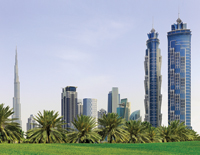
Twin tower treat
The JW Marriott Marquis Hotel in Dubai is unique in many respects; it is the tallest dedicated hotel building in the world, and it is JW Marquis’ first branded property outside North America.
01 October 2012
DUBAI’S newest luxury hotel will further enhance the emirate’s tally of superlatives by staking claim to the twin distinction of being the “tallest” and the “first” when it opens its doors shortly.
The JW Marriott Marquis Hotel Dubai will be the tallest dedicated hotel building in the world at 355.35 m. The new hotel will also be the first JW Marquis branded property outside of North America (after the JW Marriott Marquis Hotel Miami).
The “Marquis” designation is reserved for select downtown properties that offer the highest level of comfort, technology, personal service, meeting facilities, privacy and world-class amenities – and the new hotel aspires to offer exactly that.
Symbolising Dubai’s resurgence as well as the soaring ambitions of its owner the Emirates airline, the JW Marriott Marquis is housed in a stunning twin-tower complex that sits on a 221,246-sq-ft ‘L’-shaped plot between Sheikh Zayed Road (service road) in the west and Business Bay development to the east. This plot adjoins the creek (future extension) with a promenade on the south side.
The form of the towers is inspired by the date palm, a symbol highly evocative of the Arabian culture, and replicates in its detailing the trunk of the palm.
 |
The twin towers sit atop two basement levels, a ground floor and a seven-level podium, and are symmetrically positioned to allow the best views of the Burj Khalifa, Business Bay and nearby sea. The towers comprise 66 guest floors, eight service levels and six intermediate levels plus the roof top, encompassing a total built-up area of 3.525 million sq ft.
The 1,608-room hotel, which aims to cater to the ever-growing leisure and business tourism industry of Dubai, will open in two phases with the first phase comprising 804 rooms and numerous restaurants and lounges set to open in December. Each tower has two presidential suites, 506 typical King rooms, 156 typical twin rooms, four rooms fitted specifically for the disabled and 118 corner suites, with the remaining space comprising 22 executive King rooms in a choice of configurations.
The hotel – a stunning addition to Marriott International’s JW Marriott world-class luxury hotel brand – will have a total of 14 restaurants and lounges and entertainment venues as well as a banquet hall with a capacity to host 1,000 people.
Among the highlights of these facilities will be the double-height vault lounge, which will sit on the 71st and 72nd floors offering panoramic views of the city, and the late-night music venue on the ground and first floor level, which will offer live music daily.
 |
|
The live music venue and main lobby (top). |
The restaurants will include Prime 68, a boutique steakhouse; Atul Kochhar’s Rang Mahal Indian restaurant; Positano for Italian coastal cuisine; Kitchen 6, an international buffet restaurant; Tong Thai, a Thai restaurant; Izakaya Japanese restaurant; and La Farine, an attractive boulangerie and social meeting spot. The restaurants arcade is placed facing the promenade and future Creek extension.
The hotel’s 1,500-sq-m wellness facilities including a Saray Spa will offer treatments designed to ensure relaxation of the mind and body.
Other facilities include a 32-m swimming pool and an large pool deck covering the seventh floor of the hotel with elegant cabanas, lounges and umbrellas. Parking slots are available to accommodate more than 1,000 vehicles.
The lead architect of the project is Archgroup Consultants, while the main contractor is Brookfield Multiplex.
Architectural concept
According to the project architect Ashok Korgaonkar, owner and managing director of Archgroup Consultants, the vision for the JW Marriott Marquis Hotel Dubai hotel was to reflect the soaring ambitions of Emirates airline, as well as the city of Dubai, by creating an iconic tall structure that serves as a new benchmark and reinforces the image of the city as the frontrunner in the international hospitality scene.
As lead consultant Archgroup Consultants is responsible for the concept design, architecture, structure, services and coordination with all sub-consultants, in addition to complete project management and supervision till the completion and defects liability period.
The concept of the building, the brainchild of Korgaonkar, was done in-house. “We had a great time designing the project, which was challenging,” he says.
 |
|
The Dubai skyline ... as seen from a guest room. |
Design work on the project started in 2004, when Dubai was in the midst of a construction boom. The project, itself has evolved to practically double in size, having originally been envisioned as a single tower development.
Korgaonkar says the client’s brief entailed the development of a 70- to 80-storey five-star business hotel of 700 to 800 luxury rooms of 55 to 60 sq m each.
“We came with the proposals but during the process, the client managed to acquire the adjacent plot as well and so decided to go bigger and have two towers: one a hotel tower and the other to consist of service apartments. This was then changed to make both as hotel towers,” he says.
The architectural concept for the towers came into being at an inspirational moment for Korgaonkar.
“Dubai, an Arab country, has palm and desert as its basic landscape elements. I wanted to reflect the trunk of a palm tree in the shape of the towers,” he says. “The concept entailed that the protruding sections of the tower should not only be aesthetic elements but also functional on the inside as well.”
This has translated into a diversity of room sizes, giving the operator the opportunity to offer regular guests a choice of rooms every time, he says.
 |
|
One of JW Marriott’s 118 corner suites ... luxury living. |
“The project was conceptualised as a comprehensive facility serving a wide variety of clientele – from private short-term tourists to spa enthusiasts to large conference delegations – and providing for all their needs under one roof,” he says.
It aims to become the most convenient and popular location for local residents, leisure travellers and visitors as well as executives visiting the adjoining Business Bay or serving the Mena (Middle East and North Africa) region, and the Mice (meetings, incentives, conferences and exhibitions) market.
“The sheer economies of scale allow the provision of the required variety of facilities and amenities to serve all the different demands in terms of room types, restaurant variety and cuisine choices, conference facilities, banquet, spa offerings and retail,” Korgaonkar adds.
The podium houses all the public areas, restaurants, banquet hall, spa and essential back-of-house areas. Its terrace is beautifully landscaped with gardens, swimming pools and a party lawn.
The grand entrance lobby is four floors high and overlooks the Business Bay development while the banquet hall has an independent access from Sheikh Zayed Road.
The delicate forms and detailing on the exterior belie the sophisticated engineering and technological inputs within the towers. The structural design has undergone rigorous testing and rechecking on computer-generated models and wind tunnel tests.
The towers are oval in shape, which has helped solve the issues highlighted in the wind tunnel analysis, according to Korgaonkar. “The fins (that make up the protrusions, giving the building the appearance of a palm tree trunk) were a challenge as we needed to shape structures that could sustain heavy winds. In the end, we found solutions in a combination of steel and concrete structures,” he says.
The electromechanical design is of the highest standards befitting the building that aspires to set the benchmark for hotels in the region.
In total, there are four entrances to the site: Entrance One, the main entrance drop-off from Business Bay towards the east; Entrance Two, the banquet drop-off from the Sheikh Zayed Road towards the west; and entrances Three and Four, on the north side, which are the parking entrance from the internal road of the Business Bay development and the service and staff entrance, respectively.
Two basement floors as well as a section of the podium levels have been allocated to house 1,000 cars. In addition, the adjoining parking building, which belongs to the same owner, was connected at the second level from the banquet drop-off. This parking can accommodate 600 cars in the evenings after office hours and on holidays.
Layout & construction
The towers are positioned in such a way as to have a minimal peak thermal load. They sit on a 3.90-m-thick raft supported on 1.2-m-diameter piles.
Brookfield Multiplex was awarded the main contract for the construction of the development in June 2007 and launched work on the foundations immediately. Work on the superstructure started at the end of September 2007. The project is now in the process of being handed over to the operator.
The hotel towers have an oval-shaped central core with several internal lift core walls and staircase walls providing lateral stability. The podium level floors are supported by oblong reinforced concrete columns (1.6 m by 2.5 m). The podium floor slabs are designed with a combination of conventional reinforced concrete slabs supported by post-tensioned band beams. At typical floors, the structural layout is modified to suit the apartment layout. The typical floors are supported by shear walls, which are floated from 2.4 by 5.2-m-deep beams at transfer level. The bonded post-tensioning system is used for the typical floors. To ensure lateral stability of the structure and reduce accelerations at roof level, reinforced concrete outriggers are introduced at the 14th, 30th and 48th levels. The structure has been designed considering seismic zone 2A.
Considering the height, shape and close proximity of the towers, an extensive wind tunnel study was conducted to account for cross wind and vortex shedding.
“We used the slipform technique and post-tensioned slabs to expedite work on the project. The towers are basically divided into three sets of floors, which keep repeating to form the flaring pattern,” says Korgaonkar.
Elaborating on the layout, David Miller, the project director at Brookfield Multiplex, says: “The podium covers an area of approximately 520,000 sq ft and hosts most of the 14 restaurants in the development. Each one of these restaurants has a dedicated kitchen facility, while the main kitchens and food preparation areas can be found in a central location on the ground and first floor.
“The third floor has been dedicated solely to a spa and health club. These facilities encompass the complete floor areas across both towers as well as the podium zones. Emphasis has been placed on providing the finest quality spa facilities as well as the most modern and extensive gymnasium.”
“To cater for the business market, 31 meeting rooms of various sizes have been provided on the fourth and sixth floors. In order to ensure flexibility with room sizes and layouts, steel trusses were introduced to allow for a free uninterrupted span of 24.5 m thereby allowing the Level Six meeting rooms to be cleared and utilised as a second banquet hall with a similar capacity to the main banquet hall on the second floor. Swimming pools and landscaped areas are located on the seventh floor which will also double up as an external functions area.”
Guest rooms are equipped with the latest technology including LCD TVs, Blu-Ray DVD players, iPod stations and wireless internet.
The façade comprises thermal blocks with double-glazed panels and insulated aluminium panels to achieve low thermal loads. Structural glazing is a combination of stick and unitised curtain-wall with powder-coated mullion and framework, point-fix system.
Commenting on the challenges of the project, Miller says during the construction boom in the region the project experienced a shortage of concrete, but with the proactive approach of Brookfield Multiplex the impact on the project was minimal, with delays and disruptions being minimised.
 |
|
Atul Kochhar’s Rang Mahal Indian restaurant ... one of many fine dining points. |
“The biggest challenge was the recession and of course the shortage of concrete,” Korgaonkar comments. “There was a huge concrete shortage and some of the construction had to be deferred and sequenced based on how much and when concrete was available. So we lined up three or four contractors with each handling a floor. There was a monthly cap on construction based on the cash flow available but we are grateful that the client continued with this prestigious project, which is now a landmark.”
There was also significant redesign to the podium, in particular, with additional levels added and rearrangement of areas, which Brookfield Multiplex with its significant experience managed efficiently and delays/disruptions were minimised, he adds.
MEP services
The entire cooling load for the hotel complex is catered by Empower, the leading UAE-based district cooling provider. The total peak cooling demand for the project is 6,700 tonnes of refrigeration (TR). All air-conditioning serving public spaces such as the banquet hall and restaurants features air disinfection and odour control. In addition, close control units are provided for areas requiring accurate temperature and humidity controls.
The power requirements for the project are served by two substations with a total of twenty-three 1,500 KVA transformers and connected load of approximately 33 MW. In addition, the project is supported by three 1,500 KVA standby generators to feed life-saving equipment, emergency lighting and all low current systems.
Among the highlights of the project is that its entire irrigation water requirement is catered for by the condensate of the air-conditioning equipment, where the condensate water is collected in irrigation water tanks through separate condensate drain system.
The development also incorporates several other features that are designed to save energy.
 |
|
A bathroom at the hotel. |
Listing some of these features, Korgaonkar says:
• All domestic cooled and hot water pipes are insulated against thermal loss, with the major portion of domestic water distribution being through gravity lines, thus saving on energy consumption for pumping;
• Booster pumps – where used for domestic hot and cold water distribution – are with variable frequency drive (VFD), thus providing energy saving;
• All WCs are with dual flush mechanism for water conservation;
• All chilled water pumps are on VFD, thus providing energy saving.
• Air-conditioning units serving multiple spaces – with individual temperature control via variable air volume (VAVs – are with VFD, thus reducing overall energy consumption.
• The ventilation of the banquet hall ventilation is variable to meet indoor air quality requirements;
• Energy recovery capability from exhaust air is provided;
• The majority of the condensing units (for cold rooms, refrigeration equipment, etc) are cooled with chilled water, thus reducing overall energy consumption;
• All general power, lighting and fan coil units (FCUs) temperature settings in guest rooms, feature separate occupancy and non-occupancy mode for energy saving;
• The general lighting – car-parking, common areas, front-of-house (FOH) and back-of-house (BOH) corridors, etc – are controlled through time scheduling; and
• LED lights are used extensively providing low energy usage.
- ETA Melco ensures a comfortable ride
- Life Solutions brings exclusivity to spa
- VingCard locks ensure security for hotel guests
- Bio-Oxygen keeps air clean and pure
- SEDE carves niche with gypsum ceilings
- Twin tower treat
- Brookfield Multiplex adds another feather
