

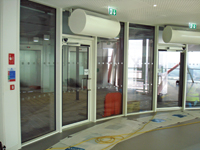
Fire doors at the Orbit.
Safe sports arenas avert tragedies
LEE COATES, technical director at Wrightstyle*, discusses the importance of fire safety in stadiums and the benefits of modern steel glazing systems in preventing major tragedies.
01 March 2013
CODIFYING by catastrophe is the term used to describe how fire and other safety regulations have often come about because of tragedy.
In the Middle East, the worst stadium disaster was at Egypt’s Port Said Stadium last year, following an Egyptian premier league football match between Al Masry and Al Ahly clubs. In scenes of crowd disorder, at least 79 people died and some 1,000 were injured.
The worst stadium disaster was in South America, at the close of a Peru versus Argentina Olympic qualifying football match in 1964. Chaos ensued when the referee disallowed a Peru goal, with 318 people losing their lives.
Argentina was again involved in tragedy four years later, at a River Plate versus Boca Juniors match. Some 74 people died when fans trying to leave came up against a closed exit and were crushed.
Lessons, however, sometimes need to be learned and relearned many times. In Guatemala City in 1996, 78 people died during a stampede before a World Cup qualifying match against Costa Rica.
It’s the same the world over. The UK’s worst football disaster at Hillsborough claimed the lives of 96 Liverpool fans in 1989, again caused by poor crowd control leading to crushing; while in Kathmandu, Nepal, at least 93 people died in 1988 when fleeing a hailstorm, only to be crushed against locked exits.
The list goes on and on.
 |
|
Wrightstyle supplied systems to both the ArcelorMittal Orbit and the London Olympic main stadium behind it. |
Nowadays, major stadiums have crowd safety as their first design prerequisite to include everything from entrances and exits that can cope with large numbers of patrons to major incident plans to deal with any eventuality.
Although crushing injuries have historically been the most common cause of fatality, fire is the other potent threat. It’s the reason modern stadiums are built with lots of concrete, steel and fire-rated glass to minimise the risks posed by fire.
But the focus on fire safety has also come about because of tragedy, most notably the worst fire disaster in the history of English football: the Bradford City fire in 1985 which killed 56 and injured some 265. Most likely caused by a dropped cigarette or match falling into a void area beneath one of the ground’s stands, it soon engulfed the whole structure, including the roof. Worse, people had to break down locked exits to escape.
While modern stadiums are very safe, fires do however still occur. Towards the end of last year, a potentially serious fire occurred at Arsenal’s Emirates Stadium in north London. It was discovered at 2 am and took 20 firefighters to bring it under control.
 |
|
The Moses Mabhida Stadium in Durban, South Africa ... advanced fire-resistant systems installed. |
And not all stadium fires are accidental. In 2011 in Portugal, angry Sporting Lisbon supporters, upset by their team’s loss to rivals Benfica, tried to set fire to the stadium. Firefighters extinguished the blaze, but not without significant damage to one section of the stadium.
Developed countries now have specific laws and regulations relating to fire in major stadiums. These regulations require stadium operators to plan, organise, control, monitor and review the necessary preventive and protective measures and, in most cases, record these arrangements in writing.
In Europe, UEFA (Union of European Football Associations) also offers guidance, making clear that “major lessons have been learned from the fire-related stadium disasters of the past”. Fifa (Fédération Internationale de Football Association) echoes that sentiment in its safety regulations, stating that “fire may present one of the greatest safety risks at a venue”.
Fifa’s regulations state that the host associations/confederations of Fifa events and the Olympic football tournaments are obliged to apply these regulations (qualifying and final competition matches) when these events are under the direct operational administration of Fifa. Preventive measures such as the removal of sources of ignition, the provision of fire doors and the adoption of sensible precautions, especially where food is being prepared, can greatly reduce this risk.
It’s those passive measures that are Wrightstyle’s international specialism. The company has supplied to both the London Olympic main stadium and the adjacent ArcelorMittal Orbit, the 115-m-high observation tower. It also supplied to an Athens Olympic project and to projects for the Asian Games in Doha, Qatar, and the Fifa World Cup in South Africa, and to the Football Association’s training ground in England.
 |
|
A Wrightstyle glazed system being tested against a simulated lorry bomb for a project for the Asian Games in Doha. A charge of 500 kg TNT-equivalent explosive was used. |
In many instances, it has been Wrightstyle’s ability to demonstrate independent testing against both fire and smoke that has proved to be a decisive factor, underlining the highly specialist nature and international context of the steel glazing market.
As the company constantly point out, the main lesson for designers is not simply to build in passive and active fire systems, but to look at the whole stadium or building’s capacity to withstand a fire. For the glazed components, that should mean analysing the level of containment the glass will provide and its compatibility with its framing systems.
Those levels of containment are absolutely vital in a stadium, with very large numbers of people in a restricted area and who, in the event of a fire, may not always follow proper evacuation procedures. Evacuation models, based on engineering and computational tools, don’t necessarily reflect the variable nature of human reaction.
Computer modelling and human behaviour diverge the moment that the fire alarm sounds. The fire safety designers may assume that patrons will immediately head for a designated fire exit. However, human psychology is likely to delay any response because many people will assume it’s a false alarm, or wait for further instruction from someone in a position of authority.
Further complicating matters is that people will generally finish what they’re doing. If they’re on a concourse buying food, they’ll often complete that purchase before deciding whether to evacuate.
The most compelling example of this, although not stadium-related, was during the Kings Cross railway station fire in London in 1987 which killed 31 people. In that tragedy, many passengers stepped over fire hoses to reach elevators taking them underground for their trains. That’s what they were at Kings Cross to do, and a seemingly-innocuous fire wasn’t going to stop them.
In the retail sector, research suggests that people would rather first go to the check-out to purchase goods rather than immediately evacuate the building.
More specific to stadiums, patrons will often seek to reunite with family members or friends. For example, if one family member is away from his/her seat when an alarm sounds – perhaps buying food on a concourse – he/she will often go back to his/her seat to find other family members before making any decision to evacuate.
It adds up to a delayed flight time that the stadium’s design and evacuation procedures must address. In buildings research, as much as two-thirds of the time it takes people to exit a building after an alarm is start-up time – time wasted in looking for more information or not taking the alarm seriously.
Stadiums do, of course, have the advantage of having public address (PA) systems and a scoreboard on which information can be posted. However, human psychology is also at work, and the passive fire measures employed in the stadium’s design must also factor in a delayed evacuation response.
That’s why modern steel glazing systems are so important, either for the exterior envelope of the stadium or for internal screens and fire doors. With advanced glazing systems able to provide up to 120 minutes of protection against the spread of fire, smoke or toxic gases, they have become an integral part of modern stadium design, giving people more than enough time to evacuate and protecting escape routes along the way. Those escape routes become more significant for the elderly, infirm or disabled who will typically need more time to evacuate.
However, one word of caution. In many instances, untested combinations of glass and frame are still being specified separately – despite the fact that, in a fire situation, the glass will only be as good as its framing system, and vice versa. Insisting on tested, and therefore proven, compatibility, and specifying it as a requirement of the tendering process, should be a matter of course.
Stadium design has come a long way in the past few decades, driven by new regulations to deliver a new generation of safer stadiums. But it’s also a tragedy that it’s taken catastrophe to make it happen.
* Wrightstyle is a leading UK-based steel glazing specialist that has supplied fire-rated systems internationally to several Olympic, Fifa and other major stadiums.
- Safe sports arenas avert tragedies
- Hempel offers complete solution
- Alubond stands strong in the face of fire
- Apollo detectors receive quality certificate
- New Graco sprayers ensure efficient coating
- Gulf success for Firetrace systems
- IKK stresses holistic approach in fires
