

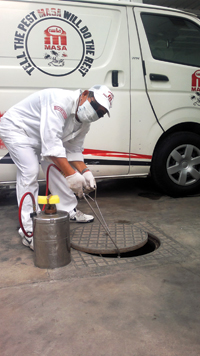
Masa experts spraying in a common washroom and in a manhole (below).
Masa eliminates pests through IPM strategy
Naimul Hasan and Mohammed Arif Hussain of Masa Establishment for Pest Extermination, Maintenance and Contracting outline the importance of pulling the plug on pests by focusing on one of their key breeding grounds: the drains and sewers.
01 March 2013
DRAINS and sewers can be breeding grounds for various pathogens that can proliferate and spread disease as most public health pests either reside or dwell in them. These drains are also the access points for many pests to enter residential or the storage areas. Hence, a proper pest management programme is required for controlling pests within the drainage and sewerage system – whether it is within a residential building or a city’s sewerage network.
To do this, a thorough knowledge of the related pests and their developmental stages is necessary as mere spraying or pouring of pesticides into drains will not eliminate the pests. This is where IPM (integrated pest management) is important where more than two tactics or measures are applied at the same time.
 |
Pests such as cockroaches, drain flies, mosquito larvae, rat-tailed maggots, rodents, pathogens and many more generally hide, reside or multiply in drainage or sewage areas. These pests cause health hazards and damage the property.
Drain flies, also known as filter flies, moth flies and sewage gnats are pests that breed in the muck of gelatinous materials that accumulates on the sides of the drains and overflow pipes in houses. Eggs are laid in irregular masses in such places as water traps in plumbing fixtures, around build sinks, garbage disposal, or wherever moist decaying organic matters occurs. The larvae and adults are aquatic and semi-aquatic, living in the decomposing film of organic matter. The adult drain flies generally rest on the walls in kitchens, bathroom, toilets and basement areas.
American cockroaches – also called water bugs – generally reside inside the drains and sewer areas, and are also found in moist areas in basements, cracks and crevices of porches, foundation areas, walkways adjacent to buildings, bathtubs, around manholes, on the underside of metal covers of large sump pumps, etc. They can get easy access to the premises if the drainage system is not properly developed and if no proper pest control measures are undertaken.
Rat-tailed maggots (Eristalis tenax), the larvae of drone flies, live in ditches and any stagnant water, such as manure pits and lagoons where they feed on decaying organic matters. It must be noted that drone flies usually do not become a problem if sewage and manure are not allowed to accumulate in pits, ponds or streams and good sanitation is maintained.
Rodents use drainage pipes or sewage systems as routes to enter buildings. They gnaw on utility pipe, clothing, household materials, and electrical wires – which results in explosions, fires and equipment malfunction.
Mosquitoes, the vectors of many diseases, complete their larval development in stagnant water. To fight mosquitoes, it is necessary to eradicate the breeding places.
Hence, it is vital to have a well-developed and maintained drainage system, sewage treatment facilities to ensure that this waste water is not dumped untreated into the sea or into rivers and that proper pest control programmes are drawn up, not just for the individual home but for the country as a whole.
There are many regulating bodies within the country and worldwide whose business it is to maintain our ecological system. Government agencies like municipalities and pest control companies play an important role in maintaining the sanitation of cities or towns.
Carrying out a successful pest control programme calls for a sequence of procedures to be implemented. Inspection and survey is an essential element in a pest control programme. A specialised consultant is required to carry out an inspection of the premises to:
• Identify pests and their developmental stages;
• Determine the source/site of breeding;
• Determine the distribution and density of pests in and around the premises;
• Locate the entry/exit points and how the pest entered within the premises; and
• Determine the factors that affect pesticide selection and performance.
Treatments are rendered by applying IPM techniques based on the findings and should be carried out by skilled pest control operators. Proper documentation of the drainage and sewerage system is an important tool in solving the pest problem in drains and sewers in urban areas.
Masa Establishment for Pest Extermination, Maintenance and Contracting of Saudi Arabia has skilled and qualified teams countrywide to sort out pest problems using IPM techniques.
The Jeddah-based company has gained a stronghold in the pest control industry through its strict observance of high-quality service standards. A member of 13 international pest control associations, Masa exerts every effort to boost public awareness of pest hazards in premises and urges the public to cooperate with professional pest control operators to maintain a healthy environment.
* Naimul Hasan and Mohammed Arif Hussain are entomologists, fumigation experts and pest management professionals at Masa.
- Slotdrain keeps excess water at bay
- Clark Drain formulates Gulf expansion plan
- Masa eliminates pests through IPM strategy
