

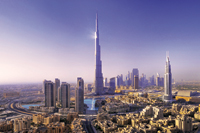
Downtown Dubai ... a focus area for new development.
Dreaming big again
New mega projects and the revival of stalled ones are signs of a reawakening Dubai that is aiming to reach for the stars once again, writes MRIDULA BHATTACHARYA.
01 April 2013
AFTER a slowdown triggered by the global financial crisis, the construction sector in Dubai is set to grow again on the back of the some mega project announcements and the revival of developments shelved in the early days of the crisis.
Two massive projects announced recently include the Mohammed Bin Rashid City, which will include the world’s biggest shopping mall, sprawling parks and more than a hundred hotels and the Dh6-billion ($1.63 billion) mixed-use Bluewaters Island.
Other key announcements included Al Barari’s new phase at its sprawling development, a $1-billion replica of the Taj Mahal at the Falcon City of Wonders, Madinat Jumeirah expansion and luxury schemes from Damac Properties.
Dubai also witnessed the re-launch of projects such as the Business Bay Canal expansion, shelved during the crisis.
Dubai’s Expo 2020 bid has raised expectations in the market and if the bid goes in its favour, the emirate will see some major developments – including the development of Dubai World Trade Centre (DTC)-Jebel Ali, the proposed site for the event.
In addition, in its quest to become an international investment hub, Dubai has pushed forward major infrastructure projects like the $7.8-billion expansion of Dubai International Airport. Dubai’s metro is also set for major expansion.
Industry players as well as markets observers have confirmed that the market is moving towards stability. In a recent newspaper report, Chris Seymour, head of property for the UAE at EC Harris, was quoted as saying that after the highs and lows of recent years the construction market was now more stable.
“High-quality, well-designed and well-located developments remain in demand and the focus is increasingly on revenue-generating developments,” he said.
According to the leading property developer Damac Properties, while the market is showing strong signs of recovery, availability of resources is a key challenge facing the industry. “As confidence in the market strengthens, more liquidity will flow and ensure that projects are developed, completed and handed over in good time. It is the consistent flow of investment which ensures a solid, stable growth pattern within the market. We are now in a cycle of sustained growth, which will continue,” said Ziad Al Chaar, managing director of Damac Properties.
A Cluttons report titled the Middle East Private Capital Survey indicates that nearly 80 per cent of high-net-worth investors are likely to make an investment in Dubai during 2013, with interest being primarily in residential real estate and hotel and leisure developments.
Dubai airport
Dubai continues to push ahead with its ambitions to be a global aviation hub with the focus currently on expanding the Dubai International Airport. Work on the airport’s Concourse D is gearing towards completion in 2015. The new facility, which will house all gates and extensive commercial outlets, will be linked to Terminal One via a new elevated train.
Meanwhile, Terminal One is set to undergo a major refurbishment as part of the next phase in the airport’s ongoing expansion to increase its capacity to 90 million passengers by 2018. Due to be launched in the first half of 2013, the refurbishment work will see all check-in desks replaced, baggage systems upgraded and public areas modernised.
The brand new Concourse A development was launched recently and has boosted the airport’s capacity from 60 million to 75 million passengers. This year the airport is expecting the passenger numbers to touch 66 million.
RTA projects
Dubai’s rail network is also set for a massive expansion involving extending both the Red and Green lines, and addition of new lines with connections to the proposed Etihad Rail network.
Land has been procured for widening the existing network and new rail routes and infrastructure are expected to be completed by 2030 in three phases. They will cover 421 km with 197 stations, according to Dubai’s Roads and Transport Authority (RTA).
Three new metro lines – Gold, Blue and Purple – and a Jumeirah tram route will be up and running by 2030. Besides these, the current Red and Green lines will grow longer.
In the first phase, train projects along a 24.1-km-long corridor with 12 stations will be completed, extending Dubai’s train network to 109 km with 70 stations. Work on the second phase covering 91 km and 58 stations is estimated to cost Dh45 billion ($12.25 billion).
 |
|
The Crystal Towers in Dubai Marina ... Turkish design. |
Meanwhile, work on the Al Sufouh Tram project is already halfway through with the first vehicle set to arrive in Dubai by December. The project, which is being constructed by Alstom-Besix Consortium, extends 14.6 km alongside Al Sofouh Road, and the initial phase envisages the construction of a 10.6-km-long track to be completed in the last quarter of 2014. The tram network comprises 17 passenger stations, 11 of which are covered under Phase One, while the fleet comprises eight trams in the initial phase, with 17 trams to be added in Phase Two. The tram is expected to lift about 3,500 passengers per hour per direction in the initial phase, which will rise to around 5,200 passengers in Phase Two.
One of the key infrastructure projects to be relaunched recently is the Business Bay Canal, which aims to link the Dubai Creek extension to the Arabian Gulf through Jumeirah. RTA is expected to begin work shortly and the project is expected to be completed in two years.
About 12.8-km long, the canal will be between 80 and 100 m wide to promote marine and tourist mass transit. Bridges up to 8.5 m high will be constructed over the canal on the key roads intersecting it. Some 10 km of the canal extension work have already been completed.
The canal will feature facilities for tourists and sports enthusiasts and is expected to include a host of new hotels, restaurants and canal-view residences on either side.
Meanwhile, the RTA is currently involved with the construction of a number of projects, including interchanges on key roads to curb congestion and pedestrian bridges in various locations across the city.
One such project is the Rashid Hospital Tunnels which, upon completion, will boost the capacity of roads within its scope to as much as 6,000 vehicles per hour. The Dh722-million ($196.6 million) scheme is expected to be opened for traffic by June.
Another major project under way is the Trade Centre Bridges at Zabeel, set for completion by the year-end. Part of the Parallel Roads development, the project comprises the construction of 22 precast concrete slab bridges extending 4,250 m with a capacity of two lanes in each direction, in addition to a 120-m-long concrete bridge to serve the traffic heading towards Al Maktoum Bridge.
The Dh719.37-million ($195.9 million) project is the largest phase of the Parallel Roads development, a massive road project being undertaken by the RTA to link the Western Parallel Road with the Sheikh Rashid bin Saeed Road and passing by the World Trade Centre.
Key phases of the Parallel Roads Project have been completed, including the initial phase which covered the construction of roads at Al Barsha and Al Qouz industrial and residential areas. Work is now under way on the completion of Phase III (A) – extending 10 km – in the area between Jumeirah Lakes Towers, linking property developments of Emaar and Nakheel in the area to the south of the Sheikh Zayed Road between Interchanges 5 and 5.5. Work is also progressing on Phase Four – covering a 22-km stretch – which serves Jebel Ali Free Zone, Al Maktoum Airport and the industrial area.
Residential & commercial
The Bluewaters Island development, a new island project featuring the world’s largest ferris wheel at its centre, is probably the most stunning project announcements for this year. Destined to be one of the largest tourist hot spots in the world, the project will be developed by state-owned Meraas Holding and will be located off the Jumeirah Beach Residence (JBR) coastline.
The 210-m-high ferris wheel, the Dubai Eye as it is known, will be a major component of the development which will also feature retail, residential, hospitality and entertainment zones. South Korea’s Hyundai Contracting and Starneth Engineering – whose engineers helped build the London Eye – have been appointed primary contractors for the design and construction of the Dubai Eye.
Another development targeting the tourism sector is Marvel Adventure, a major new indoor family entertainment centre launched in City of Arabia by the IMG Group in coordination with the US’ Marvel Entertainment. The 350,000-sq-ft Marvel centre, which is due to open by the end of 2013, will include retail outlets, dining facilities and interactive entertainment experiences featuring Marvel characters.
Another mega project, which is being positioned as a wedding destination, is the $1-billion Taj Arabia complex, a replica of India’s Taj Mahal, one of the seven wonders of the world. Part of the 3.7-million-sq-m Falcon City of Wonders, the project will be four times bigger than the 17th century original. It will comprise a five-star hotel with 300 rooms flanked by seven mixed-use buildings, including 200 serviced apartments and is expected to be completed by late 2014.
Apart from the Taj Mahal, Falcon City of Wonders is designed to feature several other recreated icons of architecture from around the world such as the Egyptian pyramids, the Eiffel Tower, Great Wall of China and the Leaning Tower of Pisa.
Among other developments, a Dh3-billion ($816.8 million) facelift is on the cards for Deira Suq area. The landmark development, which will have a soaring skyscraper as its centrepiece, calls for the construction of six hotels, residential and trade towers, a yachting marina, cargo storage areas and car-parks. The two-phased project is to be carried out by the Dubai Government Investments Establishment.
Meanwhile, the focus seems to be back on luxury projects that aim to provide investors with a competitive edge in the market. For instance, private luxury developer Damac Properties has this year launched the $1-billion Damac Towers by Paramount, which will boast the first Paramount-branded hotel in the Middle East, and Damac Residenze in Dubai, which will offer an opulent lifestyle, in conjunction with the Italian fashion house Fendi (see Page 65).
Damac Towers by Paramount is set to take shape in Downtown Dubai, Emaar Properties’ flagship 500-acre mixed-use which has become a magnet for investors. Emaar is currently developing a number of projects in this district, namely The Address Residence Sky View, The Address The BLVD, and The Address Residence Fountain Views I and II.
Dubai’s luxury hospitality company Jumeirah Group has launched the fourth phase of its Dh2.5-billion ($680.4 million) Madinat Jumeirah expansion project, which will feature a five-star hotel comprising 420 rooms, a villas complex, restaurants and a commercial centre.
In the luxury residential segment, Meydan and G&Co have launched Millennium Estates which is set to occupy Meydan’s South Extension. Work on the development has commenced and completion is scheduled for late 2015. The Dh1.2-billion ($326.7 million)-gated community will comprise 198 luxury villas built over 3.8 million sq ft of land and will be available on a freehold basis.
Nakheel has launched a new beachfront residential and recreation project on The Palm Jumeirah, known as Club Vista Mare, which comprises 33 studio apartments as well as eight cafes and restaurants, retail areas and gymnasium. Another project that the property developer is building at The Palm Jumeirah is the Dh2.5-billion ($680.5 million) Nakheel Mall, covering over one million sq ft, work on which is expects to start this year.
The luxury hotel chain Sofitel will also see its brand represented at The Palm Jumeirah, with the opening later this year of a luxury Polynesian-themed resort boasting 361 rooms and 182 serviced residences, along a stretch of private beach. The hotel is one of two Sofitel hotels slated to open in Dubai this year, the other being the Sofitel Downtown, which will have 350 rooms and suites, 12 meeting rooms accommodated in a 31-storey tower located in close proximity to Burj Khalifa and the Dubai International Financial Centre.
Meanwhile, a number of striking mixed-use projects are coming up in select locations such as Dubai Marina and Sheikh Zayed Road. Al Fattan Properties is developing a two-tower project in Dubai Marina, known as the Crystal Towers. Designed by the Turkey-based architecture firm Tabanlioglu Architects, the development will house a hotel operated by the Turkish Rixos Group, apartments and retail facilities.
And on Sheikh Zayed Road, work is being fast-tracked for a year-end completion on the three-tower Burj Al Salam complex. Rising to 54 storeys, it will comprise a hotel, offices and apartments (see Page 61).
- Dreaming big again
- Dubai Project at a glance
- Three in one
- Luxury living
- Community spirit
- Paschal optimistic on outlook for Dubai
- Sigma completes delivery on al faLah project
- Manitowoc builds on vast experience
- Taste grows for SieMatic kitchens
- Mac Al Gurg upbeat on business this year
- Iconic projects boost Alubond’s portfolio
