

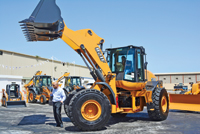
Customer day ... Ilhan briefing the audience about the Case 821 wheel loader in Bahrain.
CNH targets Gulf to raise profile
Case Construction and New Holland is building customer confidence through product shows throughout the GCC.
01 April 2013
THE impressive 580T backhoe loader and the radically redesigned 821 wheel loader were among a host of innovative workhorses put to the test in a series of product shows held in the Gulf by global construction machinery manufacturer giant CNH (Case Construction and New Holland). The events provided customers and guests a valuable insight into the latest technologies offered by key brands under the CNH banner.
The road show covered key cities in the Gulf during February and March, kicking off with customer days held by Arabian Auto Agency, the dealer for New Holland equipment in Saudi Arabia, in Riyadh (February 17) and Dammam (February 18), through to Muscat, Oman, with an event at the facility of International Heavy Equipment, the dealer for Case equipment in Muscat. These were followed by a customer day on February 28 in the UAE capital Abu Dhabi with Al Shirawi Enterprises (Case dealer), then in Bahrain with Nass Commercial (Case dealer) on March 14 and finally with United Al Saqer Group, the Abu Dhabi-based dealer for New Holland on March 17.
 |
|
The skid steer (above) and backhoe (below) loaders were among the models at the demos in Abu Dhabi and Dammam. |
In addition, Roots Group Arabia opened the first showroom of Case Construction in Riyadh last month (see Regional News).
Elaborating on the features of the loaders, Haken Ilhan, director of marketing for CNH in the Middle East and Turkey, says the benefits of a radical bottom-up approach to design can be seen in the Case 821 wheel loader which was put through its paces in the Gulf.
“In this innovative design, the engine is positioned to the rear of the machine over the back axle, with the radiator and cooling system sandwiched between the cab and the engine block in the mid-section of the vehicle. The engine acts as a counterbalance for the machine, lowering the overall machine weight by almost two tonnes compared to its direct competitor,” he says.
 |
The new design delivers improved cooling, a more stable and comfortable ride and – key for contractors – lower running costs not only on fuel but on general wear and tear on parts such as tyres and brake linings.
Similar attention to detail in design can be seen in the Case 580T backhoe loader, he says where the excavator arm is a full 650 kg lighter than that of its closest competitor. “That is 650 kg less load to be transported when the machine is moved from site to site but, more importantly, is 650 kg less load on the arm itself, giving the 580T better reach and breakout force for the same engine power as was proven (during the demo) when the 850T easily lifted a 450 kg deadweight with the excavator arm fully extended,” Ilhan explains.
Indeed the improved performance of the Case range comes across the board with a few radical changes – such as the excavator arm design of the 850T and the engine placement of 821 – coupled with smaller but similarly effective tweaks such as the blow-back facility to clean the air filter on the 821.
 |
In addition to these machines, the line-up at the open customer days featured the full range of Case skid-steers, graders and telehandlers with their various attachments, and the undoubted star of the show the CX 210 hydraulic excavator, which appeared along with its big brother, the 70-tonne C370 excavator, and the graders which come in 140 HP, 170 HP and 200 HP versions, complete with rippers.
The goal behind staging such events, according to CNH, is to target bigger market shares and assure clients of comprehensive after-sales services.
Commenting on the customer days, M Anil Tanca, Middle East marketing manager, who had flown in from Turkey for the events, says: “The aim of the open day event is to bring together our existing customers and attract new customers and show them that we are active in the market. We mean to show that we don’t forget our customers after we sell them our machines. We have our warehouse, workshop right here.”
“These are really good products. Our excavator has won the best design award in Japan. We are in some aspects better than our competitors. Our machines give our customers better value for money,” he adds.
Ilhan is keen to impress on local decision-makers just how big the Case brand is in world terms – its 170-year heritage, its financial strength as part of the €30-billion ($38.8 billion) Fiat Industrial Group and the breadth of its range of high-quality machines for the construction, agriculture and materials handling sectors in the Middle East.
“We are the third biggest equipment supplier in the capital sector (engines, tractors, buses, trucks and contracting equipment) after Cat and Volvo,” Ilhan explains. “Now it is time our brands reflect that strength.”
According to Ilhan, there are four key elements to Case’s “essential DNA” – productivity, fuel efficiency, serviceability, operator comfort.
Productivity stems from Case’s innovative design features and exceptional engines as exemplified by the machines on show. By carefully designing the individual elements of each machine for maximum efficiency and smoothness of operation, the whole package easily exceeds the sum of its parts resulting in better cycle times and productivity saving costs.
Fuel efficiency is the second strand in Case’s DNA, and a significant factor in the selection and operation of construction equipment, Ilhan points out.
Environmental concerns are also a major selling point, particularly in North America and Europe. “We are designing the products to be as green as possible – for example, Case is the only manufacturer approved for use in the UK’s environmental protection department,” he says.
The third and possibly most crucial strand of Case’s DNA, given the harsh operating conditions in the region, is serviceability, and Ilhan explains why is this is important. “If it is easy to service then people will do it; if it is not easy then people will not. It is as simple as that. The quality and second-hand value of the machine will only stay high if it is easy to service.”
This commitment to ease of service runs throughout the range of Case machines and becomes obvious even with the most casual inspection as all of the major greasing points and service panels are easily located and accessed.
The final strand of Case’s DNA is operator comfort with an emphasis on more comfortable and spacious cabins than its competitors and much improved visibility, particularly rearward. “We have much more glass than the others,” Ilhan explains. “This means better visibility for safety particularly when you are looking behind. We have more space as well and getting in and out of the machine is much easier. If the operating environment is more comfortable the operator will work better. You get better productivity and it’s more money in the customer’s pocket.”
Case was founded in 1842 and has evolved over the years through joint ventures and partnerships. The company reached a major milestone in 2005 when it rolled out its 500,000th backhoe loader.
“Actually, Case is the company that invented the backhoe and gave 100 per cent warranty on the machine,” says Tanca. It also produced its 200,000th skid-steer loader a few years ago.
Case’s skid-steers are manufactured in the US, backhoes in Italy, graders in Brazil and wheel loaders in the US. The company holds around 25 per cent market share in the US and is doing well in Europe as well. In the Middle East, it is trying to increase its market share by tying up with strong corporations. It is targeting an overall market share of 10 to 12 per cent in the GCC in the next 10 years.
Tanca says the response to the other shows held Saudi Arabia, Oman, Abu Dhabi and Dubai has been good.
“We want to gain people’s confidence with these shows. There will be more of these shows throughout the region. Our partners tell us that we are close to finalising many deals,” he says.
Another product show in Bahrain will be held in the second half of the year. About Bahrain, Tanca says: “Bahrain might be a small market but at Case we don’t differentiate between markets. Each one is as important as the other. Actually, when the market is smaller, you sometimes have an advantage of acquiring a better market share. Our products really fit the market here. The skid-steer and backhoe loaders, and telehandlers are the main products for the Bahrain market.”
Tanca adds: “We tell customers that they are investing in a company that has annual revenues (for 2012) of €30 billion ($38.8 billion). It is part of Fiat Industrial group, which is the third largest goods manufacturer in the world.”
Ilhan continues: “Our main focus is retail which is why we are here for the open day, showing all of the good things (we have); to give confidence to our dealers but, most importantly, to the end-user that they are investing in a product that is going to last and is part of a 170-year-old heritage and is part of a huge organisation that’s going to continue to service them with after-sales service and parts.”
While acknowledging that every machine can breakdown, Tanca says what is important is the response time. “Downtime is very important for the client and we realise that. Case gives all kinds of support to the dealer. In addition, people from Case visit dealers every month to give service managers here every support.”
According to Ilhan, the company has spent some $140 million on R&D (research and development) alone in the past few years.
About the company’s vision for Middle East, he says: “We are trying to achieve a full line of construction and earthmoving equipment supplied through a network of distributors, who know the value of aftercare and have the capability of reflecting our core values of productivity, efficiency, serviceability and operator comfort.”
- CNH targets Gulf to raise profile
- Doosan adds muscle to wheel loader range
- Bobcat unveils six new-gen skid-steer models
