

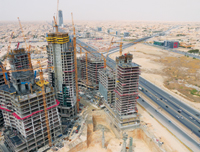
King Abdullah Financial District ... key source of business opportunities.
Housing hope
With the waiting list for homes growing longer by the day, Saudi Arabia is spending huge amounts of money to alleviate its housing crunch.
01 May 2013
REAL estate development and social housing will be among the prime drivers of the construction industry in the medium term with the private sector bolstering government efforts to tackle Saudi Arabia’s huge housing shortage.
In addition, the kingdom has set its largest budget to date to address the nation’s key infrastructural requirements and over the past year has issued key contracts in the transportation, social housing, oil, power and manufacturing sectors, which are providing a key source of business for the upbeat construction sector.
However, delays in executing a massive housing programme involving an investment of a whopping SR250 billion ($66.65 billion) to construct 500,000 homes over a number of years have been a cause for concern and have been blamed on a shortage of urban land. These concerns will now be addressed, following a royal decree issued last month that has shaken up the way in which the government allocates land. The housing programme – announced by King Abdullah in March 2011 – could now be put on track by opening up thousands of acres of state-owned land for construction.
Other strategic initiatives such as the Real Estate Development Fund (REDF) allowing banks to offer bridge financing and the newly-passed mortgage law will stimulate the real estate sector.
Some 2.4 million housing units are expected to be built in Saudi Arabia during the next 10 years at an estimated cost of SR1.3 trillion ($346 billion), according to a National Commercial Bank (NCB) report on the kingdom’s housing sector. The country’s housing stock was 4.6 million units in 2010 and annual demand is expected to rise from 195,000 in 2011 to 264,000 units by 2020, driven by a growing population entering the marriageable age, an expanding labour force and a rising income per capita, the report said.
The lack of affordable housing continues to be challenge in Saudi Arabia, where nearly 60 per cent of the population lives in rented accommodation. A number of real estate developers, such as Maban Real Estate Investment (see Page 151), Maskan Arabia (Page 123), Injaz Development Company (Page 129) and Nesaj (Page 156), have recognised this gap in the market and have joined initiatives to meet the demand in the mid-segment of the housing market.
Meanwhile, the government has launched a number of housing projects in various parts of the country. For instance, the Ministry of Housing last month launched a 7,000-unit housing project in Riyadh, while a 5,000-unit first phase of the Salman Bay project was earlier unveiled in Jeddah. The Riyadh project, to be built by a local company under a SR1.06 billion ($283.4 million) contract, will also comprise 24 schools and 24 kindergartens, among other amenities.
The Salman Bay housing project will eventually have 25,000 housing units in 1,250 residential buildings, 24 mosques, 14 schools, a hospital and two polyclinics. The first phase of the project is estimated to cost more than SR1.5 billion ($400 million).
Apart from housing, the focus has been on improving education, healthcare and social services and basic infrastructure in line with the king’s efforts ensure the well-being of his citizens, particularly in the wake of the Arab Spring that toppled regimes in Tunisia and Egypt.
Last year, infrastructure contracts topped SR235.1 billion ($62 billion), reflecting the construction industry’s continued vibrancy and its foundation as a fundamental building block of the economy, despite a 13 per cent decline compared to 2011’s SR270 billion ($72 billion), according to the NCB Construction Contracts Index (CCI) for Q4 2012.
The CCI hit 264.26 points at the end of the fourth quarter, when the value of awarded contracts rebounded strongly to reach SR69.1 billion ($18 billion) following a relatively weak third quarter.
Although the value of awarded contracts dipped compared to 2011, several sectors witnessed unprecedented capital spending compared to previous years such as power (SR47 billion – $12 billion), petrochemicals (SR47 billion – $12 billion), healthcare (SR14 billion – $3.7 billion) and roads (SR17 billion – $4.53 billion).
The education, health, municipality, transportation and water sectors witnessed a significant increase in expenditures in 2012 to reach SR60 billion ($16 billion) and this trend is expected to continue this year. On the anvil are plans to construct 539 new schools, 19 new hospitals and 3,700 km for new roads across the country, among a range of other facilities. Furthermore, anchor sectors like power, petrochemical, industrial and oil and gas are expected to build upon their impressive performances during 2012, the bank report states.
BUDGET
Infrastructural spending is expected to receive a major boost this year through allocations made in the 2013 budget as well as additional funds allocated from the budget surplus of 2012.
The country, which has unveiled its largest budget in its history, projects revenues at SR829 billion ($221.02 billion) and expenditure at SR820 billion ($218.62 billion) – 18.8 per cent higher than the budget figure for 2012 – implying a surplus of SR9 billion ($2.4 billion) for the year, but lower than the budgeted surplus of SR12 billion ($3.2 billion) for 2012.
In addition, transport infrastructure projects in major cities across the kingdom will be allocated SR200 billion ($53.32 billion) from the budget surplus of 2012, according to Finance Minister Ibrahim Al Assaf.
With this allocation, the kingdom’s total spending in 2013 will rise to more than SR1 trillion ($266.6 billion).
In line with its commitment to invest in human capital, the government is focusing on improving education, healthcare and social services and basic infrastructure, says the Global Investment House’s report on the Saudi budget for 2013.
The Kuwaiti investment company indicates that the education sector will enjoy about a quarter of the total budgetary allocation at about SR204 billion ($54.4 billion) – 21 per cent higher than the figure for 2012. The projects include construction of 539 new schools and expansion of others; upgrade of 2,000 school buildings; and improving safety measures. Furthermore, Saudi Arabia plans to open 15 colleges, construct three university hospitals and technical colleges as well as housing facilities for faculty members of newly-formed universities.
The health and social affairs sector has been allocated SR100 billion ($26.66 billion), up 16 per cent for 2012, with plans including the construction of primary care centres and 19 new hospitals. In addition, the government intends to build stadiums and sports facilities in 22 towns; 15 social welfare centres; and labour offices.
Some SR36 billion ($9.6 billion) will go into projects of the municipality services sector, a 23 per cent increase over that in 2012. The projects include construction of bridges; inter-city roads; drainage systems; and public transport in Riyadh and Makkah.
A sum of SR65 billion ($17.33 billion) has been earmarked for the infrastructure and transportation sector, up 16 per cent over that in 2012. This includes SR30 billion ($8 billion) investment for the development of 3,700 km of roads; modernisation of ports; construction of regional and international airports, and berths; and infrastructure projects in Yanbu, Jubail and Ras Al Khair.
Saudi Arabia intends to modernise public transport systems in major cities such as Riyadh, Jeddah, Dammam and Makkah, including a planned mass transit system in Jeddah and Makkah. A metro project has also been planned for Riyadh.
The country’s aviation sector is also being upgraded, with the $7-billion King Abdul Aziz International Airport expansion under way, upgrade of the Madinah airport into an international facility, expansion of King Khalid International Airport in Riyadh, and plans for three new domestic airports in Jazan, Abha and Qassim.
The water, agriculture, industry, and other economic resources will receive SR57 billion ($15.3 billion), up 11 per cent over that in 2012, to be spent on projects that will boost water resources through desalination, construction of dams, and improvement of water and water treatment services.
KEY PROJECTS
While social housing and major infrastructural projects have been in the limelight in the recent past, the kingdom’s iconic developments such as the SR75 billion ($20-billion) Kingdom City and its centrepiece Kingdom Tower in Jeddah, have been making progress this year with key contract awards. Kingdom Holding Company (KHC) has appointed Calthrope Associates as the lead masterplanner for the Kingdom City and has also named Godwin Austen Johnson (GAJ) as urban architects for the project. A joint venture team of EC Harris and Mace has also been selected to project manage the SR4.6-billion ($1.25 billion) Kingdom Tower, which is designed to be the world’s tallest building at over 1,000 m in height.
Meanwhile, work is being fast-tracked on the prestigious King Abdullah Sports City project in Jeddah to enable its completion a year ahead of schedule, in line with a royal decree to complete it this November (see Page 114).
In Riyadh, work on several packages of the landmark King Abdullah Financial District is under way with more than 45 buildings as well as infrastructure work in progress on site. The SR28 billion ($10 billion) project will transform a vacant 160-hectare site in the northeast of the capital into a nucleus of world-class institutions, residential and recreational areas, hotels and civic amenities befitting the financial hub of the economic powerhouse of the region (see Page 108).
Also in Riyadh, the 308-m Burj Rafal, which stakes claim to being the tallest residential tower in the capital – is now receiving its finishing touches (see Page 119).
Makkah and Madinah continue to be hives of construction activity to enable them to cater to the surging number of pilgrims which is projected to rise to 17 million by 2025. Key developments that have made significant headway include the $29.1-billion Haramain High Speed Railway, the expansion of Islam’s holiest sites – the Grand Mosque in Makkah and the Prophet’s Mosque in Madinah – and numerous real estate projects such as the Jabal Omar development.
The ambitious Grand Mosque expansion, which will increase the mosque’s capacity to more than 2.5 million worshippers, is expected to cost SR80 billion ($23.5 billion), while the expansion of the Prophet’s Mosque will increase its capacity to more than 1.6 million worshippers, at an estimated cost more than SR75 billion ($20 billion).
OUTLOOK
According to the NCB, construction and manufacturing will continue to show robust growth this year, at 10.5 per cent and 8.5 per cent, respectively, supported by buoyancy in the projects’ market and strong business confidence. The awarded contracts in the manufacturing sector – excluding petrochemicals segment – reached SR17.8 billion ($4.75 billion) in 2012, the fourth largest share across all sectors, surpassed only by the oil, transportation and power sectors, with Ma’aden aluminium smelter awarding the highest contracts by value, the report added.
However, the bank said: “We are concerned about the recently-released report by the Saudi Control and Investigation Board (SCIB) that detailed 650 projects facing delays and that will need to be financed from excess surpluses of previous budgets.”
According to the bank’s Business Optimism Index (BOI), construction, trade and hospitality, and manufacturing are the sectors that are expected to expand further on the back of higher volume of sales and new orders.
“Optimism levels in the construction sector were the highest among all sectors, with 50 per cent of the firms planning to invest in business expansion. Obviously, approving the mortgage law back in July has impacted sentiments positively and will continue to do so as Sama (Saudi Arabian Monetary Agency) finalises the regulations on real estate financing and leasing along with supervisory guidelines,” says the NCB in its Saudi Economic Perspectives for 2013-14.
The world’s largest oil producer and exporter with substantial funds to drive its ambitions forward, Saudi Arabia has taken key initiatives to propel real estate growth and create investor confidence. What is now required is the drive to remove further obstacles and streamline process to prevent delays in projects and inject further dynamism into its construction sector.
Link for the Housing market size versus total population:
Link for the Incremental housing demand versus investment required:
Link for the NCB construction contracts index:
Link for the Value of contracts:
Link for the Value of awarded contract by year (SR millions):
- Housing hope
- Project at a glance
- Future of finance
- Seeking sustainability
- Signature sports city
- Luxury living
- Islamic inspiration
- Creating communities
- Classy compound
- In high demand
- Boosting capacity
- Proving its mettle
- Climbing up
- Innovative spirit
- Meeting market needs
- Gearing for growth
- Strong debut
- Concrete growth
- Huge expansion
- Cashing in on opportunity
- Decade of success
- Prestige orders won
- Spreading out
- Cool business
- Marketing push
- Proactive approach
- Expanding portfolio
- Building networks
