

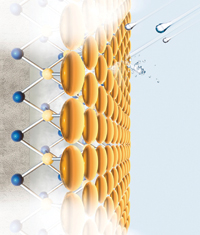
Wacker’s new Silres BS 1303 silicone resin ... stable long-lasting silicone network.
Wacker resin keeps surfaces crack-free
With its Silres BS 1303 resin emulsion, Wacker Chemie has sounded the end to the beading effect of exterior coatings giving a crack-free surface.
01 May 2013
GERMANY-based Wacker Chemie, a global leader in silicones, polymers and a range of high-growth end-user sectors, has expanded its portfolio with the addition of a new silicone resin emulsion that can be used for creating moderately hydrophobic surfaces, thus giving coating manufacturers considerably more flexibility when developing their formulations.
Known as Silres BS 1303, the silicone resin emulsion for exterior coatings was unveiled at the recent European Coatings Show 2013 held in Nuremberg, Germany, in March (19 to 21).
The new resin emulsion eliminates the pronounced beading effect that its counterparts produce and ensures good binding of the plaster, resulting in crack-free surfaces, according to Wacker.
Silicone resin emulsion is a key component in silicone resin emulsion paints (SREP) and plasters that are used as coatings for building facades that are water repellent yet permeable to water vapour, says a Wacker spokesman.
“The paints and renders used as exterior coatings perform more than just architectural styling – they also protect the building’s façade from the elements,” the spokesman points out. “The most important protective function of these materials is their ability to regulate the water balance. In this capacity, they act as a barrier to water seeping in from outside, yet permit water vapour to diffuse out, thus preventing moisture from building up behind the plaster.
“While silicone resin plasters and paints perfectly fulfil these requirements, they offer other benefits as well. They are distinguished, for instance, by the hydrophobic (that is, water-repellent) surfaces they produce.
“Their long life cycle is another advantage, as these paints and plasters typically do not need to be reapplied for roughly 20 to 25 years.”
These types of coating systems are based on a silicone resin and organic polymer binder system. The coating material is prepared using the two binders in liquid form: the silicone as an aqueous emulsion and the polymer as an aqueous dispersion. The chemical interactions between the polymer and the silicone resin keep water absorption low while allowing water vapour to pass through easily – a hallmark of all resin emulsion paints and plasters, he explains.
The relative amount of organic polymeric binder, for instance, must be kept low enough to prevent a closed polymer film forming upon drying. Otherwise, the film would seal the pores and prevent the coating from breathing. The polymer content must be high enough, however, for the pigment and filler granules to reliably bind to each other and to the substrate.
 |
Moderate beading effect
Until now, emulsions of methyl silicone resins were the only available raw materials for silicone resin emulsion paints and plasters. “In most cases, these emulsions produce a pronounced beading effect on the building’s surface. However, manufacturers hoping to achieve a less hydrophobic system – that is, one with less of a tendency to bead – need a different silicone resin, if they wish to prevent problems such as the formation of undesired condensation,” he states.
To meet this need, Wacker has added another binder to its masonry protection portfolio. This new binder is an aqueous, solvent-free emulsion of a silicone resin that has been used for the first time in this way for protecting masonry.
The product – Silres BS 1303 – is highly compatible with the polymer dispersions used and reduces beading on the coating, thus giving manufacturers considerably more flexibility for formulating exterior coating materials, the spokesman indicates.
“Because it is alkoxy functional, the silicone resin used in the new emulsion is capable of crosslinking,” he points out.
Upon application of the liquid or pasty coating material, the silicone resin immediately spreads over the surface of the pigment and filler granules, completely enveloping them and forming an extraordinarily stable network in the process – one that strengthens and hydrophobises the pores at the same time.
“The open pores of this network are responsible for the long-lasting hydrophobic properties of the coating, which protects the substrate from water and moisture like an umbrella.”
The moderate surface hydrophobicity of Silres BS 1303 offers other advantages as well: it can help reduce the effects of condensation water, which has a tendency to form in moist, shaded areas on the north faces of buildings, where highly effective thermal insulation is used. In microclimates such as these, the tiny, virtually spherical droplets take a very long time to evaporate.
“Thanks to its moderate surface hydrophobicity, Silres BS 1303 can counteract this phenomenon by causing condensation droplets to spread out more, which allows them to wet the paint layer more thoroughly and thus evaporate more quickly,” he adds.
Surfaces with no pinholes
Silicone producers can select from various organic groups in order to influence both the hydrophobising effects of the product and the compatibility between the silicone resin and the organic polymer. Organic components account for only 11 per cent of a methyl silicone resin, and the chemical counterpart to the organic polymer binder is present at a similar level. In this kind of resin, the methyl groups provide suitable protection from water, forming a tightly clustered group of hydrophobic molecular shields surrounding the pigment and filler granules.
Silres BS 1303, by contrast, is a new functional alkoxy silicone resin with an improved compatibility to organic dispersions, which moderates the hydrophobising effects of the product. This is not a disadvantage, however, since by using Silres BS 1303, manufacturers can produce exterior paints that are just as water repellent and breathable as traditional silicone resin emulsion paints, he says.
“Depending on the formulation, an effect known as pinholing can occur in coarse-grained silicone resin plasters with close-grained structures. This phenomenon, in which small depressions and holes the size of pin heads penetrate down to the substrate, occurs during the setting process when the plaster shrinks upon drying.
“While irregularities such as these are not critical (provided no cracks form), they do, however, mar the appearance of the building’s façade. Customers wanting to play it safe can use Silres BS 1303 to ensure good binding of the plaster, resulting in crack-free surfaces,” the spokesman says.
Thanks to Silres BS 1303, exterior coating developers now have a silicone resin emulsion with moderately hydrophobic properties. This solvent-free emulsion can either be used as an additive for silicone resin plasters or as a binder for silicone resin emulsion paints.
In addition to being water repellent and permeable to water vapour, coating systems formulated with Silres BS 1303 also form crack-free surfaces and prevent the harmful effects of condensation water.
Wacker’s line of silicone resins ranges from moderately to extremely hydrophobic products. Silres BS 1303 complements this product line, offering paint manufacturers entirely new possibilities for tailoring silicone resin emulsion paints and plasters to specific application conditions, the spokesman says.
“Silicone resin emulsion paints have outstanding properties, including high water-vapour permeability along with extremely low water uptake. They guarantee exceptionally high resistance against weathering and environmental influences.
“Thanks to their exceptional durability, they are by far the most economical solution for long-term façade protection,” the spokesman says. “All this is made possible by the use of silicone resin as binder – an invention for which Wacker researchers filed a patent in 1963, exactly 50 years ago. Their discovery paved the way for the development of innovative silicone resin emulsion paints, which provide building facades with reliable and long-lasting protection against the effects of moisture and weathering.”
Since then, Wacker has forged ahead with the development of these products and is now the largest manufacturer of silicone resin binders and additives for facade paints. The chemical company, headquartered in Munich, supplies an extensive portfolio of Silres BS building protection products based on water-repellent silanes, silicone fluids, silicone resins and aqueous silicone emulsions.
The main aim of all these products is to make facade paints and construction materials water repellent, protecting them from moisture and thus from long-term damage.
