

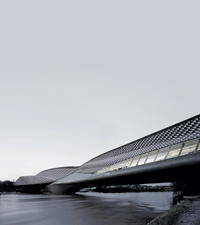
Zaragoza Bridge Pavilion ... 29,000 triangles made of fibreC in different shades of grey.
Rieder rides high with new concepts
The innovative fibreC 3D by Rieder Smart Elements can give shape to any ambitious design, giving architects the freedom they want and allowing the creation of engineering wonders.
01 May 2013
RIEDER Smart Elements continues to expand its range of customised concrete-based facade solutions to meet today’s architectural demands to create facades with complex geometries and construct sustainable buildings.
Among the latest innovations from the Austria-based company is fibreC 3D, which are three-dimensional mould elements made of glassfibre reinforced concrete (GRC) that make facades with ambitious geometric forms possible. This follows the recent development of conveniently-sized, easy-to-handle GRC slats known as Öko Skin and the internationally successful large-format fibreC panels.
Rieder unveiled its fibreC 3D production technology at Bau, a leading trade fair for architecture, materials and systems held in Munich, Germany, in January this year. Based on the newly developed manufacturing technology, fibreC 3D elements can be produced in fair-faced concrete on both sides, providing architects with even more design freedom. As the mould elements can be combined with Rieder’s fibreC facade panels, they represent an economical solution for one-of-a-kind facades.
Elaborating on the new fibreC 3D, a spokesman for the company says: “A special manufacturing technology permits the production of fibreC 3D elements in customised shapes and dimensions with a monolithic appearance. The components are poured at one time so that no layers are visible. The modular moulds are adapted to the architect’s respective design. By filling the mould with self-compacting concrete (SCC) with fibre reinforcement, individual dimensions and complex forms can be produced to meet project requirements. The colour and surface textures are also variable.
“In addition to two-sided fair-faced concrete, relief concrete can also be produced by using form liners. The characteristic concrete appearance of the 3D elements blends with the extruded fibreC panels. This combination offers architects and builders an economical solution for the entire facade. An intelligent fastening system means that hidden fastening anchors can even be integrated during production.”
Meanwhile, Rieder’s fibreC large-format facade panels are 13 mm thin and give architects plenty of scope in the design of individual facades. The format can be customised up to a maximum size of 1.2 by 3.6 m.
 |
|
Hotel Well in Terme Tuhelj, Croatia ... 5,000 sq m of fibreC terra with perforated elements. |
The panels are coloured throughout with natural colour pigments and are offered in 10 different colours and three different surface textures allowing the creative use of colours, textures and shapes in both outdoor and indoor applications.
As the material is deformable, fibreC panels can be shaped smoothly over corners and edges. The facade cladding is designed as curtain-type, rear-ventilated facade and is suitable for almost any type of building. The attractive properties of fibreC panels can be used to enhance the structural and economic benefits of rear-ventilated facades, the spokesman adds.
Another innovative Rieder product Öko Skin, which was introduced in 2009, comprises thin-walled and conveniently sized GRC slats with lengths of 1,800 mm available with widths of 147 mm and 302 mm. The slats, which are easy to install, can be cut to size and processed directly at the building site. Due to the robustness of concrete, the slats never have to be sanded nor need a fresh coat of paint to maintain their characteristic appearance, he says. Öko Skin can be installed with special screws and rivets that match the colour of the panels. Concrete slats with a width of 302 mm can also be installed as bevel siding.
The spokesman says the company uses state-of-the-art production technologies for a resource-saving and energy-efficient production of concrete elements.
“Catch phrases such as ‘energy turnaround’ and ‘sustainability’ are not just mere marketing trends for our traditional family-owned business, but a call for action,” says the spokesman. “Concrete is a natural product and Rieder sees it as such. Only natural raw materials are used for the production of fibreC to ensure the authenticity of this sustainable product.”
The company’s research and development department is dedicated to optimising production processes and products to ensure maximum environmental compatibility.
 |
|
FibreC elements at a private house ... in ivory and white. |
Due to the fibreC commitment to environmental protection, the use of high-grade raw materials consisting of purely mineral substances and glassfibres ensures optimum product quality. The use of purely mineral-based raw materials, natural stone components in combination with glassfibre elements build a unique material mix which is manufactured in an innovative production process in order to meet highest client expectations, the spokesman points out.
“As fibreC is based on purely organic substances, the material can be completely recycled. The product is listed in the GreenSpec directory as an environmentally preferable product.
“Therefore, fibreC can, for example, be evaluated for US Green Building Council’s (USGBC) Leed (Leadership in Energy and Environmental Design) credits,” says the spokesman.
Rieder had its quality management certified in accordance with DIN EN ISO 9001 in 1995. Since then, it has integrated safety, health and environment into the standardisation system and produces its products in accordance with the international environmental management standard DIN EN ISO 14001.
“In addition, the Environmental Product Declaration (EPD) awarded by the Institute for Construction and Environment (Institut Bauen und Umwelt) further confirms the sustainable character of the concrete products. It offers verifiable and internationally valid information about the environmental impact of a product. For this voluntary certification, Rieder has disclosed the entire lifecycle of its facade products, from raw material extraction and production to processing and recycling. For architects and building owners these key figures offer an ideal basis for product comparisons,” he says.
Rieder products have enhanced some of the striking landmarks worldwide. In 2008, the company supplied the concrete envelope of the Zaragoza Bridge Pavilion, designed by Zaha Hadid for the Expo 2008 in Spain – which focused on water and sustainable development. In 2010, fibreC contributed its expertise to the biggest football stadium in Africa – the Soccer City Stadium in Johannesburg, South Africa, which has a capacity for almost 97,000 spectators, built for the Fifa World Cup 2010 final.
At Rhine Harbour Cologne in Germany, there are three conspicuous buildings dubbed “crane houses” by the local population. Some 1,500 sq m of fibreC panels were needed to clad the facade of the third and most recent ‘crane’ building, which was finished in 2010. The 60-m-high building was designed by star architect Hadi Teherani.
The Main Point Karlin office building in Prague is adorned by 2,650 formed fibreC elements. The 10-storey building obtained Platinum, the highest level of certification in the Leed system. Main Point Karlin, with its organic curves and coloured fibreC facade elements, is already a dominant feature in the cityscape, he says.
Rieder Smart Elements is part of the Austrian Rieder Group, which specialises in the production of solution-oriented, environment-friendly and cost-effective concrete products. With five international production sites and 320 employees, Rieder Group manufactures and distributes innovative concrete products for infrastructure, structural engineering and architecture.
The company has been run as a 100-per cent family-owned business for more than 55 years and is a European leader in the fields of noise protection, traffic safety and architectural concrete, thanks to its focus on continuous innovation. Its GRC facades are distributed in 47 countries.
- Rieder rides high with new concepts
- Rainscreen ‘preferred choice’ for facades
- Mulk on flight path to success in India
- New Versatile series lives up to its name
- Dura Cladding ‘durable option to real wood’
- Exova boosts testing services in region
- PCT creates stunning landmarks in region
