

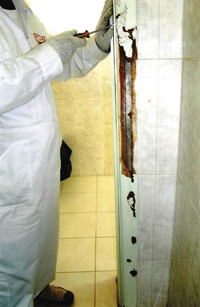
Inspection ... key to termite control measures.
Masa offers tips on protecting timber
MOHAMMAD ARIF HUSSAIN, entomologist and fumigation expert at Masa Establishment for Pest Extermination, Maintenance and Contracting, outlines the methods to protect timber resources from pests.
01 May 2013
TIMBER plays an important role in building construction in various applications in the form of windows, doors, furniture and components. Its high strength-to-weight ratio, ease of working with tools and machines, insulating properties, resistance to chemicals and inherent beauty make it a suitable material for use in the construction of buildings.
However, as part of the natural process that takes dead wood to the forest floor, timber falls prey to an array of organisms, the most damaging of which are termites. Beetles are the next most important group of pests and are of two kinds: those that reinfest the wood they have emerged from until it can no longer be used and must be replaced; and those that emerge from wood after it has been milled and installed.
Third in importance, depending upon geographical location, are bees, wasps, and ants, followed by fungi especially in areas that are warm and humid.
Termites
Subterranean termites are social insects that live in colonies and have a striking caste system. Termites are very significant pests, damaging wooden structures such as furniture, building materials, wooden floors, railways sleepers, wooden bridges, boats, books and trees.
Termite control measures include inspection, moisture management, selection of termiticides, and installation of physical barriers and termite baits. Simply put, a termite integrated pest management programme involves a group of techniques selected and applied according to the infestation or the structure to be treated.
Masa renders such termite management using integrated pest management (IPM) that is quality assured. Inspection for subterranean termites is an essential element in its management plan and is performed by specialised consultants to reach the correct diagnosis. These inspection reports include important aspects such as accurate graph measurement of the entire area, building sketch plan, dimension and layout. Along with an indication of the extent of termite damage, this plan should also pinpoint the location of electrical cables, water pipes, sewerage and water reservoir; the flow of water off the structure; and location of the air-conditioners and the areas that are prone to stay wet. The sources of food for termites such as mulch, wood-to-ground contacts, firewood, live trees, among other aspects, must also be mentioned in the inspection.
Moisture control is essential for the long-term management of the termites. It is important to know how water flows away from the building and the presence of any wells and water tanks – especially underground concrete ones. As a chronic moisture problem is a termite attractant, this problem must be tackled first. Food sources of the termites should be identified and removed, along with debris, wood, stumps, dead bushes and mulch.
A range of termicides are used in the treatment of pests. Masa selects termiticides on a scientific basis and has recently registered a new termiticide of a Neonicotinoid family, Raslan, with the Saudi pesticide regulatory authority. Raslan – which has an active ingredient Imidacloprid 30 per cent SC – is a systematic and contact insecticide that is ecologically friendly and has low toxicity in people and animals. This odourless product creates a non-detectable treated zone that functions not as repellent zone/barrier, but as a “killing field” whose effects may be transmissible to other termites and leads to contamination of the colony.
Termite control measures that can guarantee results include creating chemical barriers around and below the building. This can be accomplished by several ways like rodding, trenching, spraying, drilling, injecting and dusting. This soil treatment can be done at two stages:
• Pre-construction treatment, where the termiticide emulsion is applied during the early construction stages of a building starting with the foundation footing. This treatment depends on the type and composition of the structure to be built. This termite-proofing method guarantees a complete chemical barrier.
• Post-construction treatment, which is done in existing buildings, mainly by drilling, injection and patching. Sometimes trenching and rodding is also carried out with the focus being on attaining a continuous chemical barrier that will block termite entry. The main entry points of termite are foundations, expansion joints, perimeter walls, and cracks in flooring/foundation walls and footings.
The pre-construction treatment is more effective in controlling termites than the post construction treatment measure. Chemical barrier remains the standard method here and there is no single technique among the newly-developed ones that can claim to be a standalone method of termite control. All these new methods provide extra tools for integrated pest management.
Other types of termites include drywood and dampwood termites.
Drywood termites are difficult to detect and attack dry, non-decayed wood, including structural timber, dead limbs of native trees, furniture and lumber in storage. Seldom seen, they appear only during the period of swarming and live deep inside the wood. Unlike subterranean termites, drywood termites have a low moisture requirement and can tolerate dry conditions for prolonged periods. They remain entirely above ground and do not connect their nest to the soil. Piles of their faecal pellets, which are distinctive in appearance, may provide a clue of their presence.
All drywood termite control methods can be categorised as either whole-structure or localised (spot treatment). Whole-structure treatments have an advantage over spot treatments in that they can eliminate all infestations, even hidden ones. Given the uncertainty of current detection methods, particularly when drywall or other wall coverings conceal infestations, there is always some doubt as to the extent of the drywood termite colony boundaries within homes. Consequently one can never be sure that all infestations have been treated when applying spot treatments. Treatments for this pest include whole-structure applications of fumigants or heat and localised or spot treatments using chemicals or treatments that use heat, freezing, microwaves, or electricity. Techniques to prevent infestations of this species include the use of chemicals, pressure-treated wood, barriers, and resistant woods.
Dampwood termites only attack moist wood are frequently infest door frames of building baseboards, fence posts and fallen trees. They nest in wood buried in the ground, although contact with the ground is not necessary when infested wood is high in moisture. Because of their high moisture requirements, dampwood termites are commonly found in cool, humid areas along the coast and are typical pests of beach houses. Winged reproductives – sometimes called swarmers – typically swarm between July and October, but it is not unusual to see them at other times of the year.
Dampwood termites in structures cannot be adequately controlled by fumigation, heat treatment, freezing, or termite electrocution devices because the reproductives and nymphs are concentrated in nests near or below ground level in structures out of reach of these control methods. The primary methods of controlling these termites include the application of insecticides or baiting programmes. Use of termiticides or baits should be supplemented with the destruction of their nests and access points. If infestations are small, removing infested wood and excess moisture from wood will also destroy their nests.
Wood-boring beetles
Powderpost, death watch, and false powderpost beetles damage wood furniture as well as structural and decorative wood inside buildings. The beetle larvae do most of the damage to the wood and when they reach the adult stage, they emerge through round exit holes, which they create by chewing through the wood surface. Adults of some species also bore exit holes through plaster, plastic, and even soft metals that might cover the underlying wood.
The first step in managing wood-boring beetles is identifying the group involved in the problem. Detection can be difficult because much of their life cycle takes place beneath the wood surface and in hidden wood joints where a homeowner or inspector might not easily detect them. Wood-boring beetles are difficult to control once an infestation has begun. Therefore, prevention is the best management method.
Protective measures should be taken at every stage of lumber processing and handling including at lumber and plywood mills, lumber yards, furniture-manufacturing factories, and construction firms. Sanitation is the most important aspect of prevention. Dead tree limbs and scrap lumber around buildings or near any area where wood products are stored should be removed.
Masa, a pioneer in pest control management in Saudi Arabia, has a thorough knowledge of the way insects live as well as safety measures in controlling the insect pests. It has successfully treated and saved thousands of dwellings, buildings, artwork, museums, antiques, wooden frames and other similar materials made of wood. Its treatment methods are based on 33 years of dedicated service to the public and environment.
