

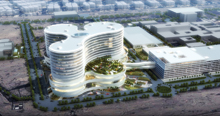
An artist’s impression of Al Adan Hospital expansion ... part of the ambitious Kuwait National Healthcare Development Plan.
High Hopes
While Kuwait’s drive to diversify its economy continues to make slow progress, there are some major developments planned or under way that promise to keep the market busy, writes DHUSHYANTHI RAVI.
01 December 2013
A LITTLE over three years ago, Kuwait unveiled an ambitious four-year development plan in which it aimed to spend billions of dollars on key infrastructure projects and reduce the nation’s dependence on oil revenues by encouraging private sector participation in the economy.
These included a new metro, railway and other mega projects such as Silk City, an urban area in Kuwait’s north, and the Subiya Causeway, a 36-km link between the southern port of Shuwaikh and the north of the country, all of which would have positioned Kuwait among the most lucrative construction markets in the world.
However, prolonged political wrangling and bureaucratic red tape have held up the vast majority of initiatives in the $105-billion plan announced back in 2010. A Business Monitor International (BMI) report points out that delays in key projects and claims of corruption are putting off foreign investors from investing in infrastructure projects in Kuwait, despite government’s support towards development projects.
With oil still accounting for nearly half of Kuwait’s gross domestic product (GDP) and 95 per cent of export revenues, energy and non-residential segments are seen as areas offering relatively better growth potential during the medium to long term, according to BMI’s Kuwait Infrastructure Report Q4 2013.
With energy schemes such as the $17-billion clean fuels project (CFP) – for which commercial bids are due this month – and the $14-billion refinery project planned for Al Zour as well as the much-awaited new $3.2-billion showpiece terminal at Kuwait International Airport expected to move ahead in the New Year, there are hopes for a revival in the country’s construction sector. Other major projects in the offing are the first public-private partnership, the $2.5 billion Al Zour North independent power and water project (IWPP) and the $1.5-billion Umm Al Hayman wastewater and treatment plant.
The CFP, which will reconfigure the country’s three refineries and the new 615,000 barrels per day (bpd) refinery project at Al Zour, will nearly double Kuwait’s total refining capacity to 1.4 million bpd. The country, meanwhile, intends to increase its crude output from 3 million bpd to 3.5 million bpd in 2015.
Other key areas of investment include roads and urban upgrade and hospital construction. One striking project in the roads sector is the KD507-million ($1.8 billion) Jahra Road and Jamal Abdul Nasser Street, a landmark project of its kind in the Middle East.
In the real estate sector, rising demand for residential units could see increased activity in the sector and this coupled with the fact that there is higher government spending on social housing could provide a boost to the construction industry.
Major infrastructure initiatives will be supported by the robust financial state of Kuwait, whose budget surplus of the fiscal year 2013-2014 ranges from KD12 billion to 14 billion ($42.37 billion to $49.44 billion), according to a report by KFH-Research, a subsidiary of Kuwait Finance House (KFH). The country has posted a budget surplus for the 13th consecutive year, said the report, adding however that the government should be cautious in matters of reducing spending, diversifying government income resources and increasing privatisation efforts.
According to a report issued by the National Bank of Kuwait (NBK) in early September, nominal gross domestic product (GDP) growth hit 16 per cent last year, mainly the result of a 19 per cent rise in the contribution from the energy sector.
Oil & Gas
The clean fuels project will take a step closer to realisation when a delayed tender is expected to be floated at the end of this month (December 24) for three engineering, procurement and construction (EPC) packages making up the project. The CFP involves a major revamp of the country’s three existing refineries to improve their efficiency and meet higher international fuel standards. The scheme involves upgrades and expansions of the Mina Al Ahmadi and Mina Abdullah refineries to increase their combined capacity to 800,000 bpd from the current 736,000 bpd. The Shuaiba refinery, which sits between the two, will be decommissioned as its rehabilitation has been deemed economically unfeasible.
Meanwhile, Kuwait’s total refining capacity will reach about 1.4 million bpd after completion of the planned Al Zour refinery project in 2019, said Hatem Al Awadi, the acting CEO of Kuwait National Petroleum Company (KNPC), adding that a tender has been issued for land reclamation work in connection with site preparation for the 615,000-bpd refinery project.
KNPC awarded a $528-million project management consultancy contract for Al Zour to the UK’s Amec in December 2012.
Kuwait’s plan to build what could be the largest refinery in the Middle East is years behind schedule due to parliamentary opposition to the project and frequent political upheavals in the country.
Airport
 |
|
The new terminal at Kuwait International Airport ... an artist’s impression. |
Tenders are expected to be announced shortly for Kuwait International Airport’s new terminal complex. The state-of-the-art passenger terminal building, Terminal Two, will comprise a basement, ground, and two floors supported by multi-storey car-parks with a minimum of 4,500 car spaces, taxiways and aprons adjacent to the terminal, 28 terminal gates including eight gates for the Airbus A380, and a transit hotel with a capacity for 400 beds, among other facilities.
The new terminal will be located south of the existing terminal between the two existing runways, but with all road and public transport links gained from the south via a new highway connecting to the Sabhan Road and the new seventh Ring Road.
The design is being undertaken by a consortium led by Foster + Partners in association with local consulting firm Gulf Consult. Other members of the design team include Arup of the UK, Netherlands Airports Company of the Netherlands, and Parsons Brinckerhoff of the UK. The expansion aims to boost the airport’s capacity to serve 25 million passengers per year by 2024, up from the current eight million passengers.
Roads & Railway
Kuwait is seeing the construction of one of the largest viaduct projects in the region involving a total of 16,091 segments. The two-package project includes the upgrade of the Jamal Abdul Nasser Street and the Jahra Road development at a total a cost of KD507 million ($1.8 billion). The ministry has employed the joint venture of Louis Berger Group and Pace to undertake the design and construction supervision of the projects, which are being implemented in five
phases.
Package Two of the project aims to transform the existing Jamal Abdul-Nasser Street into an international standard multi-
level expressway.
A major project on the drawing boards is a metro, involving a network extending 171 km and 60 stations on the four main lines that will cross Kuwait City. The study for the development of the first phase of the network is almost completed.
In addition, the Ministry of Communication intends to develop a railway system which will link Kuwait City to Kuwait airport, seaports, and other GCC countries. The Kuwait National Rail Road System will be an integrated rail network with 511 km of double-track to serve freight and passengers and will have a speed, ranging from 120 km per hour to 200 kmph. The project, which is expected to be implemented as a build, operate, and transfer (BOT) agreement, is currently in the feasibility study phase.
Hospitals
Hospital projects are a key focus in Kuwait’s infrastructure development plans with the country currently seeing the construction of its largest medical centre. The $304-million ($1.07 billion) Jaber Al Ahmad Al Jaber Al Sabah Hospital will provide 1,168 beds together with state-of-the-art medical services to a projected population of 600,000 in the South Surra area.
Civil works for the dental clinic building at Jaber Hospital is scheduled to be completed next April, while the outpatient building in expected to see completion in September 2014 and the remaining buildings by 2015.
Another key healthcare project is the KD98-million ($342.2 million) Al Amiri Hospital expansion, which involves the construction of a new tower, doubling the existing capacity by adding 460 beds, and a multi-storey car-park.
In addition, tenders have been issued for the expansion of Al Adan Hospital to provide new maternity and pediatric healthcare facilities. The project, being implemented by the Ministry of Health, involves a total built-up area of some 220,000 sq m to provide 632 beds over 14 floors.
Other hospital projects on the cards include a new 1,710-bed hospital to be built at Qasr in Jahra Governorate, and a Kuwaiti-Japanese venture to establish and manage a hospital providing advanced regenerative medicine and cancer treatment. The latter will be attached to an educational institution that will train nurses and other medical professionals with the co-operation of the Japanese government. The proposed hospital, to open as early as 2016, will be established in Kuwait City and have about 1,000 beds for inpatients.
Power & Water
Kuwait is mulling importing electricity from neighbouring Gulf states in a bid to save money spent on energy production at home, the local daily Al-Rai reported quoting Ministry of Electricity and Water sources. There are seven power plants in Kuwait that produce electricity and desalinated water for a total population of 3.8 million on a daily basis, with plans to fully operate the new Al Zour North power plant by 2015.
To meet its demands for electricity, Kuwait is also looking to venture into new territory when it launches work on a 280 MW solar thermal power plant in Abdaliya. Current projections are that the project – the first of its kind in Kuwait – could end up costing around $3.27 billion. The Technical Office for Examining Development Projects and Initiatives intends to float the venture under the country’s public private partnership programme (PPP).
Kuwait is currently aiming to obtain at least 15 per cent of its energy needs from renewable sources by 2030.
The launch of the much-awaited Al Zour North project could provide a much-needed impetus to Kuwait’s water sector which has seen a total investment of $5.28 billion between 2005 and 2014. The plant will supply and erect 15 multi-stage flash distillation units each of 17 million gallons per day capacity (mgpd) with a recarbonation plant, in addition to one reverse osmosis desalination plant that has 25 mgpd capacity.
Housing & Real Estate
Kuwait’s housing shortage poses a challenge to the government, which is faced with a backlog of more than 105,000 pending applications, according to the Public Authority for Housing Welfare records.
Current plans to address this problem aim to set up three new mega housing projects, with the possibility of adopting ‘vertical construction’ or granting citizens apartments instead of houses. The government intends to build new residential areas – two in Al Mutlaa (north of Kuwait City) and one in Al Khairan (south) with capacities ranging between 40,000 and 60,000 housing units per area.
Kuwait’s housing law stipulates that the government must provide housing to Kuwaitis within five years of submitting their applications, but land scarcity and lack of projects have resulted in the huge backlog.
With much of Kuwait either unsuitable for construction or in areas that do not appeal to homeowners, there is limited space available. There have been calls for the government to free up more land for development, especially to cater to the growing need for lower- to medium-cost housing.
Over the past few years, land prices are reported to have surged by 50 per cent which has sharply cut developers’ revenues in Kuwait while delays in the conversion of public lands to private properties are also adding to the industry’s woes, a contractor was quoted as saying by the local Al Anba newspaper.
Yousuf Al Omar, chairman of Radeef Real Estate Services Company, said developers now need an average four years to start major construction projects and that they are facing difficulties in finding land for investment.
