

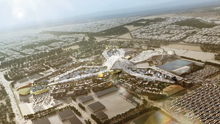
Bird’s eye view ... the Expo site will cover an area of 1,082 acres.
Expo 2020 euphoria
Dubai’s successful bid to host the 2020 World Expo has certainly created a stir in the market, with the initial project announcements including a 13.63-million-sq-m integrated urban centre and golf destination. The venue for the event itself, designed to reflect the winning theme, is estimated to cost between $2 billion to $4 billion.
01 January 2014
THE euphoria is palpable in the market following Dubai’s triumphant bid to host the 2020 World Expo – the third-largest global event after the Olympics and the Fifa World Cup that is expected to draw more than 25 million visitors from October 2020 through April 2021.
Already, the real estate market is abuzz with many developers now keen to push ahead with their projects and landlords quick to anticipate a surge in demand and hence sending rents soaring upwards – although analysts believe these should start to moderate as new supply comes in. The improvement in the real estate sector will naturally boost the construction sector with new projects coming on the market.
Among such new projects, Emaar Properties has been quick off the mark by signing a memorandum of understanding with Dubai World Central to develop an integrated urban centre and golf destination at the home of the Expo 2020 site. The masterplan for the joint venture project is currently being finalised.
The development will spread over an area of 13.63 million sq m with the first phase of the project to include a golf-course villa community, several hotels, a high-end shopping mall, leisure attractions, and a business hub that promotes youth entrepreneurship.
Dubai World Central is expected to witness several new projects to build an integrated city.
 |
The Green Expo Village at the venue. |
The UAE is expected to award an estimated $35 billion in construction and other supplier contracts during 2014 – up from $30 billion this year – and this figure is expected to rise significantly to support the Dubai Expo 2020. According to Bank of America Merrill Lynch predictions, the event could positively impact UAE’s GDP by as much as $23 billion between 2015 and 2021 and add 277,000 new jobs.
Dubai’s selection, based on the theme ‘Connecting Minds, Creating the Future’ was announced on November 27, 2013 by representatives of the 168-member Bureau of International Expositions (BIE). The emirate beat off competition from three nominated cities in Brazil, Russia and Turkey, and will become the first Middle Eastern city to host the event in its 150-year history.
Venue
The venue for the Expo 2020 – which is estimated to cost $2 billion to $4 billion – is a 1,082-acre site on the southwestern edge of Dubai in Jebel Ali, near Dubai’s new Al Maktoum International Airport and Jebel Ali Port. The site was selected and designed for maximum visitor and participant benefits. It is located at Dubai World Central, a dedicated free zone that sits at the heart of the newest business hubs of Dubai. It is equidistant from the two largest airports in the UAE.
Sustainability is a key priority and aggressive targets are in place to generate 50 per cent of the energy on site from renewable sources and deliver a carbon-neutral Expo. This alone would necessitate Dubai to invest around $100 million on installation of solar panels. As per the present plans, part of the solar power at World Expo 2020 will be generated by a facade of panels criss-crossing the area.
The masterplan for the Expo was created by a design team led HOK, a global design, architecture, engineering and planning firm.
 |
The Al Wasl central plaza. |
HOK’s design features three separate pavilions symbolising opportunity, sustainability and mobility, with ‘innovation pods’ and ‘best practice areas’ in each thematic zone. These three zones emanate from a central plaza named the Al Wasl – a historical name for Dubai meaning ‘the connection’ to fit with the Expo theme. Inspired by the layout of a traditional Arab suq, or marketplace, the design places larger pavilions on the perimeter while clustering smaller exhibit spaces toward the centre of the site. This creates a smooth pedestrian flow while encouraging interaction among visitors.
The team planned the Expo site and infrastructure to create a new sustainable benchmark for events in the Middle East. An iconic photovoltaic fabric structure covers the main walkways, acting as a solar-powered sun shade and combining with photovoltaic panels on building facades to capture enough sunlight to generate at least half of the Expo’s energy requirements on site. At night, the fabric will be transformed into an illuminated display of lights and digital projections. Smaller connective streets will be shaded through the use of pavilions and strategic landscaping. The alternative transportation plan includes a gondola that links each of the thematic zones and the main entrance while creating an additional viewing experience for visitors. Other sustainable strategies include recycling wastewater, reusing materials and monitoring the carbon footprint.
After the close of the Expo in 2021, three main pavilions – the welcome pavilion, the innovation pavilion and the UAE pavilion – will be combined and transformed into the ‘Museum of the Future’.
Commenting on the historic win, Daniel Hajjar, management principal in Dubai of HOK, says: “This win is a testament to the commitment of the UAE citizens to create a prosperous future for their country and region.
“We are proud to have led the design of the Expo site and to be associated with producing a winning entry for Dubai so that this great country can continue to boost its reputation on a global stage.”
“Dubai’s win elevates its status as a global city with world-class infrastructure and highlights its commitment to sustainable energy,” adds Bill Hellmuth, HOK president.
“With its mixture of education, innovation and entertainment, the plan reflects the wonderful qualities of Dubai and the form and spirit of a World Expo,” says Tim Gale, director of planning for HOK in London.
HOK teamed up with Populous, which provided venue planning and participant design guidelines, and Arup, which provided infrastructure and transportation services, on the masterplan.
Impact
According to Tecom Investments, a leading developer and operator of business parks, the UAE’s business community will benefit tremendously from the Expo 2020.
Amina Al Rustamani, Group CEO, Tecom Investments, believes the expo will be a catalyst for the ongoing development of Dubai’s knowledge economy.
“Winning Expo 2020 is a remarkable achievement for Dubai and the UAE. We must recognise the vision of His Highness Sheikh Mohammed bin Rashid Al Maktoum, Ruler of Dubai, in seeking to bring the World Expo to the Middle East for the very first time – and for foreseeing the benefits it will bring to the business community and the wider knowledge economy,” she says.
According to Al Rustamani, these benefits will come in three distinct phases, directly helping businesses and further developing the emirate’s knowledge economy.
“There will be an immediate shot in the arm in terms of economic confidence. This will be followed by the planned infrastructure and project investments taking shape over the next six years during the
preparation stage, which will offer growth opportunities across a range of industries – from manufacturing and media to tourism and education. Once the event is complete, there will also be a strong legacy that the event leaves behind, which businesses will be able to take advantage of.”
Al Rustamani says that companies of all sizes and sectors will benefit as they seek to support the event with products and services before, during and after the Expo. “Importantly, through it all, Tecom Investments will play an important supporting role in providing the business-friendly, stable and dedicated environments from which thousands of companies will be able to compete and succeed, creating hundreds of thousands of jobs along the way.”
She says Tecom’s 11 industry-focused business parks – 10 of which are free zones – will play an important role in providing a stable and dedicated platform for thousands of companies as they seek to take advantage of the commercial opportunities hosting the Expo will bring.
 |
The suq shade structure. |
According to Helal Saeed Almarri, director general of Dubai’s Department of Tourism and Commerce Marketing (DTCM) and CEO of Dubai World Trade Centre, a wide range of sectors will benefit from the event, including the construction, engineering and transportation, hospitality, retail and aviation sectors.
“With regards to hospitality, there are currently 82,000 hotel and hotel apartment rooms in Dubai with this figure expected to double by 2020; this expanded hotel portfolio will be vital to ensure the demands of the Expo visitors are met and DTCM will work with our partners in both government and the private sector to put in place the infrastructure and processes needed to meet the demand of the 25 million expected visitors over the Expo period,” Almarri says.
Dubai Multi Commodities Centre (DMCC) was among the first to honour this momentous win by naming its skyscraper project – designed to be the world’s tallest commercial tower – as Burj 2020.
Ahmed Bin Sulayem, executive chairman, DMCC, says: “Few can imagine the impact the Dubai of 2020 will have on the Expo and how it will connect people, their ideas and aspirations.
“We are honoured to dedicate the world’s tallest commercial tower to this historic win by naming it Burj 2020.”
The naming of the Burj 2020 follows DMCC’s announcement last year (2013) to build the world’s tallest commercial tower as part of its Free Zone Business Park expansion plans (107,000 sq m), catering to the increased global demand from multi-nationals and regional corporates for large-scale commercial space in Dubai. The masterplan for the Burj 2020 is currently in its final stages. Architects are to be appointed in 2014, with groundbreaking planned for 2015.
DMCC will be engaging with partners and stakeholders such as the Dubai Municipality (DM), the Roads and Transport Authority (RTA) and the Dubai Electricity and Water Association (DEWA), in early 2014 to ensure a successful and timely delivery of the Burj 2020 and the DMCC Business Park.
