

Gulf shaping urban transport of future
All across the GCC, transportation is undergoing a revolution. A study by Siemens reports how member states are setting a template for cities around the world to follow.
01 February 2014
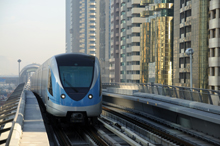
WITH the world’s longest automated metro, cutting-edge road traffic management systems and a host of world leading schemes in progress across the region, the Middle East is pioneering the future of urban transport, according to a study commissioned by Siemens.
Conducted by leading strategy consultant Credo, the early findings of the research show that rapid growth of urban economies in the Middle East, aided by rising and increasingly well-educated populations, have prompted radical thinking to keep road traffic flowing smoothly and to develop public transport as a genuinely viable alternative to the car.
“So far the successes have been staggering: Dubai’s metro carries 360,000 passengers per day, relieving road congestion and generating massive social and environmental benefits – with a further massive expansion planned,” says a spokesman for Siemens Mobility and Logistics, a company with a major and growing presence in the Middle East.
“In Dubai and Abu Dhabi, sophisticated road traffic control centres have speeded journeys and improved safety. Abu Dhabi is planning a 131-km network of metro, light rail and bus rapid transit systems and Riyadh is set to open a six-line automated metro network by 2018,” he adds.
Sami Atiya, CEO of Siemens Mobility and Logistics, says the company wanted to better understand why the transport networks of some cities are highly successful while others are not. Hence, Credo was commissioned to conduct the study which examined more than 30 cities around the world, analysed and compared them for transport provision, quality, development and planning. It also examined external factors such as population growth, the potential impact of emerging technologies and working practices, and historic investment to provide cities and policymakers with the information they need to draw on best practice from around the world and identify the best channels for future investment.
More than 10,000 data points and 50 different metrics were used by Credo to provide the most complete picture possible. The study is expected to be completed shortly.
“The implications of this pioneering study for cities around the world are profound: for the first time, city planners will soon have a robust and independently gathered source of information which provides insight and lessons to help cities more effectively plan their transport investment,” says the spokesman.
What Credo discovered offered total confirmation for those who advocate transport investment in an integrated fashion. Most important of all is the conclusion that mobility and transport are essential for successful cities – they make them better places to live in and work, and they attract inward investment which creates jobs and wealth.
For some locations, optimising existing road capacity through better traffic management systems can deliver spectacular results; for others only a high-capacity metro rail system will provide capacity to meet future demand.
Atiya comments: “The importance of transportation networks is really emphasised by the preliminary findings of this new study. We are proud to present those findings in a region which the evidence suggests very strongly is setting new standards for transport development which will be applied all over the world.”
The study indicates that Dubai’s and Riyadh’s ambitious transport plans are setting a template for cities around the world to follow. Dubai’s massive and sustained recent investment places it highly in the 30-plus cities studied, while Riyadh’s high quality road and forthcoming metro networks will allow the Saudi capital to confidently manage future growth in population and traffic levels.
Siemens Mobility and Logistics Division, a provider of integrated technologies that enable people and goods to be transported in an efficient, safe and environment-friendly manner, says the importance of enhancing road traffic management is hard to argue against.
The company’s intelligent traffic information and management systems – of which more than 1,000 have been either built or are in planning around the world – cut traffic jams and road accidents, and just as importantly, can slash carbon dioxide emissions by up to 20 per cent.
In Dubai, for example, Siemens installed its Falcon traffic control management system, which uses 69 monitoring cameras and video systems to automatically detect accidents and control more than 300 traffic lights on main routes. Up-to-date information is relayed via SMS and internet services.
Abu Dhabi has also seen significant gains from Siemens technology, with the company’s latest traffic management systems installed on Yas Island, Reem Island and at Ras Al Akhdar to optimise traffic flow in this rapidly growing city.
“The key aim of this installation was to optimise traffic flow at intersections and Siemens intersection controllers were connected to the traffic control centre to achieve this,” says the spokesman.
At Ras Al Akhdar, meanwhile, Siemens installed a sophisticated tunnel control system to ensure the safety of road users and smooth traffic flows.
The spokesman points out that such high levels of investment and ambition have no parallels anywhere in the world and that the likes of Dubai, Abu Dhabi and Riyadh have made the correct decisions in focusing their attention on transport.
He adds that for many cities optimising road traffic is vital. However, urban rail systems can also have a significant and positive impact on city transportation – as Dubai so spectacularly proves.
“Transport investment is naturally long term as cities don’t stay still – they grow and develop according to demographic and economic changes. Lack of investment, land availability, political will, planning controls, the state of existing infrastructure and a host of other factors can either enable a city’s growth and prosperity or limit it. Nonetheless, it is clear that for growing cities that rail networks offer unrivalled capacity, speed and safety for the investment.”
In the Middle East, of course, fuel for road vehicles is generally very affordable and this does pose a challenge for the region’s transport planners, particularly when comparing road investment to that of rail, the Credo study points out. So how does one balance the equation between providing cheap public transport with the need to make it sufficiently attractive to encourage use?
The spokesman stresses that there are many challenges ahead: transport investment must be integrated between all modes, able to handle future demand and be affordable.
“It must also – and increasingly – be economically sustainable and environmentally friendly, and a balance between quality and capacity must be found. And regardless of existing infrastructure, the critical role a well-planned metro or commuter rail system can play for cities cannot be ignored – the body of evidence to support rail investment is already vast and is growing rapidly,” he says.
“But perhaps the greatest argument for cities around the world to invest more in transport is a simple one: transport investment creates wealth, which ultimately benefits every single person in a city and its surrounding region,” he adds.
Siemens has been at the forefront of transport technology for over 170 years, and its innovations in rail and road transportation have been improving safety, speed and mobility ever since.
- Gulf shaping urban transport of future
- Cat raises bar with new compactor series
- Vogele’s total solution ensures efficiency
