

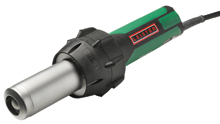
Next generation ... The Electron ST and Triac ST (below).
Leister tools work wonders with hot air
With its new generation of hot-air handtools, Leister has made welding and shrinking jobs all the more easy. The Triac AT, Triac ST and Electron ST have set the benchmark for functionality, quality and reliability.
01 February 2014
LEISTER Technologies of Switzerland has introduced its new generation of hot-air handtools for welding or shrinking in an extensive range of applications, including for executing roofing, civil engineering, and plastic fabrication jobs as well as for billboards and for processing plastic flooring.
With research and development always accorded high priority at Leister, the company has been constantly bringing out new products or adapting existing tools to meet the needs of the market. The new generation of Leister’s hot-air handtools such as the Triac AT, Triac ST and Electron ST have set the benchmark concerning functionality, quality and reliability, says Roland von Ah, sales manager Asia and Middle East at Leister, Switzerland.
The Triac AT is an intelligent yet robust hot-air handtool for welding and shrinking plastic, incorporating an ergonomic design, secure handling and a modern look. It is designed to meet the needs of even the most demanding professional, according to him.
“The Triac AT once again proves the renowned reliability of all Leister tools. This high-quality hot-air handtool is equipped for any use,” says von Ah.
He adds that the Triac AT will continue to prove its merit under any weather conditions and is just as effective outdoors as it is indoors – all during continuous operation.
“With its ‘e-Drive’, the Triac AT is equipped with a sophisticated control unit for intuitive handling: the turning knob fitted on the back of the easy-grip housing enables all the necessary functions to be controlled.
“The large display ensures that information is highly visible and understandable. Thanks to its sophisticated electronics, the Triac AT now offers the option to set the temperature and air flow independently. The thermal probe positioned in front of the heating element allows the highest level of precision,” he says.
Leister has also introduced the Triac ST, the successor model to its legendary Triac S, which is claimed to be the most common hot-air handtool used for welding plastic in the world.
“The renowned sturdiness and durability of the Triac S have been the cornerstone of this success, even under adverse working conditions outside,” von Ah stresses.
 |
|
|
During the development of the Triac ST, a deliberate choice was made to do without extra technical features. “Instead it is distinguished by handiness, reliability and versatility, like its predecessor. A prominent feature here – like on all tools of the new generation – is the two-component handle, which is not only attractive visually but also gives the user perfect grip,” explains von Ah.
The low weight of less than 1 kg ensures a perfect weight balance. The innovative motor and turbine design, combined with the heating element familiar from the Triac AT, enhance the value even more. Also, the two air filters can easily be removed and cleaned. The heating power can also be set infinitely up to 700 deg C.
More than 80 nozzles fit onto the Triac ST – also compatible with the Triac AT and Triac S – making all conceivable applications possible, both indoors and outdoors, von Ah adds.
Another new-generation model, the Electron ST, with an output of up to 3,400 W, is Leister’s hot-air handtool packed with power. Its wide range of potential applications makes it a true all-rounder and it stands out aesthetically compared to its predecessor, the Electron, having drawn on the features of the Leister tools of the Triac family.
Here also, the two-component handle ensures perfect grip. With a leaner and neater design – its handle is narrower by 8 mm and its weight reduced by 100 g – the Electron ST rests optimally in the hand. For the user, this means improved ergonomics and hence the ability to work in more comfort.
The Electron’s successor is equally at home on the roof or floor, no matter whether welding bitumen, shaping plastic floors or shrinking.
“What makes the new Electron ST particularly attractive is the fact that existing nozzles of its predecessor fit onto the different models,” says von Ah. “Finally, the 230 V/2,300 W version of the Electron ST means operation in household networks with 10 A fuse is no problem at all.”
Leister has been successfully developing, producing and selling hot-air handtools, automatic welders, extrusion welders and associated accessories for more than 60 years. With around 600 in-house employees and an extensive network of 120 sales and service partners around the world, Leister guarantees unparalleled delivery and service provision in the industry, the spokesman says. The company’s hot-air handtools continue to be developed and produced in Switzerland, where functionality, safety and design are especially emphasised and every tool undergoes stringent quality checks prior to leaving the factory.
“Central Europeans are reputed for the high demands they place on the quality of their products. This is not only seen in internationally renowned products such as watches or the Swiss army knife: users of Leister tools also benefit from this focus,” von Ah concludes.
