


Middle East Industry Congress in Saudi Arabia provided a practical platform for exchanging ideas, addressing real-world challenges, and highlighting tangible, real-life solution.
Eurovent Middle East leads HVACR transition, focuses on skills for low-carbon future
With technologies for low-GWP refrigerants already available, Eurovent Middle East is driving the transition towards energy-efficient and climate-adapted systems through education and capacity building. Executive Director NERISSA DEORAJ highlights to Gulf Construction how upskilling the workforce can close the gap between policy ambition and sustainable performance.
01 December 2025
Eurovent Middle East is intensifying efforts to prepare the Gulf’s HVACR industry for a low-carbon future through education, certification and regulatory collaboration, according to Executive Director Nerissa Deoraj.
Speaking to Gulf Construction in an exclusive interview, Deoraj says that accelerating the transition to energy-efficient and low-Global Warming Potential (GWP) refrigerant technologies requires “a people-first approach”, highlighting that while new systems are technically ready for the region’s hot climate, workforce training remains the missing link.
“Technology is ready, but the people are not,” she says, noting that up to 70 per cent of refrigerants placed on the market are leaked or vented into the atmosphere, underscoring the environmental impact of inadequate technical competence.
Eurovent Middle East, which serves as the region’s leading industry association for HVACR manufacturers and stakeholders, has made education and capacity building central to its mandate. Through its working groups and the HVACR Leadership Academy, it provides hands-on training and guidance to enhance technical and regulatory knowledge.
 |
|
Our role is to support regulators with industry expertise so that this transition happens smoothly and in line with national sustainability goals – Deoraj |
The association recently published guidance on the refrigerant transition to support regional authorities in implementing low-GWP policies. Deoraj cites the UAE’s new Climate Law, which came into effect in May 2025, as a milestone compelling the use of alternatives to saturated fluorocarbons.
“Our role is to support regulators with industry expertise so that this transition happens smoothly and in line with national sustainability goals,” she says.
She adds that Gulf governments are making steady progress on refrigerant management. Saudi Arabia was the latest to ratify the Kigali Amendment to the Montreal Protocol, joining other GCC states and aligning the region with global commitments to phase down high-GWP refrigerants.
Amid shifting global supply dynamics, with the EU and other major economies restricting high-GWP equipment from 2027, manufacturers are already redesigning systems around mildly flammable and non-fluorinated refrigerants.
“Globally, every major production hub has begun its HFC phase-down,” Deoraj observes. “The Middle East must keep pace by building local capacity.”
 |
|
Eurovent Middle East has made education and capacity building central to its mandate. |
Among the initiatives shaping the region’s adaptation is the newly launched Eurovent Desert Certification, the first scheme designed specifically for high-ambient conditions. The certification tests equipment performance up to 52 deg C, addressing the mismatch between imported standards and regional reality. “This will be a critical tool for providing regulators and developers with reliable data,” Deoraj explains.
Deoraj also points to growing attention to indoor air quality (IAQ) as a marker of building health and sustainability. Eurovent Middle East is promoting adoption of the ISO 16890 air filtration standard and discouraging outdated practices such as washing filters.
“Authorities across the Gulf are increasingly embedding IAQ parameters into building codes and sustainability mandates,” she says.
On future trends, Deoraj highlights the rise of AI-driven HVACR systems capable of real-time performance monitoring and predictive maintenance. With integration into building management systems, she says, these technologies can enhance reliability and reduce operational and carbon costs.
Eurovent Middle East is also expanding its training footprint with new accreditation courses. Following the introduction of its F-Gas Certification, a dedicated refrigeration design and maintenance course is set for launch in early 2026 to strengthen the region’s cold chain capacity.
 |
|
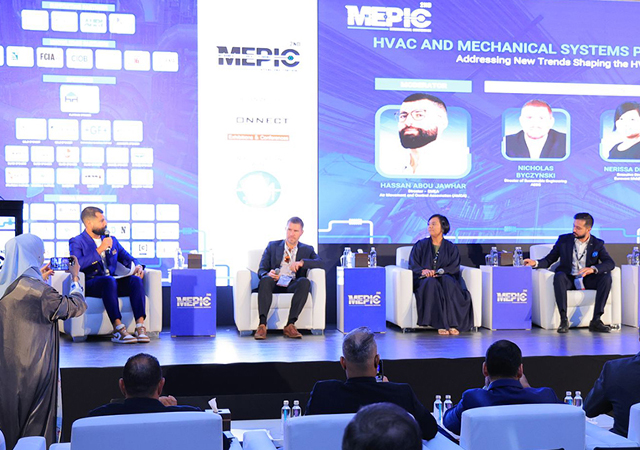
Eurovent Middle East participates regularly in events focused on the HVACR sector. |
“Our mission over the next three years is to strengthen education, advocacy and technical excellence,” Deoraj says. “Only when the workforce is equipped with the right knowledge can true sustainability goals be achieved.”
Excerpts of the interview with Nerissa Deoraj, Executive Director of Eurovent Middle East:
Eurovent Middle East plays a vital role in promoting sustainable HVACR practices in the region. How does it support the industry’s transition towards greater energy efficiency and environmental responsibility, including the region’s transition to low-GWP refrigerants?
Energy efficiency and sustainability are two of several core issues which form Eurovent Middle East’s overall objectives as an industry association. We support measures that require manufacturers to decrease the energy consumption of their products and encourage end-users, consultants, and developers to utilise more sustainable products, which will increase energy efficiency within their buildings. Regarding the refrigerants transition, we advocate for the global phase-down of refrigerants with a high GWP along the lines of the European Union ‘F-Gas Regulation’.
To support this, education and capacity building are a big part of our activities. Our activities are facilitated through dedicated working groups focused on cooling, ventilation and air filtration and refrigeration, to address specific needs within the industry when it comes to education and awareness raising. Through our HVACR Leadership Academy and other initiatives, we provide ongoing training opportunities for professionals to strengthen technical competence and awareness across the value chain. We also actively contribute to the industry’s knowledge base by publishing position papers and guidance documents designed to help stakeholders, including government bodies, navigate the rapidly evolving regulatory and technological landscape. Recently, we concluded the second Middle East Industry Congress in Saudi Arabia, which provided a practical platform for exchanging ideas, addressing real-world challenges, and highlighting tangible, real-life solutions. Together, these initiatives ensure that our efforts translate into meaningful progress for a more sustainable and future-ready industry.
How are regional governments and regulatory authorities approaching refrigerant management, and what kind of policy support or enforcement do you believe is still needed?
Overall, the Middle East is demonstrating strong momentum in aligning policy frameworks and industry action towards responsible refrigerant management, signalling a clear regional commitment to sustainability and climate goals. Saudi Arabia was the most recent GCC country to ratify the Kigali Amendment to the Montreal Protocol, joining the Kingdom of Bahrain, State of Kuwait, Sultanate of Oman and the United Arab Emirates, in addition to Jordan, Lebanon and Syria. This means the remaining countries in the region will have to follow suit shortly. The UAE Climate Law (Federal Decree Law No. 11 of 2024) came into effect on May 30, 2025 and mandates the use of alternatives to saturated fluorocarbons. This transition is now compulsory, making it essential for all stakeholders to understand the implications for their future operations.
To support this development, Eurovent Middle East has proactively published industry guidance on the refrigerant transition, outlining some of the first steps which need to be considered by governments, regulatory bodies and the wider industry to facilitate the transition in the region. Our role is to support regulatory entities with the expertise and knowledge from the industry to ensure a smooth transition and adoption of low-GWP refrigerants, while supporting sustainability and decarbonisation objectives. The publication is available for download free-of-charge from Eurovent Middle East’s website (https://www.eurovent.me/)
Can you share insights on how the refrigerant transition is progressing among manufacturers, especially in meeting international targets and timelines?
With China, India, Japan, Korea, Türkiye, the European Union (EU) and the United States of America having ratified the Kigali Amendment, every key production hub for air-conditioning equipment has already implemented specific steps to phase down hydrofluorocarbons (HFCs), resulting in a strong surge of A2L and non-fluorinated refrigerants. The EU has also imposed restrictions on the export of equipment with refrigerants not complying with its rigid GWP limits from 2027 onwards. This global trend will significantly reduce the availability of products using HFCs with higher GWP in the years to come.
Against this global backdrop, manufacturers have already started to shift to low-GWP alternatives, while also working on product development to ensure products meet the upcoming requirements as the refrigerant transition evolves globally. Keeping in mind that the EU F-Gas Regulation has been in force since 2014, there has already been a significant amount of time for manufacturers to prepare themselves.
What are some of the main challenges manufacturers and operators face in adopting low-GWP refrigerants in the region, especially considering local climate conditions and market dynamics?
From a technical standpoint, the transition towards mildly flammable and non-fluorinated refrigerants is possible and is already being practised in several countries. Even with the high ambient temperatures in the Middle East, the transition can be made, provided suitable safety standards are followed. The biggest challenge in the region is that the technology is ready, but the people are not.
The higher risks associated with A2L and A3 refrigerants mean the education, training and qualification of personnel – starting from design engineers to service technicians – constitutes a key factor, one that is missing among the workforce in the region. But the situation also presents a unique opportunity. The industry estimates that between 50 per cent and 70 per cent of the refrigerants placed in the market are either leaked or intentionally vented into the atmosphere, which means that building local competence can deliver immediate environmental gains.
From your experience, which technologies or solutions are proving most effective in improving energy efficiency and reducing environmental impact within HVACR systems in the Middle East?
As an industry association, we are technology neutral. However, what’s most important is to understand the benefits of the available technologies and how to put them to the best use. We see that there are a number of existing and emerging technologies in the market that can provide significant energy savings, but due to lack of awareness and understanding, they are not adopted. In this instance, the best approach is through dedicated education and training for the design and application engineers through to the installation, operation and maintenance personnel.
Eurovent Middle East recently launched the Eurovent Desert Certification. Explain what this certification entails, the objectives behind the certification and how does it address the unique climatic and operational challenges of the Middle East?
Historically, most equipment in the region is certified using European (EN) or American (ANSI) standards, both of which don’t reflect the regional climate conditions. The result is certified performance that fails to reflect real-world operation in this extreme climate. The Desert Certification is the first certification of its kind in the region, which conducts performance testing according to high-ambient temperature conditions (46 deg C). This certification has been specifically developed to test and verify performance using the Cooling Seasonal Performance Factor (CSPF) from ISO 16358-1: Amd 2019, using the 0B weather bin, as 90 per cent of the GCC countries fall within this classification in alignment with the ASHRAE weather data map.
The certification programme has been developed to consider the unique temperature challenges in the region and includes key temperature points:
• Cooling capacity and EER at T1 (35 deg C)
• Cooling capacity and EER at T3 at (46 deg C)
• Operability test for two hours at 52 deg C)
Optional performance testing at T4 (48 deg C), as mandated in Kuwait, is also possible, so the certification really covers the full range of test points to reflect the most accurate product performance.
We believe this will be a critical tool for the region, providing manufacturers, regulators, and end-users with reliable data to drive better design, policy, and operational decisions.
Highlight the most effective methods and strategies being adopted to achieve good indoor air quality in buildings, and discuss how developers, building operators, and regulators in the Gulf are giving increased priority to IAQ?
There is a growing and encouraging shift across the Gulf towards prioritising IAQ as a cornerstone of building health and occupant wellbeing. For example, ongoing research by air filtration expert Dr Iyad Al Attar, an Associated Consultant of Eurovent Middle East, is currently focusing on a study which explores the link between indoor air quality and fertility, an aspect which has not previously been placed under the spotlight.
From our point of view, one of the most effective strategies is to implement ISO 16890, the most up-to-date and sophisticated test standard for air filters, which has been in place since 2016. In addition, adhering to established ventilation standards and guidance, abstaining from washing filters, and timely replacement of efficient, high-quality filters are simple best practices to the benefit of IAQ and energy efficiency.
Across the Gulf, authorities and developers are increasingly integrating IAQ considerations into building codes and sustainability frameworks. Many projects now include continuous monitoring, improved ventilation design, and better filtration practices as standard requirements, reflecting the growing importance being placed on this issue.
From a sustainability perspective, what are the most promising technologies or solutions you believe will have a lasting impact on the built environment in the GCC?
Artificial Intelligence (AI) and smart HVACR components, which continuously monitor efficiencies and performance in real time, have the potential to transform the way we manage and monitor systems in the region. These technologies will help enable predictive maintenance. With integration into Building Management Systems (BMS), they can support lower operational costs, improve system reliability and ultimately reduce carbon footprint and environmental impact.
What new initiatives or collaborations is Eurovent Middle East involved in to further advance cold chain solutions and climate-resilient infrastructure?
Eurovent Middle East has launched an HVACR Leadership Academy, which focuses on the education and training of industry personnel. We have seen the successful introduction of the F-Gas Certification, a hands-on training course for the handling of F-Gases, which is more relevant as we move towards the phase-down of HFCs in the region.
We are also currently working on a dedicated, hands-on training course for refrigeration technicians and designers – expected to be launched at the beginning of 2026. The course will focus on equipping technicians and designers with practical skills in designing, selecting, and maintaining commercial cold storage systems.
How is Eurovent Middle East engaging with other industry associations, government bodies, and international organisations to align regional standards with global best practices?
Lobbying, advocacy and a harmonised approach are key pillars of our operation as a leading industry association. We advocate for policies that support inclusivity and a level playing field, as well as for the adoption of standards that are best for the regional climate conditions.
As such, Eurovent Middle East is part of several technical and standards committees in the GCC, providing industry expertise to support regulatory development. We also collaborate closely with regional and international associations that share our objectives. A recent example is our partnership with AMCA Middle East to organise our second major industry congress in Riyadh, which addressed key topics such as the refrigerant transition, ventilation and IAQ, and decarbonisation and sustainability.
Ultimately, we cannot achieve meaningful results in the industry segment without ensuring that we are all aligned on the long-term, strategic goals set forth by the relevant governments, so we are always open to cooperating with all entities that work in a similar way towards the same goals.
What are the association’s primary goals for elevating environmental protection and technical excellence over the next three years?
Education and capacity building are key to technical excellence. If people are properly equipped with the skills and knowledge, that already goes a long way to ensure environmental goals can be achieved over time. While we work on industry guidance, lobbying and advocacy, we will be working in parallel on the development of our technical training and knowledge development courses to support capacity building for HVACR professionals.
Looking ahead, what emerging trends do you foresee shaping the HVACR industry’s environmental and energy agenda in the next five years, particularly in cooling and indoor air quality?
With the impending refrigerant transition, we foresee the emergence of non-fluorinated refrigerants being adopted more in the cooling sector for high-ambient temperature conditions. Training and certification requirements for technicians to handle these refrigerants are a necessity, so there will be a lot of emphasis placed on education initiatives to support the transition. Indoor air quality will remain a top priority, exploring more strategies and technologies to improve energy efficiency while providing optimal indoor environments.
Is there anything else you would like to add about energy efficiency, IAQ and Eurovent?
Energy efficiency, IAQ and ventilation are crucial aspects of creating and maintaining healthy indoor environments. Yet, we are still faced with the problem of selection of products driven by price rather than performance and quality, poor operation and maintenance practices. Ultimately, this leads to degradation of equipment in a short space of time and sick buildings and occupants. More emphasis needs to be placed on market education, not just from the product perspective, but also from the sustainability standpoint, with a focus on the benefits and opportunities related to the total cost of ownership (TCO).
This is a topic that Eurovent Middle East always places in the spotlight, as we have seen time and again that the long-term returns far outweigh the initial investment costs and can significantly impact the energy consumption and savings. In this context, we need to stop being short-sighted and plan for the future.
- Eurovent Middle East leads HVACR transition, focuses on skills for low-carbon future
- Why sustainability and ESG matter in GCC construction
- How cardboard and soil can replace concrete
- Global engineers group calls for ‘nature-positive’ shift
- USGBC opens LEED v5 certification
- Think beyond materials to AI-driven energy efficiency
- Low-carbon concrete guide launched
