

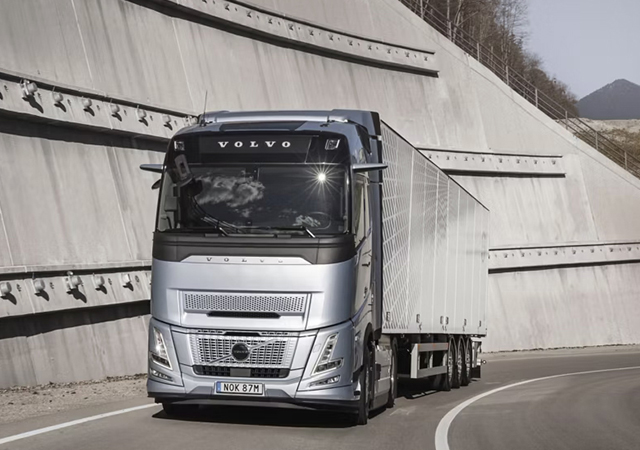
The new engine stop/start functionality is activated at speeds above 60 km/h.
Volvo Trucks unveils world-first stop/start engine technology
01 December 2025
Volvo Trucks has introduced a new generation of its I-Roll technology, adding an engine stop/start functionality – a world first in the heavy-duty truck industry. The new stop/start function will cut fuel consumption and CO2 emissions.
This latest initiative from Volvo to reduce the climate impact and running costs of transportation was developed in-house and is based on the company’s existing I-See and I-Roll technologies.
The new stop/start engine feature is enabled by constantly monitoring road data and road curvature information. The engine will be turned off temporarily when an oncoming downward slope is identified along the route. While the engine is turned off, zero fuel will be consumed and consequently, there will be no CO2 tailpipe emissions, according to Volvo Trucks.
“Our engineers have done it again – innovating a new engine technology that contributes to making transport by truck more fuel-efficient”, says Jan Hjelmgren, Head of Product Management, Volvo Trucks.
“As part of our decarbonisation strategy, we will continue to innovate to make our combustion engines even better and to reduce our impact on the environment,” he adds.
The new engine stop/start functionality is activated at speeds above 60 km/h. Depending on enabling conditions such as topography and ambient temperature, the new I-Roll with Engine stop/start will be able to cut up to one per cent of fuel and CO2 emissions on top of already achieved savings. Together, Volvo’s many innovations represent significant efficiencies and a positive impact on emissions from transport, as well as running costs for the operator, Hjelmgren points out.
The new feature will be offered on the Volvo FH and FH Aero with 13-litre diesel engine and is now available for customers.
Volvo Trucks’ strategy for decarbonisation includes combustion engines powered by renewable fuels, battery-electric and fuel-cell electric trucks.
“Volvo Trucks’ recent victory in the 2025 Green Truck Award test with the Volvo FH Aero is proof that its latest technologies and innovations have a real impact on fuel efficiency. The new Aero cab that was introduced in 2024 and the further aerodynamic improvements since then pay off in terms of significant fuel consumption and CO2 emission reductions,” Hjelmgren adds.
Among other innovations, Volvo has boosted its medium-duty truck offer with an upgraded sturdy Volvo FL 4x4 model, tailor-made for demanding offroad applications.
The Volvo FL model is known for being a compact and agile medium-duty truck. Volvo Trucks has now launched a modified truck, suitable for environments where customers need extra capability in terms of offroad performance.
“We can see a clear trend towards a higher demand for this type of truck from our customers”, says Hjelmgren. “This compact, agile and easy-to-manoeuvre 4x4 truck will enable access to remote areas in rough conditions – this is a workhorse built with a clear purpose.”
Volvo FL 4x4 comes with new front- and rear axles and new axle ratios to support the all-wheel drive transmission. In combination with a robust exterior, single tyres and generous ground clearance, the updated truck model has capabilities to meet the toughest requirements not only in the construction segment but also within rescue, fire-fighting, energy- and power supply companies, and defence applications, he says.
The cab choices for the new truck model include both a day cab that accommodates two people and a crew cab with room for six people. Specific optional equipment includes a winch, bullbar, headlight protection and extra protection of the transfer gearbox for extreme off-road driving.
The Volvo FL 4x4 model is offered with Volvo’s efficient eigh-litre diesel engine. Production began last month.
- Excavation to energy: Caterpillar introduces new equipment
- Volvo Trucks unveils world-first stop/start engine technology
- Epiroc’s InSite boasts total visibility, fleet control
