

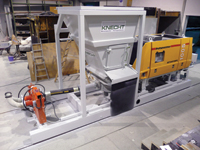
The Autocor 1005 E AC with buffer storage and DVH transfer tube.
Autocor helps ease concrete distribution
01 March 2012
PUTZMEISTER Concrete Pumps, a global leader in concrete machinery, has come up with a flexible and economical solution for the distribution of concrete at precast concrete factories in the region.
With Autocor (automatic concrete placing on rail), the company has developed a trend-setting system for the automated delivery and placement of concrete in such plants.
Traditionally, in precast concrete factories, buckets or bucket conveyors are used for filling moulds with concrete. Often, the conveyor is the link between the mixer and the concreting stations in the plant. In smaller plants, a bucket is filled and transported to the casing by a forklift or indoor crane.
 |
The concrete flow is distributed to two delivery lines with the help of a DVH transfer tube. |
“Both systems are well-engineered, but have their disadvantages,” says a spokesman for the company. “A bucket conveyor requires an elaborate rail system and is inflexible if for example new concreting stations are added, or casings are to be filled at alternating locations in the factory or a new production hall is constructed. The transportation of a bucket with a forklift or indoor crane is time-consuming and obstructs work such as the transport of reinforcements or finished elements.”
Putzmeister’s flexible solution includes a distribution system comprising a concrete pump, delivery line and if necessary a boom arm. This can also be useful in connection with a bucket conveyor. “This solution is flexible because a pipeline can be laid quickly and simply and at peak times for instance, makes possible outdoor production with a pipeline fitted temporarily,” he points out.
The Autocor installation makes particularly sense in plants that process pumpable and preferably self-compacting concrete for medium and large-sized precast elements. The system can also be easily retrofitted in existing plants that are looking at expansion.
The Autocor can be a mobile concrete distribution unit on rail chassis or stationary.
Provided that there is requirement-compliant planning, the Autocor offers the precasting plant operator several advantages over traditional concreting with finishers, semi-gantry distributors or bottom discharge buckets, including:
 |
The cleaning connections are filled with sponge balls or pigs and connected to the transfer tube before concreting. Compressed air or water is used for draining and cleaning the delivery line. |
• Constant concrete quality;
• Considerably higher emplacement performance;
• Lower manpower requirements;
• Constant production even with formwork elements of different dimensions and varying heights; and
• Easy cleaning in the complete production process.
Putzmeister uses tried-and-tested components and controls for the Autocor system. For example, the rotor pump system that is well known from Pumi, flexible placing booms and a mixer drum with a capacity of 7 cu m as temporary storage.
The complete unit is mounted on a rail-guided working platform and needs no support devices. There is also a control unit, which is integrated into the production process and the EBC system which has proven its worth for many years on PM truck-mounted concrete pumps.
This apart, it dampens the movement of the concrete placing boom while shifting and rotating even by high output. Beside of this the EBC system can – if required – limit the working radius of the placing boom, so that it does not collide with any floor beams or other obstacles in the area.
 |
High-quality precast concrete components manufactured using Autocor being transported. |
The advantages of Autocor include continuous and clean delivery of concrete; suitable for all pumpable concrete and self-compacting concrete; delivery rates up to 53 cu m per hour with a delivery range of up to 100 m; loading is possible directly from the mixer by a bucket conveyor or truck mixer; clean production channels; higher productivity; and improved utilisation of operating equipment, area and crane.
Putzmeister provides support during the process planning stage and ensures smooth, long-term and economical production.
- Peri at forefront of major projects
- Bauer to reveal latest machines at Intermat
- Liebherr cranes cover Oceanscape project
- Optimal plays moving role in Gulf’s green plans
- Autocor helps ease concrete distribution
