

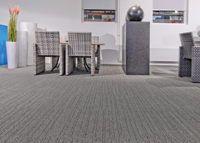
AirMaster in use and a close-up (below) ... more effective in capturing and retaining fine dust.
New Desso carpet focuses on health
01 April 2012
LEADING European carpet manufacturer Desso has focused on air quality and sustainability in the manufacture of AirMaster, a carpet that is claimed to be eight times and four times more effective in capturing and retaining fine dust than hard flooring and standard carpeting respectively.
The product has recently been supplied to the Cairo headquarters of international food company Nestle, whose corporate ethos is centred on nutrition, health and wellness, and which specified Desso’s AirMaster carpet for its Egyptian headquarters.
Desso, which sells in over 100 countries worldwide, is able to bring an international perspective to trends in floor-coverings.
“The significance of the contract – which follows similar installations for Doha-based Maersk – is that Nestle Egypt, which employs over 3,000 people, aims to provide the best possible working environments for its staff,” says a spokesman for Desso, regionally headquartered in Dubai, UAE.
The contract also indicates that attitudes to the environment and workplace health are changing in the region, says the company.
In terms of its health benefits, AirMaster scores over hard flooring and standard carpeting because of its ability to filter fine dust from the air, reducing the risk of inhaling these particles.
 |
“This carpet type is eight times more effective in capturing and retaining fine dust than hard flooring, and four times more effective than standard carpeting,” he says. “These figures are based on tests performed by GUI – an independent German testing institute which specialises in assessing air quality, dampness and dust particle count – on Desso AirMaster versus standard PVC hardfloor and against standard structured loop pile carpet. These figures are significant considering that research from the World Health Organisation (WHO) shows that particulate matter can lead to acute health effects.”
He adds that the German asthma foundation (DAAB) has for some time advised that the harmful effects of particulate matter can be greatly reduced if carpeting is chosen over hard flooring options(1).
“More recently, at the end of last year, The Netherlands Organisation for Applied Scientific Research (TNO) finalised a study into the relationship between particulate matter in indoor air and the presence of soft or hard flooring. One of the findings of the study was that textile floor coverings absorb more particulates from the air than their hard equivalents,” he says.
“Putting that in context, occupational asthma is the most common work-related lung disease in developed countries and is caused by occupational exposure to airborne substances known as asthmagens. Over 200 respiratory sensitisers have already been classified and others are being identified all the time,” he adds.
Desso indicates that the trend in the region towards creating better workplace interiors is not confined to air quality but also extends to other aspects such as noise pollution. For example, Desso recently installed carpeting for the Petroleum Development Oman (PDO) – which is also committed to the health and wellbeing of its employees. This carpeting is specifically designed to reduce impact sound and, therefore, provide employees with a more productive working environment,” he says.
Another trend that is fast emerging across the Middle East is towards sustainability, and the recognition that individuals, companies as well as governments have a role to play in conserving scarce resources, says the spokesman.
A pioneer project in this regard is the new Masdar City in Abu Dhabi, which is a model for sustainable urban development regionally and globally and a world-class development that is seeking to push architectural and urban planning boundaries to build a living and working environment with the lowest-possible ecological footprint, says a spokesman for Desso.
“This is an enormously important initiative as more than 50 per cent of people now live in cities, with that figure expected to rise to 70 per cent by 2030, and also because cities today are responsible for over 70 per cent of global carbon dioxide emissions,” says the spokesman.
It is for this important development that Desso recently has secured a contract: the company has been appointed to supply carpeting for the prestigious Masdar Institute of Science and Technology (MIST), the new $500-million campus building at Masdar City.
In line with regional efforts towards sustainability, Desso has also been involved in raising environmental awareness in the Middle East among manufacturing companies by co-hosting a Cradle to Cradle event in the UAE, with Aldar, Abu Dhabi’s leading property developer.
The event was attended by Sheikh Aziz Al Nuaimi, a leading exponent on sustainability in the Middle East, and an adviser to the public, private and academic sectors on environmental issues.
The hugely successful event was attended by more than 100 of the UAE’s leading architects and designers, as well as government representatives from the tourism and urban planning sectors, and overseas representatives from New York University.
A similar presentation was also held in Turkey, as part of Desso’s global programme to promote its ground-breaking policies on sustainability, and how companies in other industries can also adopt the Cradle to Cradle philosophy.
For Desso, its central premise is that at the end of a carpet’s useful life, its components will be disassembled and reused without being down-cycled or, worse, simply thrown away.
Desso was the first carpet manufacturer in the Europe, Middle East and Africa (Emea) region to adopt Cradle to Cradle – which Time magazine has called “a unified philosophy that, in demonstrable and practical ways, is changing the design of the world.”
Pioneered by German chemist Professor Michael Braungart and US architect William McDonough. Cradle to Cradle is a closed loop theory that aims at only creating products that can either be entirely recycled to provide the raw materials for new identical products, or that are 100 per cent bio-degradable.
“The challenges facing the global manufacturing sector are immense as we all grapple with the new environmental agenda of the 21st century. But what we’re seeing is a strategic change of attitude in the Middle East and elsewhere,” the spokesman says.
Economic well-being and employee well-being and environmental sustainability are not incompatible concepts – as Desso and a growing number of other companies are proving – and must be balanced, he concludes.
References:
(1) Study performed by Deutscher Allergie-und Asthmabund e.V. in 2005.
