

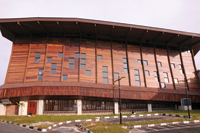
The new exhibition centre in Tebrau ... glulam timber showcase
Three storeys tell of glulam timber strength
The Malaysian Timber Industry Board explains the advantages of glued laminated timber in construction compared with concrete and steel and details how this product has been effectively showcased in an iconic landmark built using Malaysian wood.
01 May 2012
WOOD has a greater tensile strength relative to steel – two times on a strength-to-weight basis – and has greater compressive resistance strength than concrete. Therefore, it is a highly suitable material to produce large engineered wood components such as glued laminated (glulam) timber.
The high strength and stiffness of laminated timbers enable glulam beams and arches to span large distances without intermediate columns, allowing more design flexibility than traditional timber construction. The size is limited only by transportation and handling constraints. By combining engineered strength with the warmth and beauty of wood, structural glulam offers designers a multitude of options for large, open spaces with a minimum number of columns. Glulam timber is two-thirds the weight of steel and one-sixth the weight of concrete – the embodied energy to produce it is six times less than the equivalent strength of steel.
Despite the above advantages of timber, the general belief is that timber is not a durable, strong or worthy structural material, suffering, particularly in a tropical climate, from both insect and weathering damage. In addition, there is a perception that a timber structure presents a greater fire hazard than alternative materials such as stone, bricks or concrete. To overcome this erroneous and negative perception, in July 2009, the Malaysian Timber Industry Board (MTIB) had proposed to establish a new exhibition centre, in Tebrau, Johor (Malaysia), which could showcase and pioneer the first commercial use of glulam as load-bearing structures in Malaysia.
Simultaneously, MTIB also planned to demonstrate the potential offered by indigenous Malaysian tropical hardwood as a suitable raw material for glued laminated timber. The effort is in line with the role of MTIB to promote the use of innovative engineered timber products in the domestic market as inspired in the National Timber Industry Policy (NATIP) and to encourage timber-based industry to manufacture glulam products for structural and aesthetics application.
Construction
The three-storey exhibition centre uses glulam timber as a 100-per-cent load-bearing structure. This building features unique innovative applications of engineering with the use of glulam as the main building structure as well as the application of other local timbers for other structure and aesthetic applications such as timber fins, wall cladding, ceiling and shingles.
The building is also a showcase and referral centre for professionals such as architects, engineers, contractors and all levels of users and stakeholders, including government agencies and the relevant authorities.
This iconic building exemplifies the unique applications of engineering features, with the use of 39 sets of wood glued laminated timber products as the main structure. The species used are Keruing and Resak. The main glulam structure reaches a height of 17.5 m while the longest structure frame measures 34 m. In addition to glulam, Belian shingles replace the original metal deck roofing, with a total of 350,000 pieces of shingles used, enhancing the beauty to the building. Each Belian shingle is 6 mm thick, 100 mm wide and 520 mm long. This option was in keeping with the concept of creating the first iconic timber building in Malaysia.
All in all, this building utilises more than 80 per cent of Malaysian hardwoods, totalling about 640 cu m of timber.
The exhibition centre is composed of three exhibition halls, formed by parallel portal frames, built using a combination of Resak and Keruing hardwood glued laminated members (700 mm wide by 150 mm thick). These structural members are connected by glue-in steel rods, bolted and welded to steel brackets and steel plates, applied both at the factory and on-site. Construction commenced in January 2010, based on a design comprising a three-portal frame, each consisting of eight glued laminated sections connected by anchor plates and bonded in rods.
 |
Manufacture of hardwood glued laminated beams and columns commenced at Woodsfield’s Timber Industry in July 2010, using a Weineg press, an adhesive Phase One Dynea prefere 4001-2 and an adhesive Phase Two Akzo Nobel Synteko 1734 with hardener 2734.
Work on the foundations was commenced in January 2010 by Malaysian main contractor Bintang Kencana. While placing the portals base plates it was necessary in some cases to adjust the size of the plate fixing hole, due to cast-in bolt misalignment.
The jointed timber columns were manufactured at the factory and delivered sequentially to the Johor construction site starting August 2010. In January 2011, the erection of the structure was finished. This structure consists of a total of 39 portals, each made up of four 700-mm-wide and 150-mm-thick glulam timber elements.
The portal frames were covered with 12-mm-thick marine plywood sheets, which were subsequently covered with 0.3-mm-thick zinc sheets. Work on the inner side of the roof involved the placement of Keranji and Balau solid timber pre-coated boards (12 mm thick, 57 mm wide and 3 m long). Concealed within this inner surface is the fire sprinkler system.
All interior and exterior exposed timber has been coated with single-pack PU (polyurethane) lightly pigmented while all interior and exterior end grain surfaces have been treated with a Boron solution.
 |
Glulam timber has been used at the centre as a 100 per cent load-bearing structure. |
During the construction, some repairs to the hardwood glulam members were carried out to ensure the durability and expected service life of the construction. A monitoring plan was set up to account for the possible impact of the ambient conditions (temperature and humidity) on the performance of glued-in rods connections – and detect any manufacturing defects.
A temperature monitoring system has been installed at critical points on the structure to detect any impact of the elevated temperature when utilising glued-in rod connections with epoxy structural adhesives. It comprises type K thermocouples placed in drilled holes at appropriate positions on the sides of the beams and columns, enabling easy access during the life of the structure.
The objective was to measure the surface temperature of timber, cured adhesive, at the surface of the internal 32-mm-diameter steel shear bars and at the surface of the shear bar integral connection plate. This last plate has a greater heat sink than the bars and also its exterior surface is closer to the outer surface of the timber.
A close match was observed between the ambient temperature and temperature inside the glulam members. The monitoring plan will continue for the next two to three years in order to evaluate possible risks to the resistance of the glued joints.
Completion
The construction of the timber building was completed at the end of October last year and handed over to the MTIB by the Public Works Department last December. The exhibition centre, which was due to be fully operational last month, will serve as a showcase application of structural timber engineered products to specifiers as well as to promote Malaysian timber products such as furniture, moulding and builders joinery and carpentry (BJC).
It will also be used to train Malaysian young designers as part of MTIB’s roles to catalyse and encourage Malaysian furniture industries to shift from OEM (original equipment manufacturing) to OBM/ODM (original brand manufacturing/original design manufacturing).
References
i. Associate Professor Dr Zakiah Ahmad, Faculty of Civil Engineering, Universiti Teknologi Mara, Malaysia, project technical adviser.
ii. Dave Smedley, Rotafix, United Kingdom, project technical adviser.
- Three storeys tell of glulam timber strength
- Pretreating wood prevents losses
- Kiln drying, quality drives AHEC ahead
- AHEC supports green code for Bahrain
