

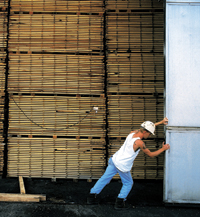
Kiln drying ... a value-added service by the American hardwood industry.
Kiln drying, quality drives AHEC ahead
There is a lack of awareness about the advantage of kiln drying in the Gulf region, says the American Hardwood Export Council (AHEC)*. In this article, it provides an insight into the finer details of the US hardwood industry and the technique used in kiln drying.
01 May 2012
THE American hardwood industry, which dates back to the first European settlers, has a wealth of experience in processing the native hardwoods of North America.
The eastern US states are heavily forested and the Appalachian mountain range, which runs through the centre of the eastern states, provides a wide variety of growing sites at different altitudes, which in turn gives rise to the varied characteristics of many species. In fact, the US has more temperate hardwood species than any other region of the world.
A massive hardwood processing capacity has been built in the US to supply the domestic and growing export demand. Today, the US is the largest producer of sawn hardwood in the world.
Sawmills, dry kilns, moulding and dimension plants, veneer slicing and plywood factories, flooring plants and concentration yards for distribution of hardwood material, exist across all eastern states. There is also a small but significant processing capacity in the Pacific Northwest, based on a few local species, the most important of which is the western red alder.
Sawn lumber is the primary product of the American hardwood industry and processing units vary from very small ‘circular saw’ forest operations through to larger integrated wood processing factories, which harness the latest technologies. Most of the industry is privately owned, comprising small- to medium-sized companies.
The approach to the primary conversion of hardwood logs varies to some extent, both by sawmill and by species. The industry works on principles designed to achieve maximum lumber yields, by cutting boards from around the log to optimise volume. As export demand grows, production techniques are being used to further improve yields of higher grades and to offer special cuts, such as rift and quarter sawn.
Measurement units
American hardwoods are produced in non-metric measure – lengths in ft, widths in inches, and thicknesses expressed in quarters of an inch. Therefore, 1 inch (1”) is expressed as ‘four quarter’, written as 4/4”. The standard thicknesses produced are 3/4” (19 mm), 4/4” (25.4 mm), 5/4” (31.8 mm) and 6/4” (38.1 mm) up to 16/4” (101.6 mm). In reality, however, the majority of kiln-dried lumber for export is only going to be available in 3/4” to 6/4”, due to the duration of and complications associated with drying thicker boards.
Lumber is most often produced in random widths (measured to the nearest inch) usually 3” (76.2 mm) and wider. Width specification will vary from producer to producer, by geographic region and by species, although ultimately it is the size of the tree that will be the determining factor. Generally, widths over 12” (304.8 mm) are rare. An increasing number of producers will cut fixed widths, as required by their customers.
Lumber is also generally produced in random lengths (measured to the next lowest ft) usually 4 ft (1.22 m) and longer up to a maximum of 16 ft (4.88 m), depending on the grade. As a general rule, lengths over 12 ft (3.66m) are relatively rare. Some producers also offer fixed lengths, depending on customer requirements, although availability tends to be limited.
Board feet are the units of measure used by the American hardwood lumber industry and are referred to as board measure. A board foot (bf) is 1 ft (0.30 m) long, 1 ft wide and 4/4” (25.4 mm) thick. Lumber prices are usually expressed in terms of cost per thousand board ft (mbf). 1,000 bf is equal to 2.36 cu m (for 4/4” and thicker). Lumber cut to 3/4” (19 mm) or planed below 4/4” is usually charged as 4/4” for weight purposes.
Wood grading
Although preliminary grading is carried out on green lumber for the purposes of monitoring yield and inventory, the final grade of each board is usually determined after drying. All sawn lumber is inspected and graded to the rules of the National Hardwood Lumber Association (NHLA), details of which are published in its rule book and summarised together with visual examples in the AHEC publication, An Illustrated Guide to American Hardwood Lumber Grades.
These rules were first established by the lumber industry over 100 years ago to service the American domestic furniture trade, and are nationally and internationally accepted. They are used as a basis for export, and are widely acknowledged as the most consistent grading standards for temperate hardwoods anywhere in the world. This is in contrast to Europe where many national and regional approaches require a greater element of buyer inspection.
The NHLA rules consist of lumber grades, which are determined by visual inspection based on yields of clear (free of defect) cutting areas and provable by mathematical calculation. While the official grades set out minimum requirements, industry interpretation does vary on upper limits.
Many individual exporters have established modified rules for specific export markets. In the US, special grading rules were developed many years ago for walnut, full details of which are included in the Rules for the Measurement and Inspection of Hardwoods & Cypresses available from the NHLA.
Export lumber is packaged to thickness and generally sorted to length where possible, although in reality there is often more than one length in a bundle. For example, a bundle of 10 ft (3.05 m) lengths may well contain a percentage of 9 ft (2.74 m) lengths. Presentation is an important marketing factor and most export material is trimmed both ends, end waxed or painted to protect against splitting, and marked with the exporter’s brand or logo.
The market for hardwood in the US is dominated by the thinner sizes. Therefore, for most species, 4/4” (25.4 mm) represents a significant percentage of production. In cases where thicker material is required, such as joinery applications, it is usual to laminate thinner sections, in contrast to the approach of many other countries. This often leads to a more stable and cost-effective product, and does explain why thicker material in some species is more difficult to source.
One of the reasons that the US is able to offer significant volumes of higher grade material for export is that there is a strong and sustained domestic demand that is able to utilise the lower grades. Therefore, some species that are limited in their domestic use may be available for export only in mixed parcels of higher and lower grades.
The availability of all American hardwood lumber for export is influenced by domestic availability and by the export demand in individual countries for certain species. Availability of logs will, of course, have the strongest influence on what lumber is produced by the industry. For example, red oak is the most widely used hardwood in the US because it is the most widely grown in the forest. At the same time, species such as sassafras and elm are limited in the forest, which affects lumber availability.
Kiln drying
Of all the value-added processes undertaken by the American hardwood industry in preparing lumber for export, kiln drying is probably the most important. It is this process which allows for a naturally unstable product to remain stable throughout its journey to the end-user overseas, as well as in processing and final application.
Kiln drying involves regulating the temperature and humidity of the circulating air to suit the state of the lumber at any given time. This condition is achieved by applying kiln-drying schedules and the desired objective of an appropriate schedule is to ensure drying timber at the fastest possible rate without causing too much degrade. Schedules are devised according to various important factors and these include the species, the thickness of the lumber, how the boards have been sawn (plain or quarter sawn), permissible degrade, and the intended end use of the lumber. Considering each of the factors, no one schedule is necessarily appropriate, even for similar loads of the same species.
This is why there is so much research and development in kiln drying and why the process is generally not easy or cost-effective to carry out in export markets, where the prerequisite skills and technology may not be readily available.
Specifically for American hardwoods, drying times will vary enormously depending on thickness and species. For example, 4/4” (25.4 mm) tulipwood can be dried from green in seven to 10 days, whereas 12/4” (76.2 mm) white oak may take up to eight months to kiln following an extensive period of air drying. Economics dictate that in the majority of cases, domestic and export lumber is kiln dried together.
Therefore, export lumber will usually be dried to the domestic standard moisture content (MC) of six to eight per cent. Thicker material in some species may be up to 10 to 12 per cent MC.
Refractory drying species, such as red and white oak, require air drying or controlled drying in pre-dryers prior to kilning to minimise degrade. Other, lighter coloured species, such as ash, aspen, cottonwood, hard and soft maple and tulipwood can be susceptible to blue staining and therefore require prompt kilning of fresh sawn material. Sticker stain or shadow can also be a problem with some species, notably hard maple. The American industry makes great efforts to minimise such problems where they are known to exist, by employing techniques such as conditioning schedules and profiled stickers.
The US hardwood industry has extensive experience in drying hardwood lumber. In fact, much of the research over the last 35 years related to drying temperate hardwood has emanated from the US. Satisfactory kiln drying can only be achieved through having the proper equipment, by employing the correct techniques and by having a full understanding of the material.
* AHEC is the leading international trade association for the American hardwood industry, representing companies and trade associations engaged in the export of a full range of US hardwood products, including lumber, veneer, plywood, flooring, moulding and dimension materials. It provides the global hardwood industry – importers, specifiers and end-users – with promotional assistance, technical information and sources of supply for American hardwoods from its offices located in Europe, Mexico, Japan, Hong Kong and Shanghai (China).
- Three storeys tell of glulam timber strength
- Pretreating wood prevents losses
- Kiln drying, quality drives AHEC ahead
- AHEC supports green code for Bahrain
