

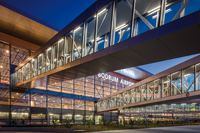
The new terminal has eight aerobridges.
Tabanlioglu creates showpiece terminal
01 August 2012
BODRUM, a sought-after summer destination of Turkey that receives more than two million foreign visitors each year, has a new showpiece airport terminal that has been designed to breathe new life into the monotonous environments normally associated with such facilities.
By maximising on daylight through the sides and the roof, minimising on the use of columns, and using high, innovatively designed ceilings that enhance its spaciousness, the new airport terminal addresses the needs of the aviation sector while keeping passenger comfort in focus.
Work on the building at Bodrum Milas International Airport started in 2011, 13 years after a design competition was launched for the project by the General Directorate of State Airports Authority of Turkey.
Turkish architectural firm Tabanlioglu Architects, which was assigned the responsibility for the project’s design, conceived it as a transition between international and regional influences. The building has been constructed using the latest technologies, building methods and materials and features state-of-the-art passenger facilities, security systems, retail areas, airline lounges and glass-clad aerobridges. Construction of the project took just 15 months and the building opened its doors to passengers on June 3.
Bodrum airport is located 40 km from Bodrum city centre, 15 km from Milas and 8 km from Gulluk, which is the closest coast. Following the expansion, the capacity of the airport has been increased from 1.5 million to five million passengers a year. The new 455,000-sq-m terminal is positioned between the domestic and international terminals, parallel to the apron.
The airport has been designed to improve efficiency of operations while enhancing comfort and convenience for travellers. As a departure from the pressure and monotony associated with these facilities, the terminal aims to balance the need for secure, efficient operations while relieving passengers of the tension created by such environments.
 |
|
The flyover to the departures section. |
Elaborating on the project design, a spokesman for Tabanlioglu says: “The building consists of two main structures, namely, the airside, which comprises the airbridges that are transparent glass and steel linear scaffold structures and the terminal building at the landside.”
The entrance/exit area of the terminal, on the south side of the building, is clad in partially screen-printed sheer glass and opaque glass while the eastern and western sides of the building feature local natural stone walls.
“Thanks to the special extra-clear glass used on the northern part of the apron side, overlooking the aircraft landing and takeoff area, passengers can enjoy a vista that extends from the meadows up to the mountains behind through the uninterrupted glass. On the southern, eastern and western parts of the air side, the use of serigraphic glass allows daylight in a controlled manner. The mild veil effect also supports temperature control,” says the spokesman.
The arrivals area is located on the ground level while the departures area is on the upper level and can be accessed directly via a flyover from the open car-park as well as two towers linked to the flyover. All the mechanical systems and storage areas are located on the ground floor to keep the roof clear as it is within view of the air traffic as well as to enhance the view of the terminal from overhead at night particularly on account of the rooflights.
The spokesman continues: “Steel columns that carry roof trusses and the roof form the main structure of the building. This has helped minimise the use of columns in the interior areas, enhancing the spaciousness of the terminal building. Load-bearing columns are left as exposed concrete for aesthetic purposes.”
 |
|
Waiting lounge at the airport ... minimal use of columns. |
The suspended ceiling, designed by Tabanlioglu Architects especially for Bodrum Airport, consists of aluminium rods in the shape of reeds, resembling a weaving loom that symbolises the carpet weaving industry of the region.
“The basic motif of the ceiling is derived by the combination of four different modules, each weighing only 3.5 kg. The light weight of the textured material that hides the mechanical systems such as ventilation, electricity, fire sprinklers and lighting facilitates maintenance of the facility,” he says.
Seen between the aluminium ‘rods’ is the deep blue background which makes reference to the Bodrum Sea while creating a three-dimensional effect.
Natural daylight diffuses into the internal space of the 9-m-high terminal through 18 skylights above the suspended ceiling.
“The expanse of the terminal is accentuated by the lofty ceilings, the innovative suspended ceiling as well as the use of black marble, which has been mined and processed in Yatagan, close to the airport site,” says the spokesman.
Passenger comfort and convenience has also been accorded a high priority. While the design of the primary elements of the terminal focuses on ensuring easy circulation, clear directions and efficient organisation, the secondary elements and finishes aim to create an atmosphere that promotes relaxation and a holiday spirit. A total of 33 check-in counters, waiting areas, cafés and toilets are conveniently located as are tourist coach facilities for arriving passengers. The duty-free area and the connected restaurant section receive natural light that filters through the suspended ceiling.
Passenger-friendly seats – purpose-designed by Tabanlioglu in co-operation with Nurus, a Turkish designer furniture brand – are strategically placed to ensure passenger comfort for reclining between flights. Additional features include four terraces on the land and air sides that allow passengers to enjoy an outdoor setting despite being within the controlled environment.
The volume of passengers at the building’s entrance is regulated – thanks to double-direction circulation provided from the first control point. This enables the airport administration to keep one wing as a reserve area during off-peak seasons, in order to lower the maintenance and operation costs.
The incoming baggage is received through a total of five carousels in the baggage area which has a 6.7-m-high ceiling. At the exit, there are kiosks for duty-free, car rental, currency exchange and other amenities, as well as a well-equipped clinic in both the arrival and departure areas that connect via an internal elevator.
The terminal has eight aerobridges – one of which can handle larger aircraft – set in a green landscaped area featuring banana and olive trees, daphnia and paper flower, all suited to Bodrum’s climate.
The facility also includes a CIP (commercially important person) area, which will be leased as a ‘general aviation terminal” to be used by businessmen coming to Bodrum with their private aircraft.
 |
|
Loft Gardens ... an award-winning Tabanlioglu Architects project. |
Following the opening of the new building, the existing international terminal will serve domestic flights, while the old domestic terminal will be demolished and the site reserved as a private jet park.
The airport also has an open parking area with a capacity to accommodate 114 buses and 426 cars, a large part of which is reserved for tourist buses as the airport generally receives charter flights.
“Bodrum International Airport was planned in the most effective way from both the technical and mechanical aspects,” says the spokesman, adding that the use of local materials supported the environment-friendliness of the structure.
Tabanlioglu Architects has its head office in Istanbul, Turkey and employs more than 80 architects and 20 administrative staff members. It was established by architect Murat Tabanlioglu in collaboration with Dr Hayati Tabanlioglu in 1990. Architect Melkan Gürsel Tabanlioglu joined the company in 1995.
In the recent past, the company’s scope and portfolio has enhanced, to provide services worldwide in architecture, consulting, master planning, interior design and coordination of related services such as engineering and restoration.
The firm’s extensive list of completed projects include Loft Gardens, Sapphire, Pelican Mall (Avcilar E5), Marmara Forum, Asmaçati shopping and meeting point, and the Middle East Technical University Student Centre in Turkey; Tripoli Congress Centre and Sirte Lounge in Libya; and Sipopo Congress Centre in Equatorial Guinea.
In addition, its assignments include Zorlu Center, Zorlu Levent Office Tower, Istinye Residence, Alaçati Summer Resort, Kisebuku Summer Resort, Çankaya Mosque Renovation, Esas Headquarters and Ziraat Bank Office Tower in Turkey; and Al Hada Complex in Saudi Arabia.
Tabanlioglu has been awarded several international and national prizes. Last year, Astana Arena was named the winner of Public Section Asia-Pacific Region by International Property Awards; and the Loft Gardens project received 2011 Riba International Awards for excellence.
- Turkey comes up trumps
- Tabanlioglu creates showpiece terminal
- Liebherr helps shape Istanbul skyline
- Turkish ceramics regain Mideast market share
