

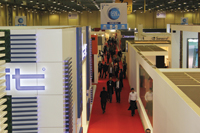
Visitors at this year’s Unicera, a major showcase for Turkish ceramic products.
Turkish ceramics regain Mideast market share
01 August 2012
THE Middle East has re-emerged as one of the biggest export markets for Turkish tiles and sanitary ware products such as wall and floor tiles, vitreous wares, granite and glass mosaics, accounting for $90.5 million worth of imports in the first six months of this year.
This growth is mainly due to the rising demand for premium-quality ceramic tiles and sanitary ware from large construction markets such as Iraq, Saudi Arabia and Qatar, says Bahadir Kayan, president of Turkish Ceramics Promotion Group (TCPG).
“Turkish exports had dropped by 35 per cent in 2008 due to the global crisis. But since then, year after year, export volumes have been improving and we are now witnessing the same level of business we had in 2007,” he remarks.
 |
|
Kayan ... export surge. |
Kayan says that Turkish ceramic products enjoy technological superiority over their rivals as most of the companies began their production in the 90s and are now ahead in the race as they constantly upgrade their technology.
“The designs of Turkish ceramics have distilled thousands of years of tradition and combine today’s modern technology and perspective, adding aesthetic qualities to life,” says Kayan.
“The average price has also seen a nice upward trend due to the product portfolio. Supported by the local construction boom and the market diversification efforts of the industry in exports, Turkish Ceramics has overcome the crisis and can claim to be the fittest as of today,” he adds.
Turkey, which ranks first in Europe in ceramic tile production, has seen its share surge over three per cent in the global ceramic tiles market.
Its total tiles and sanitary ware exports in the first half of this year rose to $401.7 million with the European Union netting the lion’s share ($187 million) followed by the Middle East ($90.5 million) and the US ($31.3 million).
“Since Turkey has been exporting to a wide geography for a long period of time, each of our industry members have certain markets they focus on,” says the head of Turkish Ceramics, which comprises 28 local companies including ceramic giants such as Kale, Kutahya Porselen, Seramiksan, Seranit, Bien, Vitra Karo and Ege Vitrifiye Saglik.
“However, our key markets will always be Europe, the Middle East, Russian-speaking states including the CIS where Turkish is being spoken, and North Americas where Turkish tiles have gained ground due to our past trading efforts,” he adds.
Turkish Ceramics companies are eyeing the construction boom in Qatar, which plans to spend nearly $100 billion in preparation for hosting the 2022 World Cup; and Saudi Arabia, which is set to spend $400 billion over the next five years on infrastructure; as well as the lucrative Iraqi market.
Kale, the oldest and the largest ceramic producer in Turkey, continues to maintain its leadership status through innovation. It has recently introduced Kalesinterflex, a thin and flexible porcelain ceramic tile produced using breakthrough eco-friendly technology.
The wonder product allows it to be bent to conform to contoured surfaces – making it ideal for covering interior surfaces of tunnels and underground stations in the region, remarks Metin Emir, the company’s Middle East project supervisor.
“The best part is that Kalesinterflex can be cut using standard glass and ceramic cutters, or computerised automatic cutting and drilling machines, in the desired dimensions,” he adds.
Kale has been supplying ceramic tile and bathware to several high-profile projects in the Middle East and around the world, Emir says.
 |
“Iraq and Saudi Arabia have turned out to be our biggest markets in the region. We have already sold products worth $20 million to the region,” he adds.
The group has an annual production capacity of 27.5 million sq m for wall tiles, 32 million sq m for floor tiles and 6.5 million sq m for granite ceramics.
Emir says the group is well represented in the Middle East through its distributors Al Shaibani in the UAE and Traco in Saudi Arabia, besides Lebanon.
On its regional plans, Emir says: “We are launching our brands in the Lebanese market. Our focus on the region is also valid for the projects market, where we serve via our project consultants.”
Another key product that Kale plans to launch in the region is the Aquasmart bath tub that helps in reducing water consumption.
Meanwhile, Kutahyah, another big name in Turkish Ceramics, has a major presence in Saudi Arabia (Riyadh and Jeddah) besides Kuwait and Lebanon.
It has recently launched its series of floor tiles, vitrified porcelain in different dimensions (from 10 by 10 to 50 by 100 cm) besides its exquisite wall tiles and glazed porcelain.
“Today, with a production capacity of 50 million pieces per year and 150 different pattern choices, Kutahya Porselen is one of the three largest manufacturers of Europe (in the ceramics sector),” says Fatih Ozcelebi, the export director.
“Our main export markets are Iraq, Azerbaijan, Turkmenistan and the Scandinavian countries, which are the most popular markets for our 10 by 10 tile models,” he notes.
“We export a lot to Iraq. Thanks to our local distributor Salih, we have been getting regular orders. Annually, our quota is 400,000 sq m products per year to the country,” he adds.
Bien Ceramics, one of the Turkey’s leading producers of ceramic tiles, has an annual production output of 22 million sq m and a $100 million annual income.
Bien is constantly expanding its portfolio adding 30 new designs every year to an already impressive variety of 1,200 designs, according to Mehmet Ozmal, the export and operation manger.
“We specialise in high-quality, aesthetic, durable, innovative wall and floor tiles of various materials including glazed porcelains, small-sized dot-mounted tiles, decors and listellos.”
“Bien is also amongst the pioneers in producing wall tiles from 9.7 by 9.7 cm up to 30 by 80 cm using digital printing technology and high standards,” he notes.
 |
|
Ottoman Collection ... newly introduced by Kale. |
Bien, he says, exports its products to more than 40 countries and has 130 showrooms across five continents.
Ege Seramik, a leading player in the ceramic industry, says it aims to enter the Gulf region especially the Saudi market ‘in a big way’ offering its comprehensive product portfolio.
The Turkish major says it has a production capacity of 650,000 pieces, which aims to increase to 1.5 million pieces per year through heavy investment in new technology.
“One-third of our output is being exported to key markets including the US, Azerbaijan, the Middle East and Europe. We are now introducing a new series Emperador produced using HiCoat nano technology, besides the Carrara, Onyx and Reflexion, which are sure to be a hit in markets such as the Gulf and Iraq,” says Mustafa Angay, the company’s sales support and export manager.
According to him, the northern Iraq region is the company’s prime market, thanks to the ongoing housing boom there.
“In the last two months, we have shipped 120 containers of ceramic materials worth $1 million there,” says Angay.
The company plans to launch its brand new products including the 60/120 glazed porcelain and 80/80 in the Middle East region.
“Beside this, we also have our specialised tiles fitted with sparkling stones priced at $60 per piece. The product is in big demand as the sparkle gives it a majestic appearance,” he adds.
Another major player in the Turkish tile sector, Seramiksan has a major presence in the Middle East and is now planning to expand its market in the region.
The company, which was founded in 1994 in Turgutlu, boasts an annual production capacity of about 28 million sq m mostly of wall and floor ceramic tiles, unglazed porcelain and ‘soluble-salt’ tiles polished with nano technology.
“We have good contacts in the Gulf region and plan to start our distribution unit in the UAE. We are in talks with some firms and hopefully by the end of the year we will start operations from there,” says Suleyman Demirhan, the company’s export representative.
“At present, there is a big demand for our glazed porcelain tiles with a natural, lappato and full lappato finish,” he adds.
The company, he says, has a solid order book for the year with major export orders from Kenya, England, Armenia and Georgia, besides the key Middle Eastern markets including Iraq, Palestine and the GCC.
On the impact from the global crisis, he says: “In 2008, we were slightly affected but could soon tide over the crisis through our entry into newer markets which were lucrative as well. We are constantly expanding with the introduction of new products.”
On the company’s new products, Demirhan says: “One of Seramiksan’s sister companies recently launched the Dekosan brand (in deco and listello) in the Middle East. It is doing well and in fact we have started getting the biggest orders from the Gulf region.” Among other major companies in the porcelain tiles sector is Seranit, which indicates that the Middle East remains a prime market for the group.
The company boasts of a production output of about 16 million sq m which it plans to raise to 40 million sq m, says Alaeddin Ergen, the export co-ordinator of Seranit.
Ergen says in the Gulf region, it has recently supplied big orders for high-profile clients including one for Zamzam towers, a 48-storey residential project in Makkah, Saudi Arabia.
“Besides, we have also completed another big shipment for a Kuwait-based showroom and also for a facade system in Saudi Arabia,” reveals Ergen.
Seranit says it has now set its sights on the booming Qatari construction market, where the government has announced big spending on infrastructure projects.
- Turkey comes up trumps
- Tabanlioglu creates showpiece terminal
- Liebherr helps shape Istanbul skyline
- Turkish ceramics regain Mideast market share
