

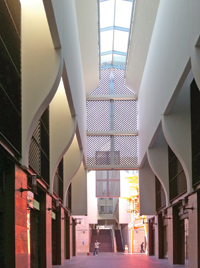
Wrightstyle systems ... installed in the Beirut suqs.
Wrightstyle puts safety first at malls
JANE EMBURY, director of Wrightstyle, a UK-based steel glazing company, looks at fire safety in the Middle East’s evolving shopping mall environment.
01 January 2013
Dubai has just announced plans to build the Mall of the World, which will be the world’s largest, outstripping the Dubai Mall that currently has 1,200 shops and 160 food and beverage outlets. It’s projected to attract some 80 million visitors annually, buoyed by the UAE’s booming tourism industry.
Large-scale retail developments are also planned to open over the next three years in the other emirates of the UAE as well as in Qatar (Doha Festival City), Egypt, Oman and Lebanon.
The ubiquitous indoor shopping mall draws in customers to shop in a single air-conditioned space and, as Middle East trends suggest, hotels too are being developed as part of the new shopping centres.
However, it’s interesting to note that in the US – the original home of the shopping mall – the shopping centre is in retreat. While the US has more than 7 billion sq ft of shopping centre space (amounting to 23 sq ft of shopping centre space per US citizen) the last indoor US shopping mall opened in 2006. Rents have remained largely static for several years, and vacancy rates have been rising since 2007.
Indeed, demonstrating how international retail has changed, of the top 10 largest shopping malls in the world, all are outside the US, with only the West Edmonton Mall in Canada making that Top Ten list. The rest of the list is made up of malls in Thailand, Iran, Turkey, Malaysia and the UAE.
One cautionary tale is the New South China Mall in Dongguan (covering nearly 6.5 million sq ft) – which some sources list as the world’s largest – which sees such small visitor numbers and has such a high vacancy rate that it has been classified as “dead.”
Creativity imperative
The requirements for “super-malls” is the same the world over – create must-go-to destinations, even if you don’t want to shop. For example, the Utama Mall in Malaysia has an indoor rainforest and the largest rooftop garden in Southeast Asia, and the CenterWorld Mall in Thailand has an indoor lake complete with sea lions.
All of which underlines how shopping malls have changed our buying habits, changed the face of urban landscapes and are reinventing themselves for the 21st century. The Mall of the World, for example, plans to incorporate a park larger than Hyde Park in London, complete with golf courses (see UAE Focus).
Fire safety
However, these mega-structures have special requirements with regard to fire safety, because a shopping mall isn’t one building. It’s an interlocked building, with multiple occupiers – with the range and complexity of those occupiers becoming increasingly diverse.
 |
The Langham Place in Hong Kong … key projects that used Wrightstyle systems. |
In a changing retail environment, there is great onus on mall managers to revisit fire safety plans and procedures because incorporating a hotel or amusement park changes the nature of the fire threat and the age profiles of potential visitors.
Current safety requirements require collaboration between the designers, developers, fire system installers and the centre’s management team. It’s the reason why shopping centres in the developed and developing world are so safe.
But, as the face of retail changes, it’s as well to remember how the smallest of insignificant fires can have devastating consequences.
The worst such event in recent history took place in Paraguay in the summer of 2004. It involved a small fire, which started in a fast-food outlet in the Ycuá Bolaños supermarket on the outskirts of Asunción, the country’s capital city. The final toll was 364 dead, nine simply “disappeared”, and nearly 500 injured. Forty-six children died. The sheer scale of the tragedy so overwhelmed local health services that burns victims were also treated in nearby Uruguay.
Here in the Middle East, the Qatar shopping centre disaster offers more pertinent lessons: a small fire in an electrical socket that went on to claim the lives of 13 children, mostly from smoke inhalation, four teachers and two firefighters. The fire alarm, according to an eyewitness, sounded almost “like a door bell” – which many people ignored.
However, in developed or developing countries, the threat from fire is being slowly reduced with stricter building regulations covering both passive and active fire safety measures – everything from better systems to detect the fire early to better sprinkler systems to put it out.
The International Association for the Study of Insurance Economics (better known as the Geneva Association) says that – in the developed world – the cost of fire has reduced over the past decade from 0.28 per cent to 0.16 per cent of the GDP (gross domestic product), and the risk of dying in a fire has fallen from 1.88 to 1.34 per 100,000 of population.
The Paraguay fire started with just an ember from a chimney, and that’s how most catastrophic fires begin – often just a dropped cigarette or a spark from faulty wiring, as in Qatar. If dealt with adequately, most fires pose little threat. But when a fire does take hold, occupants must be able to get out quickly and safely.
 |
Ocean Terminal Two in Edinburgh, Scotland |
Kitchens, most obviously, are a key source of risk but fire safety in complex buildings is determined by many different factors, including means of escape, the ability of a building to resist the effects of fire and minimise the spread of fire and smoke.
Fire is spread through three methods: convection, conduction and radiation, of which convection is the most dangerous. This is when smoke from the fire becomes trapped by the roof, spreading in all directions to form a deepening layer. Smoke, rather than fire, is often the real danger.
Materials such as metal can absorb heat and transmit it to other rooms or shops by conduction, where it can cause new fires to break out. Radiation transfers heat in the air, until it too sets off secondary fires, spreading the danger away from its original location.
The fact is that shopping centres can be extremely complex, with potentially large fire loads and equally large numbers of people within a series of spaces that can include hotels, food-courts, cinemas, restaurants, bars, as well as offices, with most people unfamiliar with the shopping centre’s layout and exits.
As Dubai is demonstrating with the Mall of the World, and others elsewhere, the complexities are multiplying, with the huge interior spaces in use, in some cases, 24 hours a day, seven days a week.
That’s why compartmentation is so important, dividing the building into discrete fire zones, with retardant materials to limit the spread of fire, and an adequate sprinkler system able to extinguish the fire at source. The fire safety approach involves engineering assessments based on computational fluid dynamics and zone models.
 |
The Golden Hall shopping centre in Athens, Greece |
That’s also where Wrightstyle’s advanced systems come in, with its internal and external steel and glass systems having been tested together, to US and European standards, and subjected to furnace temperatures of well over 1,000 deg C – testing the strength of the glass, the protective level of the glazing system, and their overall capability to maintain compartmentation in a fire situation.
This is the core function of an integrated glass and framing system: to provide an effective barrier against the passage of fire, heat and toxic gas and, by preventing oxygen from reaching the seat of the fire, inhibit its progress. This allows people to escape and, by containing the fire, minimises fire damage.
The main lesson from Qatar and Paraguay is that fire can spread with devastating speed, particularly in a large open space such as a shopping centre. The key is containment, trapping the fire, and allowing people to escape – which is what Wrightstyle systems are helping ensure in shopping centres around the world.
As shopping malls grapple with a changing future, becoming destinations for much more than retail activity, the issue of fire safety should once again be a key priority.
In the Middle East, Wrightstyle has supplied to a number of prestigious projects including the Beirut suqs in Lebanon, Dubai Metro and other projects in the UAE, as well as in Qatar and Egypt.
- Wrightstyle puts safety first at malls
- Assa Abloy to showcase solutions at Intersec
- Somfy brings home security to your fingertips
