

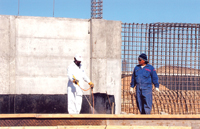
Masa pest control operators at work.
IPM integration vital in building design
NAIMUL HASAN* stresses the importance of taking a proactive approach in proofing structures against pests at the construction phase rather than having to tackle the issue once infestation sets in.
01 January 2013
A holistic approach, including proactive measures to ensure environmental safety, needs to be taken prior to constructing an industrial facility to prevent it from being infested with pests. In a bid to erect pest-proof or pest-resistant buildings, construction engineers should take future concerns with implementing an integrated pest management (IPM) strategy into consideration in the design and construction of a structure.
Construction engineers must aim for a termite-proof structure at the design stage rather than having to deal with the problem when infestation occurs. Soil treatment for the subterranean termite is the first step in such efforts, with the major objective of a pest control specialist being to establish a chemical barrier between the termite nest (usually in the ground) and the wood (in a structure). To do so, the operator or the applicator must be knowledgeable of the different types of construction and should be well-versed in determining the points of entry to block them.
Pre-construction treatment
Pre-construction termite treatment or termite-proofing refers to the application of termiticide emulsion during the construction stages of a building, starting from the foundation footings. It depends on the construction technique as well as the structural composition of the building. This treatment will guarantee a complete chemical barrier to control or prevent termites that is more effective than post-construction applications.
In Saudi Arabia, prevention or proofing is focused on soil poisoning. The types of pre-construction treatments include:
• Foundation treatment, which involves the application of termiticide at the excavated pits prior to the pouring of the cement for the foundation footings and/or walls of the building. This application will prevent the entry of termites through cracks that may develop in the foundation;
• Slab treatment refers to the application of termiticide at the pre-slab backfill prior to pouring of concrete; and
• Perimeter treatment, which entails the application of termiticide at the perimeter of the building. This is usually done when the building is finally erected with walls and all other structures complete and/or before the outside perimeter pavement (concrete) is placed.
Subterranean and dry wood termites cause serious problems in structures worldwide. Prevention of termite attack is preferable to remedial control, due to the structural damage that will inevitably occur prior to detection and control of an active termite infestation. In short, prevention includes:
• Proper architectural design;
• The use of termite-resistant building materials, such as preservative-treated or naturally-resistant timbers, or non-cellulosic building products;
• Installation of either physical or chemical barriers beneath and around the perimeter of the structure to prevent penetration by foraging subterranean termites; and
• Possible installation of a network of bait/monitoring stations within or around the structure.
Termite-resistant building materials and physical barriers to termite penetration have gained importance following the phasing out in most parts of the world of the long-lasting cyclodiene soil insecticides, and increasing environmental concerns over possible ill effects from applications of large quantities of liquid insecticides for termite control.
Good design practices involve avoiding any contacts between wood and the soil; avoiding construction details that may trap water within the structure; keeping structural wood dry and controlling moisture conditions beneath and around the structure; and ensuring that portions of the structure that are prone to infestation can be readily inspected.
Soil insecticide applications represent the most widely accepted method of creating a barrier to termite penetration.
Rodent-proof construction
Rodents are the most dangerous pests for human beings as they spread diseases, destroy crops, stored grains and other materials, and damage all kinds of structures if they gain access to them.
Many types of land, air, and water transportation systems and their infrastructure also face serious rodent infestation problems.
Rodents destroy insulation, electrical wiring, plumbing, and other structural components of buildings. Insulation damage alone may amount to a loss of several thousand riyals in a matter of just a few years. Rodent-induced fires from damaged electrical wiring or nest building in electrical panels cause loss of property and threaten human safety.
To limit rodent damage, new buildings should be designed and built to prevent rodent entry as this is less expensive than having to tackle the issue later. Nevertheless, poor maintenance or management practices, such as leaving entry doors and unscreened windows open, will make the best constructed building susceptible to rodent entry.
Several types of building structures have common rodent entry routes because of a similarity in design (particularly entry and service areas), utility sources, and building equipment.
In broad terms, similar structures and settings can be grouped as follows:
• Commercial offices, buildings, hotels, hospitals, and retail stores: Commercial buildings are constructed from materials that vary greatly in their susceptibility to rodent infestation (for example, metal and concrete versus wood). However, most structures eventually become less rodent proof due to deterioration, alteration, or repair.
Heating, air-conditioning, plumbing, electrical service, and fire sprinklers provide some of the most commonly encountered rodent entry points. Even in new buildings, utility pipes, electrical conduits (often at meters or circuit breaker panels), water and gas lines, and communication cables generally have large openings that permit entry of mice and rats.
Once these rodents have entered the premises, they generally have ready access to much of the building via holes for utility pipes and wires in the framing, and via overhead suspended ceilings or other types of construction adjacent to utility enclosures.
• Food handling facilities and warehouses: Areas where food is stored or handled are especially prone to rodent invasion. Also, good sanitation practices are essential to control the pest population. Scraps of food can often be found in floor drains, under food preparation equipment and stored products, and around refuse and entry areas. Entrance doors are often left ajar or fit poorly due to heavy use, physical damage, or improper installation.
Space under equipment (mixers, stoves, counters, or refrigerators) should allow easy cleaning and inspection, or be closed off completely with rodent-proof materials.
Power lines have always been a favourite route of travel for rodents and rats and mice have access to the roof via wire, pipes, plants, or rough-textured walls and roof joints.
In manufacturing plants and farm buildings, overhead or underground pipes, conveyor belts, and augers are often used as routes into and between buildings. Such equipment, particularly, if abandoned, may provide harborage. This apart, rodent-proofing these areas is not easy if the equipment is still in use.
If work patterns require doors to be kept open at night when rodents are most likely to enter, rodent barrier may be needed, such as solid fences or walls or metal wing walls between the foundation and adjacent loading dock areas. Sections of prefabricated buildings should be assembled tightly, and gaps at joints should be covered with metal flashing.
Excluding rodents from livestock and poultry operations is another challenge due to livestock and manure management and various animal husbandry practices. Nevertheless, rodent-proofing is important and can be accomplished.
Exclusion of rodents from an existing infested building can be tackled by taking care of holes and openings, vents and windows, external doors, foundation and floors, gaps or flaws along building exteriors. While rodent-proofing of drains and pipes and placing of physical barriers/guards can prevent rodents from entering especially in storage areas or godowns and food preparation and handling areas, care should be taken around livestock feed bunks and bins, feed and refuse storage.
The degree of a structure’s susceptibility to rodent infestation depends on several considerations that the architect, engineer, builder, and end-user should keep foremost in mind prior to and during construction.
* Naimul Hasan is an entomologist, fumigation expert and pest management professional at Masa Establishment for Pest Extermination, Maintenance and Contracting.
