

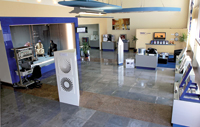
Trox’s Middle East Centre of Excellence in Dubai.
New Trox facility a breath of fresh air
Trox Middle East’s Centre of Excellence in Dubai features the first and only air flow studio in the region where various air-conditioning products and systems can be tested in real time.
01 April 2013
CUSTOMER satisfaction is at the core of its business ethos, says Trox Technik, a world market leader in the field of ventilation and air-conditioning components and systems, whose approach to this complex field is summed up in the words of the chairman of its supervisory board Heinz Trox prominently displayed at its premises: ‘The human being is the yardstick and his well-being is our goal’.
“In today’s environment it has become so much about cost – Capex (capital expenditure) and Opex (operating expenditure) and how we can ‘value engineer’ a solution – but at the end of the day, an HVAC (heating, ventilation and air-conditioning) solution is only successful if the person sitting in the space is happy,” explains Thomas Orr, managing director of Trox Middle East. “Sometimes we tend to forget that.”
But how can consultants, architects, contractors and interior designers ensure that this goal is met? The easiest – and indeed the best – way, according to Orr, is to take a couple of hours out of their busy schedules and visit the company’s Middle East Centre of Excellence in Dubai, UAE. Once there, consultants can engineer a real-life solution and then test it in real time in the region’s first and only air flow studio where Orr and his team of experts can demonstrate mock-up testing of various products and systems.
“What we try to engineer is indoor air comfort,” Orr continues. “A lot of people refer to indoor air quality (IAQ) but that is a very small part of environmental comfort. We look at indoor environmental quality, which is the overall quality of a building’s interior and the comfort and health of the occupants. What we focus on are the direct things that affect you when you are sitting at your desk.”
Orr’s checklist is comprehensive: volume of air – how much air is coming into a room; the percentage of outdoor air; the IAQ; the space temperature; the humidity; the sound levels, the velocity of the air and the temperature difference in various parts of the space. Other indirect factors less apparent to occupants – but of equal importance – are the control systems, safety, and energy efficiency.
To show how Trox deals effectively with all of these issues, the company has set up the air flow studio, which allows the company to portray the efficiency of its devices in a stunning visual way.
Essentially, the testing facility is a glass-fronted room with a variety of different Trox air distribution solutions installed – ceiling, chilled beam, displacement, and wall-mounted and floor-mounted diffusers. Smoke is then bled into the air flow, which is pushed through the diffusers at different temperatures and flow rates and the air flow can be seen in real time.
Real-life conditions are replicated with a variety of heat sources affecting the space. In the studio are three mannequins each set up to emit 85W – the heat a normal person would produce seated at their workspace. Heating lights are installed to reproduce the effect of incandescent lighting and there is a heated wall to replicate the effect of sunlight falling on an exterior wall or window at varying degrees of intensity. Sensitive probes that measure air temperature and velocity are set up at 1.8 m (standing), 1.4 m (sitting) and at ankle heights, to check the effects of the cooling for people wearing national dress and sandals as opposed to shoes and socks.
 |
|
The testing room ... can be used to test proposed project set-ups while they are still in the design stage. |
“You are able to view air collisions, how air reacts to interior and exterior façade walls, and also what transpires from discharge, through induction/displacement, and then return,” says Orr.
Data covering the room size, the readings from the probes giving velocity and temperature, and how much air is put into the room, are all recorded in real time and can then be printed out for analysis.
Best of all, the studio can be used to test proposed project set-ups while they are still in the design stage. For example, Orr and his team organised a test for the air-conditioning for the grandstand areas of the swimming pool at Hamdan Bin Mohammed Bin Rashid Sports Complex in Dubai to prove the efficacy of the air-conditioning systems and prior to the opening of the air flow studio, the bedroom arrangements for the Burj Al Arab were tested at the company’s extensive facilities in Germany.
All this supports Trox’s basic philosophy: “We don’t want to sell you just any diffuser; we want to sell you the right diffuser. And the right volume controller. And the right filters and so on,” Orr explains. “Most people know Trox and know it is a quality product. So what we are trying to sell here is on a professional and technical level. We also want to show people that Trox is an effective and reliable partner.”
Another key element of Trox’s offering is its online product selection software which can be downloaded from its website free of charge. This allows the consultant to select a diffuser type and through clever modelling, check the efficacy of the system before drawings are even rendered. The key is the comfort zone that stretches from the floor up to a height of 1.8 m – the average person’s height. The conditions above this point are irrelevant to the occupant. “We need to know at that height (1.8 m) what the conditions will be, that is, the temperature, the temperature change, and the air velocity. Air needs to come out of the diffuser fast enough that it doesn’t dump onto occupants,” Orr says. “Most people have a number (for air speed) in their head at which air must discharge from a diffuser but we say that it doesn’t actually matter (provided noise criteria are met). What matters is the velocity when it gets to the comfort zone. On filling out the room dimensions and temperature difference, a simple click will tell you everything you need to know – the velocity of the air, the pressure drop, noise levels etc.”
If consultants need to include the diffuser on their CAD drawings, the Trox selection system will provided a 3D drawing with sizings which can be exported directly into the consultant’s own drawings. Once a decision is made, the user can go straight to order detail which tells him exactly what he needs to order and then exports the data to an Excel file. “You just keep on adding items and at the end of the day your bill of quantities is done,” explains Orr.
“If you don’t know what you want, the air diffuser room wizard is a step-by-step guide to what you should be looking for. You input the type of diffuser, height, length and width of the room, the volume and temperature of the air, and the wizard will present a solution.”
The centre of excellence also serves as a showroom for the latest technical innovations the company has to offer. These include the Flextro flexible plenum box for ceiling diffusers. Historically, Trox has found it difficult to sell plenum boxes because of the costs as Orr explains: “Many people prefer not to import proprietary plenum boxes because it costs a lot of money – you are effectively shipping a lot of air. So Trox has come up with a knock-down plenum box. It arrives flat and can be assembled in just 60 seconds.”
The Flextro has a PVC fabric top, which combines aerodynamic function with easy handling and is 50 per cent lighter and 60 per cent cheaper to ship than a conventional unit. It has a double-lipped spigot and adjustable damper blades that can be moved in 15-degree increments and can be fitted with a wide variety of different ceiling diffusers and hence be integrated into any type of ceiling system.
 |
|
Xarto swirl diffusers ... produced using new materials. |
Popular among architects and interior designers are Trox’s new Airnamic and Xarto swirl diffusers, which are the result of extensive development work using new materials such as ABS plastic technology, which has enabled the production of three-dimensionally profiled blades, thus allowing high-volume flow rates and low sound and power levels.
“The Airnamic is capable of handling a lot more air with the same properties as a conventional galvanised 2D swirl diffuser, the same noise and pressure drop – as it creates an optimal swirl. Architects and interior designers love the Xarto as we can do bespoke designs on the faceplate and it provides a solution for every creative or architectural concept,” Orr comments.
Traditionally, slot diffusers come with pre-set blades that are fixed at the factory. However, Trox has the VSD range of slot diffusers that have a rotating barrel, which can be easily adjusted even after the diffuser has been installed. The barrel adjusts the blades to a possible six different orientations. The VSD range comes in different sizes, with one to four slots of different widths, options for black or white insets and can be flangeless.
Orr is keen to get the message out that Trox is the place to come for professionals seeking a different kind of service and technology in air-conditioning and believes they can gain maximum value when Trox is involved right from the start. “We would love to be involved in every project from concept and we have the expertise to do it. If we don’t have the answer in Dubai we have 3,300 employees globally, just a call or an email away, who will have the answer,” he points out.
“Access to our flow studio and presentations/demonstrations is free of charge – we give of our time and of our knowledge freely at all times and our goal is to be the enhanced HVAC supplier, and best-rated partner, for architects, project developers, and consultants, and a key supplier for contractors, distributors and other sales partners,” Orr concludes.
- New Trox facility a breath of fresh air
- Port-A-Cool taps into nature’s way of cooling
- Aldes innovates with Twisted 850
- Ashrae endorses DC manual
