

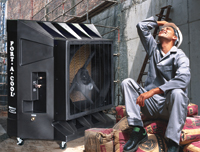
A Port-A Cool portable cooling unit model ... efficient cooling in hot work environments.
Port-A-Cool taps into nature’s way of cooling
01 April 2013
US-based Port-A-Cool has harnessed the advantages of a natural evaporative cooling process to provide cooling units that offer highly effective spot cooling in virtually unlimited applications.
Its portable evaporative cooling units considerably reduce temperatures, are cheaper than air-conditioners and can be used anywhere cooling is needed, and where traditional air-conditioning is impractical, unavailable or costly. In addition, they are environment-friendly and portable.
Explaining the cooling process, a spokesman for the company says: “Evaporative cooling is the cool sensation felt when wind blows across your wet skin. These units employ the same natural cooling process, using forced air over water-soaked evaporative cooling media thus providing a constant flow of cool, refreshing air into hot, uncomfortable environments and reducing temperatures by as much as 20 deg C.”
The units are suitable for various environments including agricultural and horticultural; manufacturing; industrial and commercial; business; entertainment; sports; home and recreation.
All Port-A-Cool evaporative cooling units are manufactured in Center, Texas, by Port-A-Cool, a member of the Walter Meier Group.
Port-A-Cool units such as the PAC2K36HPVS, which has a high-performance variable-speed motor and 36-inch-diameter fan blade, are superior quality products among portable evaporative coolers, and are available in 220 to 240V 50Hz units through authorised distributors in all GCC markets.
The evaporative cooling units are better than conventional fans because they cool instead of recirculating stale, hot air. Units are available to cool up to 400 sq m with the largest unit, or smaller models for tight spaces. They provide spot cooling where needed with no harmful chemicals or refrigerants and incur low daily running costs.
“Evaporative cooling is ideal for preventing heat stress,” the spokesman continues. “Heat stress can occur in people, animals and even equipment, says the spokesman. According to the US Occupational Safety and Health Administration (OSHA) and other agencies, employees required to work in high temperature environments should be allowed frequent breaks in a cool place to avoid symptoms of heat stress including nausea, dizziness, cramps, confusion, unconsciousness, seizure and even death. High temperature environments are generally referred to as those over 31 deg C for light work, over 28 deg C for moderate work and over 26 deg C for heavy work.
 |
“The evaporative cooling units turn a restrictive 45 deg C area into a comfortable 25 deg C area with the added benefit of reducing employee heat-related health issues, and increasing productivity with a cooler working environment,” he says.
Evaporative cooling is also beneficial in reducing heat stress in animals. Citing the Journal of Dairy Science, he says the estimated national annual losses to heat stress in the US – across all animal classes – are estimated at $2.4 billion.
Port-A-Cool portable evaporative cooling units accomplish an effective degree of cooling by using premium quality cooling media. The heart of an evaporative cooling system is the cooling media, or cooling pad, where the water evaporates and the air passing through the pads is cooled.
Evaporative cooling pads, like Kuul pads manufactured by Port-A-Cool, are constructed using the heaviest, highest-quality virgin fluted kraft paper and the highest resin content in the industry for maximum longevity, and are chemically impregnated with special compounds to prevent rot and ensure a long service life. Kuul pads outperform the competition in tests for high tensile strength/psi, high dry crush strength/ psi, and high wet crush strength/psi, the spokesman claims.
A point to be bear in mind however, says the spokesman, is that evaporative coolers are not air-conditioners. “Though evaporative coolers and air-conditioners both serve the same important purpose – environmental cooling – the two systems operate very differently. Understanding the difference can help get the most out of any system and minimise energy consumption,” he says.
Evaporative coolers cool air by filtering it through water, thus lowering the temperature of the air through evaporation. They produce a small amount of humid air because the air absorbs water during the cooling process. These systems work best when a small amount of outside air circulates into the space where the evaporative cooler is employed. This also introduces fresh air into the environment and reduces the risk of poor indoor air quality.
Air-conditioners, on the other hand, work by taking humidity out of the air. These systems produce cold, dry air and work best in an airtight environment.
The major advantage of an evaporative cooler is the initial equipment cost is also lower than air-conditioners – 50 per cent less expensive – to install and its operating costs are typically one-third those of an air-conditioner, according to the spokesman.
Along with lower operating costs and simple installation, evaporative cooling can be a perfect, ozone-friendly alternative to traditional air-conditioning. And while refrigerated cooling makes the air dry and uses chemical refrigerants, which can harm the environment, evaporative cooling is based on a totally natural process of air cooled by water and won’t dry out the air, irritate the skin, throat or eyes, or negatively affect the environment.
“Evaporative cooling is the healthiest way to cool because it replaces stale air with clean, fresh air many times an hour. The air is never recirculated which means smells and airborne germs are expelled.
“Portable evaporative cooling units by Port-A-Cool provide not just effective cooling solutions but also evaporative cooling without harming the environment with ozone-depleting chemicals,” the spokesman concludes.
- New Trox facility a breath of fresh air
- Port-A-Cool taps into nature’s way of cooling
- Aldes innovates with Twisted 850
- Ashrae endorses DC manual
