

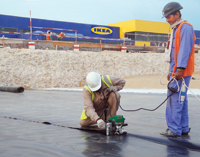
The Comet automatic hot wedge ... easy operation and clean working.
Leister puts seal on watertight solution
Leister’s Comet and Fusion machines were used to ensure the integrity of a massive reservoir tank for Ikea in Doha, Qatar.
01 May 2013
WELDING tools from Leister Technologies of Switzerland were used in yet another striking project, this time in Qatar for Ikea.
The leading Swedish furniture giant has recently opened a 32,000-sq-m sales office north of Doha. The building, which was constructed in a year, is different from the 300 worldwide branches of the company in one respect – it has a giant reservoir tank in which water from the surroundings is collected, filtered and used for irrigation.
 |
The tank, which is 42.4-m-long, 24.5-m-wide and 2.125-m-tall, has a capacity of 2,200 cu m. A special feature of this project is its support structure, which comprises plastic support medium drain trenches that have been stacked directly in the 6-m-deep trench, on a 15-cm-thick sand layer and the lower part of the sealing system. The individual support media – 17,670 in total – are made of polypropylene and each is 740-mm long, 400-mm wide and 420-mm tall. They not only support the sealing system with the collected water but also the 3.7-m-thick excavation of sand and earth that lies above the tank and that was filled back on completion of the tank as well as the car-park.
To ensure the integrity of the tank, the sealing system comprises two layers that support the entire structure on all six sides. A350 g/sq m heavy geotextile was laid as an inner layer. The outer layer comprises a 1-mm-thick high-density polyethylene (HDPE) sealing sheet.
 |
|
Stacked baskets in the foreground, behind the two-layer system structure with geotextile and HDPE sealing sheet. |
The Doha-based company Qatar Engineering Material Solutions (QEMS), which installed the system, joined the individual sheets with two Comet hot wedge automatic welding machines from Leister.
“This proven machine is predominantly used in civil engineering projects and in tunnel construction,” says a spokesman for Leister. “Thanks to its light weight of just 7.5 kg, it can also perfectly join vertical seams. Here, it is tensioned between the two overlapping sheets and then easily climbs even steep walls or – as here – descends them. In tunnel construction, it is even possible to use the machine for overhead welding.”
 |
|
The Comet welds two parallel weld seams with up to 1,000 N of pressure. |
With this project, a total of around 600 m of welding seams were processed at a rate of 2.5 m per minute.
“A special feature of the Comet is the upper and lower drive/pressure rollers that press the two overlapping sheets together after heating with up to 1,000 N of pressure, depending on material thickness,” the spokesman continues. “They create two parallel 15-mm-wide weld seams. The cavity in between them serves as a test channel after the welding process. The seal between the two weld seams can thus be tested using an injected test needle and compressed air.”
Leister is now offering the Comet as a USB version. With this, the relevant welding parameters of speed, pressure, temperature and covered distance can be easily saved and later evaluated.
 |
|
The handy Fusion 3. |
QEMS used the Fusion 3 extrusion welders from Leister for detailed work on corners, edges, pipe connections and for applying patches. “Unlike overlap welding with the automatic welding machine, the parts that are to be welded here are joined with an extruder. In doing this, plastic welding wire is drawn into the extrusion welder, shredded, melted and drawn over the parts that are to be joined as a finished extrudate. “The handy Fusion 3 outputs extrudate at up to 3.6 m per minute. In civil engineering, it is the perfect supplement to the hot wedge welder but is also often used for welding PE (polyethylene) or PP (polypropylene) plates and pipes when making plastic fabrication.
The two extrusion welders welded about 250 m of seams for the Ikea reservoir tank.
 |
|
Schematic representation of the overall system. |
In addition to hot wedge welders and extrusion welders, some hot air tools were also used primarily for detailed work. “Here, as always, the Triac S from Leister was a reliable tool that never failed even under adverse environmental conditions,” says the spokesman.
QEMS not only laid the entire sealing system, the company is also a distribution partner of Leister. It can, therefore, carry out its own service and repair work.
“In sales, customers therefore benefit from the valuable experience of the QEMS assembly teams. Customers also appreciate being able to obtain all of the equipment for processing plastic from one source – from a supplier that is represented all around the world, as they are here in Doha. In any event, upon completion the QEMS employees were rightly proud of the result of their work,” the spokesman concludes.
