

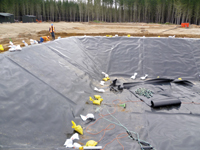
Modified PE geomembrane ... under installation.
New geomembrane is durable at high temperatures
01 May 2013
FOLLOWING intensive research, AGRU Kunststofftechnik has launched a new type of geomembrane made from polyethylene (PE) that provides increased durability at elevated temperatures thus extending the use of geomembranes to new applications.
“It is well known that degradation of polymers is accelerated at elevated temperatures,” says Fabian Beermann, division manager at BMC Gulf, the UAE-based agent for AGRU in the region. “Hence, geomembranes made from high-density polyethylene (HDPE) cannot be used continuously at temperatures above 40 deg C without a significant reduction in their life span. This has prohibited the use of geomembranes in many applications.”
“AGRU has now developed a solution for these applications. By using modified PE materials, geomembranes that are suitable for use in high ambient temperature environments can be produced. This opens new opportunities in various fields of applications,” he adds.
AGRU anticipates high demand for the product in the future especially in the field of renewable energies, such as for long-term heat storage facilities or facilities for geothermal energy.
Beermann says that the new geomembrane has already been put to test in a project in New Zealand where the company impressively demonstrated the product’s high temperature resistance.
The new modified PE geomembrane was used in the vicinity of Lake Taupe located in the middle of the northern island of New Zealand.
Near the lake, which is 40-km long and 400-m deep, there are several wells that bring boiling water to the surface. This brine is pumped into the nearby Ngatamariki power station to help generate electricity.
When the water is released from the power station, it has a temperature of 80 deg C and therefore cannot be discharged directly into the river because it would pose a danger to all flora and fauna in the area. It was, therefore, decided to build an artificial lagoon where the hot brine can cool down to ambient temperature.
“Geomembranes made from standard materials are not suitable for this type of application,” Beermann says. “Consequently, the high temperature resistant geomembrane from AGRU, made from modified PE, was selected for this demanding project. The AGRU team based at its New Zealand office, supervised this project and ensured that it was executed with great success,” Beermann concludes.
A multi-layer sealing system was used for the lagoon project, which has a surface area of 7,000 sq m. The system comprises a geotextile for protection, a 1.5-mm-thick HDPE geomembrane of standard quality, a swellable geotextile, and a 1.5-mm high temperature-resistant geomembrane.
