

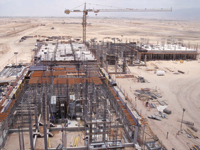
Salalah International Airport ... wide range of RMD Kwikform shoring equipment used.
RMD solutions raise two Oman airports
01 June 2013
FORMWORK systems from the UK-headquartered RMD Kwikform are being employed on diverse projects in the region, ranging from airports to pumping stations.
Among the most recent projects to utilise the company’s innovative systems are two international airport developments in Oman, where the speed they offer in erection and the support provided have been among the reasons for their selection. These projects include the new facilities in Muscat and Salalah.
RMD Kwikform’s self-climbing wall formwork system, Tru-lift, has been utilised by Carillion Alawi, a joint venture of the UK-based Carillion, for the construction of the air traffic control (ATC) tower at the Muscat International Airport, which at 100 m tall is the tallest structure in Oman.
The project is part of the sultanate’s plan to expand and upgrade Muscat International. The design for the terminal is based on an initial capacity of 12 million annual passengers. Cowi-Larsen joint venture is main consultant on the project, which is expected to be completed by 2014, with three subsequent expansions planned to boost capacity to a total of 48 million passengers per annum.
The existing airport, designed in 1973, has reached its maximum capacity, and the new airport terminal has been designed to accommodate the nation’s passenger growth numbers.
Commenting on the project, Steve Phillips from RMD Kwikform says: “This was an interesting project that was unusual in that the main challenges were organisational, as opposed to construction based. We had to get approval from civil aviation and airport authorities that would allow us to cross height zones. This extra work required a greater level of input from the team and focused the need for fast, safe solution to the construction of the tower. This is why we opted for the Tru-lift system, which requires a minimal number of components, ensuring quick and easy erection while maximising construction cycle times. This allowed the contractor to meet its deadline, despite the organisational hurdles that they faced.”
 |
|
The new air traffic control tower |
The design of the tower consisted of two elevator shafts, running parallel, to the top of the 100-m ATC tower, on which the control station will be built. Eight Tru-lift cylinders were used, and with the system’s capability to be raised in one jack stroke during the lifting cycle, no additional crane was required to lift the forms.
Carillion’s project manager Neil Crofts says: “This was the first time we have worked on the construction of a tower this size, making the selection of the wall formwork system essential. When RMD Kwikform introduced us to the Tru-lift system, we quickly recognised that it was the best solution for the job. It was safe, quick and easy to erect and efficient, helping us to overcome timescale challenges imposed by crossing height zones. We are already familiar with the level of onsite assistance and technical support RMD Kwikform provides, so once we had seen the Tru-lift system, the decision to select them as the supplier was easy.”
The Tru-lift solution also utilises a reusable tapered form tie system, eliminating the use of sacrificial hardware and ultimately driving down construction costs, says RMD Kwikform. “Lifting cycle times are further reduced due to unique internal corners, allowing fast and easy striking, with accessible connection points from the Tru-lift system to the re-usable anchor screws cast into the previous pour, improving set-up speed for subsequent pours. Both these features were important at the Muscat International Airport project, allowing construction to be completed to budget, and to schedule,” says Phillips.
He continues: “We have a good relationship with Carillion, having worked with them on numerous projects in the past, including the Majlis Oman. We understand the priority they place on safety, and we knew this was an even greater concern given that the air traffic control tower would be the tallest structure ever built in Oman. That’s why when they approached us to supply a formwork solution for the ATC, we recommended Tru-lift.
“The complete system can be raised during the lifting cycle, maximising its effectiveness and making it incredibly efficient, but it also has three levels of fully covered platforms, creating a completely safe and protected working environment. This meant the project was completed with no accidents or near misses reported, with the Tru-lift system receiving high accolades from the ministry officials.”
Carillion Alawi has been active in Oman since 1965, in the early period mainly developing the oil industry with Petroleum Development Oman and facilities for the Armed Forces. Since then, the company has been involved in the construction of many industrial projects, restoration and construction of prestigious buildings, roads and harbours. To meet specific demands in excess of existing resources within Oman, the company is able to draw upon the large number of managerial, technical and construction personnel and support services employed by the Carillion Mena business or by the Carillion Group worldwide.
Salalah Airport
Meanwhile, RMD Kwikform Oman has supplied Larsen & Toubro Oman with a shoring solution to support construction of the new Salalah International Airport, which once complete, will cater for up to one million passengers per year.
The $765-million project involved the construction of a passenger terminal building, an ATC tower and eight ancillary buildings, roads and bridges.
Located in the southern region of Oman, Salalah is a popular tourist destination for both visitors from the Middle East and abroad. Improved infrastructure was needed to support the rising influx of people travelling to Salalah, and the construction of a new airport was awarded to a joint venture between Larsen & Toubro India and Galfar Engineering.
The project was divided into two segments: first, the buildings and the ATC tower and second, the roads and bridges. The buildings section was then subcontracted to Larsen & Toubro (L&T) Oman, which approached RMD Kwikform to provide a shoring solution to support construction of the terminal building, and ancillary buildings.
 |
|
Different design solutions devised for Salalah airport buildings. |
James D’Souza from L&T Oman says: “Having worked with RMD Kwikform Oman on a number of previous projects, including the Athaiba flyover in 2011, we were confident that their equipment and engineering expertise would enable us to complete construction to schedule, and to budget. We were faced with the challenge of casting the first level of the passenger terminal building in just six months. With this in mind, it was important to know they had the access to equipment and logistical experience to put the infrastructure in place to help us meet this tight deadline.”
A wide range of RMD Kwikform shoring equipment was used on the project, including 120 kN Alshor Plus, 80 kN Rapidshor, Aluminium Albeam and GTX timber beams. Different design solutions were devised for each of the buildings based on the thickness of the slab being supported.
Commenting on the project, Bellphine Campbell from RMD Kwikform says: “We had to supply shoring for a slab area of more than 40,000 sq m, making this a large-scale project that demanded an incredibly high level of efficiency and communication between the design and construction teams.”
This, he says, was particularly important to meet the initial deadline for the passenger terminal building. The structure had numerous 1-m-high plinth beams, and L&T Oman didn’t have time to backfill to start shoring.
“We solved the problem by spanning the Alshor frames over the plinth beams, saving time for the contractor without having to use additional equipment.
“The weight of the slabs and beam depth was also different in each building, so we
utilised a full range of shoring equipment to provide the customer with the safest, most cost-effective solution. For example, the passenger terminal building had 1.5-m-deep beams, so we used a steel Rapidshor shoring system, which has a maximum tolerance of 80 kN. The slab in the data centre has less beams and had 800-mm-deep ground beams, so we used Alshor Plus shoring, which can span over the ground beams,” Campbell further explains.
In the passenger terminal building, standard braces were used to lace the Rapidshor. This varied slightly from the data centre where the Alshor Plus was laced together using lacing tubing provided by the client. Rapidshor drop beam support brackets were also used to support the deep and dense beams of the slabs. This reduced the number of components needed, reducing labour costs, erection time and increasing productivity.
Campbell continues: “In some sections, decking was constructed using a combination of primary Albeams and secondary GTX beams, while in specific areas, only GTX beams were used. This system was made using fully reusable material, further reducing costs while maintaining and improving erection times.”
Throughout the project, RMD Kwikform has provided continuous sales support, technical support and site assistance, helping L&T Oman to use its shoring system effectively and safely. The Salalah International Airport is expected to be completed shortly.
With more than 60 years of experience, RMD Kwikform has extensive expertise in formwork and falsework to deliver tailored solutions. The company first started exporting its products to the Middle East in the early 1970s and since then has continued to expand its presence, and enhance its service offering across the region.
- Gulf a focus area for British companies
- Laidlaw to expand interiors portfolio
- RMD solutions raise two Oman airports
- Polypipe systems gain popularity in Qatar
