

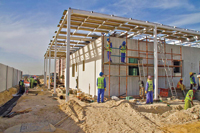
The Passivhaus-Baytna villa project under construction ... Polypipe systems extensively used.
Polypipe systems gain popularity in Qatar
01 June 2013
POLYPIPE Terrain has seen its plastic pipework, water treatment and irrigation systems used throughout Qatar’s groundbreaking Passivhaus-Baytna sustainable villa project to help meet the target of using 50 per cent less energy and water than in a traditionally-built villa.
The British manufacturer has worked as a supply partner on the project with Qatar Green Building Council (QGBC) and Barwa Real Estate.
In terms of sustainable development, conserving water is a key issue in the Middle East, says a company official.
With extremely limited fresh water resources, growing populations and urbanisation are placing increasing demands on supply, with annual demand for water increasing significantly over the last decade and projected to continue to increase.
Polypipe Gulf general manager Robin Appleby says: “The Passivhaus concept originated in Germany and focuses on energy efficiency, looking to reduce overall energy consumption in the construction and running of the building. In the Middle East, we also have to consider water preservation. Virtually all fresh water is obtained via the desalination process, which is not only expensive, but also uses large quantities of energy and has many adverse environmental impacts, so we need to think very carefully about how we use water in the home.”
A wide range of Polypipe products was used in the project. These included Terrain PVC-u (unplasticised polyvinyl chloride) above and below-ground drainage products used with the Terrain Pleura ventilation system. For the hot and cold water distribution systems, Polyplumb pipework was chosen for its fast and reliable installation. A key feature is the use of a Permavoid water treatment unit for treating foul and greywater, which is then used for sub-soil irrigation.
Appleby says Polypipe Terrain has focused its development resources on providing piping solutions to enable the utilisation of building technologies aimed at the reduction of carbon dioxide emissions and redirection of energy usage.
“In addition, the materials we use are, in themselves, environmentally friendly. Plastics are lighter and more robust than traditional materials so you need less to do more. They help reduce energy usage because they are lightweight in production, transport and use. In contrast to traditional materials like concrete or clay, plastics are recyclable, require no quarrying activities and reduce the carbon footprint from transport.”
He continues: “Our involvement in the Baytna project has provided us with a valuable opportunity to demonstrate the contribution that Polypipe products can make to sustainable development in the Middle East.”
Polypipe is one of Europe’s largest and most innovative plastic piping systems manufacturers, and the largest in the UK, with more than 20,000 product lines and 50 years of experience exporting around the globe.
With a presence in around 100 countries – especially Europe and the Gulf – Polypipe is a major international supplier, with a proven track record of delivering an impressive portfolio of high-profile, integrated projects, including supplying plastic piping systems to Heathrow airport in London (UK), Baku airport in Azerbaijan, Sports City in Dubai (UAE), Manchester United’s football stadium, and Olympic venues at the London 2012 Games.
- Gulf a focus area for British companies
- Laidlaw to expand interiors portfolio
- RMD solutions raise two Oman airports
- Polypipe systems gain popularity in Qatar
