

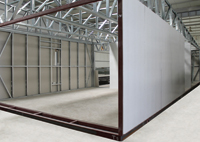
A cross-section of the cabins.
Visaka promotes next-gen boards
Visaka Industries is promoting its Vnext range as a suitable substitute for plywood. Made from fibre cement, Vnext can be used for rapid building of offices, staff camps, labour camps and even villas.
01 July 2013
WITH the growing popularity of prefabricated houses worldwide, India-based Visaka Industries is pioneering the replacement of plywood with next-generation fibre cement products for the cladding of walls, false ceilings and flooring in such structures in the Middle East, Africa and India.
Fibre cement products are taking the industry by storm around the world and are being used in some of the most iconic buildings, says Vamsi Gaddam, chief business strategist at Visaka Industries.
Visaka is now aggressively promoting the use of its Vnext range of fibre cement products in prefabricated houses, which are growing in popularity worldwide.
Prefabricated structures are being built rapidly as start-up infrastructure facilities like offices, staff camps, labour camps and stores by using next-generation products, he says.
Addressing this need from the Vnext arsenal are Vboard and Vpanel brands that are powered by new-age fibre cement technology. Created over years of meticulous innovation using the company’s vast experience, the brands have caught the attention and imagination of renowned architects and interior designers the world over, says Gaddam.
 |
Vnext range ... used for office cabins. |
“With their inherent fire-, water- and termite-resistant properties, Vnext products are widely used for external and internal wall cladding, partitions, false ceilings, floorings substrate, wet area linings and many more innovative applications in prefabricated houses and portacabin technologies,” he adds. “Owing to their rapid speed of construction, the resistance they offer to various elements, and great value for money, Vboard and Vpanel are fast becoming the preferred choice for next-generation, start-up companies to build pre-fabricated offices, canteens, villas, resorts, and penthouses.”
The Vboard is a non-asbestos, autoclaved, fibre cement board manufactured using the Hatschek process and high-pressure steam curing (HPSC) technology. The boards are a composite matrix of special-grade cellulose fibres, ordinary Portland cement, fine silica, quartz and mineral additives, manufactured as per IS 14862-2000 in standard dimensions and tolerances with flat and textured surface finishes to meet the requirements of modern building applications.
The Vboards are available for different applications in variants including V-Board, V-Premium, V-Designer board with a textured surface finish (V-Cedar, V-Stone, V-Oceanic, V-Lake and Hill), V-Ply, V-Fire Resistant Board, and V-Tiles Backer Board.
“The thermal conductivity of Vboard is lower than any other substitute of its nature, which also makes it a good insulator. Hence, Vboards are used as an energy-saving aid to maintain the temperature in closed air-conditioned rooms,” says a spokesman for the company.
Meanwhile, Vpanels are manufactured with technical know-how from Dantotech, Australia, using a unique process that bonds asbestos-free fibre cement facing sheets and the cementitious core with expanded polystyrene beads to make a composite lightweight drywall panel with a unique semi-circular tongue-groove profile for easy joining, the spokesman explains.
 |
Vnext products ... suitable for cladding, partitions and ceilings. |
The Vpanel has been manufactured with the aim of achieving cost-effective dry walls quickly. The lightweight panel is an energy-efficient product because of its excellent thermal properties. A Vpanel wall has all the advantages of a masonry wall, with additional properties preferred for construction such as its workability and proves to be a great substitute for plaster board, particle board, plywood and brick wall partitions, he adds.
Vpanels are manufactured to meet the requirements of international standards for partition walls.
Vnext’s chief business strategist comments: “Through experience, we have learnt that customers today are more aware about their requirements than ever before. They want products that match modern architectural requirements, last for a lifetime and bear an economical price tag. Vnext aptly fits the bill and fulfils the needs of today’s customers.”
Visaka Industries, which was established in 1981 to manufacture fibre cement roofing sheets, today has manufacturing plants across the country with a turnover of Rs925 crores ($185 million), making it the second largest cement sheet manufacturer in India. The non-asbestos cement board and panel division was established in 2008.
 |
Vpanels ... used for offices, camps and stores. |
“Visaka Industries has invested heavily in research and development of new materials and products to take construction to the next level,” Gaddam says.
Visaka boasts a massive portfolio with eight fibre cement roofing sheets plants, having a manufacturing capacity of 830,000 tonnes per year (tpy), two Vboard plants with a capacity of 120,000 tpy, a Vpanel plant with a capacity of 300,000 sq m, and a textile yarn plant.
With a focused vision of revolutionising modern construction, the company manufactures the highest quality products that are exported around the world, the spokesman concludes.
