

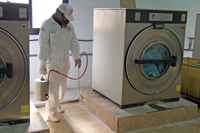
Masa’s IPM strategy ... ensuring best pest control solutions.
Masa experts use IPM strategy for pest control
Pest control operators can work in tandem with facility managers to ensure that the built environment not only remains efficiently functional but also hygienic and pest free, says MOHAMMAD ARIF HUSSAIN*.
01 August 2013
FACILITY management (FM) is a profession that encompasses multiple disciplines to ensure functionality of the built environment by integrating people, place, process and technology.
The skills of a facility manager can be broken down into two sections: the hard skills – tasks performed through physical or technological means, and the soft skills – those performed through mental intuitiveness.
FM is primarily devoted to the maintenance and care of commercial or institutional buildings, such as hospitals, clinics, hotels, resorts, schools, office complexes, sports arenas or convention centres, covering air-conditioning, electric power, plumbing and lighting systems, cleaning, decoration, grounds keeping, and security.
Although these duties constitute support services, FM serves to coordinate and oversee the safe, secure, and environmentally-sound operations and maintenance of these assets in a cost-effective manner aimed at long-term preservation of the asset value, and also other janitorial duties.
In cases where the operation of the facility directly involves the occupants and/or customers of the owner organisation, the satisfactory delivery of facility-related services to these people will be an important consideration hence, the term “end-user satisfaction” is often used both as a goal and a measure of performance.
The role of a facility manager is to ensure proper operation of all aspects of a building to create an optimal environment for the occupants to function. This is accomplished by managing activities, some of which include:
• Environmental health and safety: This includes waste removal, meeting occupational health and safety regulations, hazardous material compliance and building cleanliness: The latter sub-discipline of FM includes routine cleaning (restrooms, common areas) as well as more specific emphasis on dust control and hygiene maintenance.
Dust control is an increasing concern and is crucial for providing a safer and healthier environment for employees and customers. Indeed, the National Institute for Allergy and Infectious Diseases notes that dust mites are a common cause of perennial allergic rhinitis, an affliction that affects millions of peoples throughout the world.
• Mechanical systems: While maintaining mechanical systems, the facility managers are responsible to maintain temperature and humidity inside the facility to prevent pest proliferation.
• Integrated pest management: It is necessary for the facility manager to establish a programme or management procedure to have a pest-free environment within and around the premises. For this purpose, pest control companies such as Masa who provide an IPM (integrated pest management) strategy, can provide their services to ensure that the best pest control solution with minimum impact on human health and the environment is adopted.
Masa can provide expert advice on how to limit and prevent unnecessary pest problems. Pests seek habitats that satisfy basic needs such as food, water and shelter. A successful programme depends on the client and pest control operators (PCOs) working together to establish an environment that limits harborage areas, points of entry and conditions that attract pests.
IPM is based upon regular inspections, accurate identification of pests and of the specific area actually infested; it prevents pest problems by eliminating pest habitats, and access to food, water and other essential needs; and responds to pest problems with mechanical, physical and biological controls, and resorts to chemical controls last.
IPM requires an evaluation of the toxicity and exposure potential associated with any pesticide to ensure that the alternative used has the lowest toxicity and lowest risk for unwanted exposure.
One of the products used by Masa is Acme gel with active ingredient Imidacloprid 2.15 per cent. This provides an IPM solution in sophisticated environments like hospitals, kitchens, restaurants, hotels, food facilities, etc and will kill roaches slowly without extra/overuse of pesticide spray. Bait formulations are now in high demand among PCOs and are required by clients for the total eradication of cockroaches from their premises. The unique action of Imidacloprid 2.15 per cent gel makes it an ideal active ingredient for killing roaches. Baits offer several advantages over other insecticide formulations in the control of populations of the different stages of cockroaches’ development.
Masa offers professional and reliable services to FM companies which are delivered by its expert team of highly skilled pest control technicians. All of its services are tailored to each individual property and to the individual needs of the business in questions to ensure the best possible results are attained. The company’s expert team partakes in detailed discussions with the facility management company involved prior to starting any work to establish the frequency and level of service that is required.
Masa’s teams are equipped to successfully combat any pest control issue and will provide clients with a central point of contact to ensure that their building facilities company can quickly reach them, if necessary. The team of pest control experts that a client has at his disposal has been handpicked to ensure that it possesses all of the skills needed to provide long-lasting and reliable pest control solutions on a consistent basis.
Masa has a proven track record of 33 years of experience in the field of pest control for delivering quality and effective results obtained through the use of a wide range of tried and tested pest control solutions.
• Mohammad Arif Hussain is an entomologist at Masa Establishment for Pest Extermination, Maintenance and Contracting in Jeddah, Saudi Arabia.
- MAF Dalkia to serve Abu Dhabi airports
- Schneider UPS suits small businesses
- Masa experts use IPM strategy for pest control
- Spider weaves maintenance success in Dubai
