

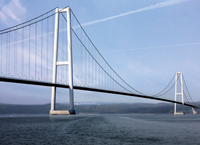
The Izmit Bay Bridge ... an artist’s impression.
Building the bay bridge
Measuring nearly 3 km, the Izmit Bay Bridge will become the world’s fourth longest suspension bridge once complete in 2016, writes Abdulaziz Khattak.
01 August 2013
CONSTRUCTION work is currently under way on one of the world’s longest suspension bridges which forms a vital component of a strategic highway development in Turkey.
The Izmit Bay Bridge is a significant part of the $11-billion highway, which extends 420 km from Gebze to Izmir linking Turkey’s largest city Istanbul with its third most populous metropolis of Izmir. The prominence of this key project is highlighted by the fact that none other than Turkish Prime Minister Recep Tayyip Erdogan laid its foundation stone in March this year. The bridge itself will cost $1.2 billion and is located 50 km east of Istanbul at the eastern end of the Sea of Marmara, near Izmit.
Crossing the Bay of Izmit, the bridge and connecting highway will provide three lanes of traffic in each direction. The total length of the bridge is about 3 km (2,907 m), with a main free span of 1,550 m between its 250-m-high pylon towers.
Construction of the permanent works for the project, which is being built for KGM – Turkish Ministry of Traffic – on a BOT (build-operate-transfer) basis, started in January this year and is expected to be completed by February 2016. The owner of the concession is Nomayg (Nurol-Ozaltin-Makyol-Astaldi-Yuksel-Gocay).
Japanese company IHI Corporation is the main engineering, procurement and construction (EPC) contractor for the bridge while Denmark’s Cowi is the exclusive designer and consultant for IHI.
Once complete, the Izmit Bay suspension Bridge will be the fourth largest of its kind in the world become of the length of central span.
“The project cements Cowi’s role as the world’s leading consultancy firm on suspension bridges,” says Kent Fuglsang, chief project manager, major bridges for Cowi and project director for Izmit Bay Bridge.
Fuglsang headed a team of more than 150 Cowi employees to complete the detailed designed of the bridge during the one-and-a-half year design period (September 2011 to February 2013).
 |
|
Tower foundation ... work under way. |
Structure
IHI won the contract to design and build the Izmit Bay Bridge, beating competition from Chinese and Korean contractors. In the bidding phase, Cowi prepared a bridge design in partnership with IHI which would enable the contractor to build faster and at a lower cost than the competitors, according to Cowi.
The bridge comprises a single-cell steel orthotropic deck (stiffening girder); stiffened steel pylons; a pylon substructure comprising cofferdams founded on a gravel bed with steel inclusion piles to strengthen the weak foundation soils; anchor blocks that support the cable systems; pre-formed parallel wire strand cable system to support the stiffening girder; and approach spans and piers.
Halcrow has been appointed by IHI to carry out a full independent design check on Cowi’s design.
Halcrow has modelled the structure using proprietary software packages Larsa4D Version 7.06 and Midas Civil 2012 V1.1. The global analysis model comprises beam and cable elements.
According to Halcrow, a special solution has been adopted for the tower foundations in order to mitigate the impact of seismic loading with steel piles driven into the subsoil as a form of ground improvement. The steel inclusion piles increase the shear strength sufficiently to withstand the seismic forces as well as hydrodynamic water pressures likely to occur during the design earthquake.
The concrete caisson foundation is then placed on a gravel bed on which it is free to slide during extreme earthquakes. The gravel layer isolates the inclusions from the piers to reduce transfer of the shear forces from the reinforced ground to the superstructure. This will dissipate energy which would otherwise affect the superstructure.
The modelling of the tower foundations is complex as non-linear sliding and uplift have to be taken into account in conjunction with the non-linear material behaviour of the soil strata underneath the tower foundations.
This was modelled by using a grillage of beam elements to represent the tower caissons which, in turn, are supported on a system of friction element, dampers and springs, modelling seismic events at 1:150, 1:1,000 and 1:2,475 year return periods.
 |
|
Excavation work in progress on an anchor block. |
The geotechnical scope included many challenging tasks and much effort has gone into defining the seismic input (time histories) and into developing a methodology which would strike a satisfactory balance between simplicity and accuracy for the incorporation of dynamic soil-structure interaction into the global finite elements model.
The Izmit Bay Bridge is being built in one of most seismically active areas in the world, which places additional demands on the bridge’s design. In contrast to the Great Belt Bridge in Denmark, in which Cowi was also involved, the design team decided to use steel instead of concrete for the Izmit bridge’s pylons.
“The risk of an earthquake places unique demands on our services. Fortunately, we can draw on our earthquake specialists from our subsidiary in California,” says Fuglsang.
He explains that the bridge will be made earthquake resistant by building its pylons on a concrete foundation that rests on a large gravel bed – the pylons can slide on in the event of a major earthquake.
“In this way, the bridge will be partly isolated from the enormous energy which a major earthquake releases.”
Fuglsang points out that the project is highly complex. “The main challenges of the project include high seismic activity at the bridge site, deep water tower foundations (40 m water depth) and requirements to meet a very tight construction schedule of 37 months duration,” he says.
“Cowi has successfully been able to face and handle these challenges due to its long-term experience with design of major suspension bridges, which among others include the Great Belt East Bridge in Denmark, Höga Kusten Bridge in Sweden, and the 3,300-m world record main span bridge crossing the Strait of Messina in Italy,” says Fuglsang.
“The experience gained during this project will provide Cowi with further significant hands-on experience and expertise in delivering highly complex major bridge projects to international contractors,” he says.
The overall construction of the bridge will require some 130,000 cu m of concrete for the anchor blocks; 45,000 cu m of concrete for the tower foundations; 16,000 tonnes of steel for the inclusions; 17,000 tonnes of steel towers; 18,000 tonnes of steel main cables; and 33,000 tonnes of steel for the bridge decks.
- Building the bay bridge
- Cultural concept
- Serene splendour
- Kale furniture range lauded for innovation
