

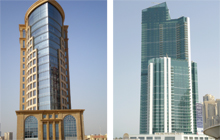
The Zamil House (left) in Al Khobar, Saudi Arabia, and Al Bateen Towers, Dubai Marina in Dubai, UAE ... showing facades as creative expressions.
Facades, more than just a pretty face
Building facades need to be responsive to environmental demands to optimise energy use, says RICHARD LEE*, highlighting the need to promote the façade engineering discipline to achieve this goal.
01 December 2013
IN RECENT years, the construction industry has begun to recognise the importance of engineers who fully understand how a building’s external envelope can significantly contribute to the reduction and control of the building’s energy consumption.
The facade of a modern building is becoming one of the most expensive and important elements of building construction representing up to 35 per cent of the total building costs. Facades have become a creative expression of the architect’s and client’s aesthetic intentions but they have also become the primary environmental modifier of the building, significantly influencing the building’s internal conditions, energy use and occupants’ comfort.
It is well understood how insulation is important to prevent energy losses from the building but this general rule is not always applied in all types of construction. Some buildings that rely heavily on air-conditioning energy use might not necessarily benefit from very high levels of insulation when cool external weather conditions could actually help in lowering the warmer internal temperatures.
In the future, building facades will need to be much more adaptive than current constructions so that they work in a similar fashion to a person removing their coat and putting on sunglasses on a hot day. Obviously, we have the ability to open and close window panels for ventilation purposes but varying levels of insulation and window transparency will be required to further optimise building energy use.
 |
|
Brital systems ... utilised in various projects. |
The increasing complexity and environmental demands of modern building envelopes means that the technical design and execution of sustainable buildings now requires properly trained and skilled engineers to be part of a holistic approach from the very beginning of the concept for any new building project.
Facade engineering is becoming an increasingly important aspect of building design and performance in addition to its environmental impact, yet it is a relatively new science with only a very small handful of universities in Europe offering master’s degree level of study in the science. It emphasises the need to design and fully understand how building facades contribute to energy in use so that optimum forms of construction can be achieved with calculated certainty. This results in qualified and trained professional engineers with a full understanding of the issues and requirements of a modern building envelope.
The Society of Facade Engineering (SFE) is a professional body established originally in the UK 10 years ago that is fast growing into the major body for facade professionals to continue to learn and benefit from the experience of their peers in this relatively new field of specialised engineering. The SFE defines the science as “the art of resolving aesthetic, environmental and structural issues to achieve the closure of habitable spaces”.
 |
|
Facades need to be much more adaptive to environmental demands. |
To celebrate its 10th anniversary, the SFE launched Facade 2013, an international competition designed to recognise, promote and reward excellence in this key element of building design and construction.
The prize will be awarded on a project basis with entries welcomed from individual members or project teams from around the world. The winner will be decided by a panel of experts who will make their choice based upon a clear demonstration of excellence in the technical design and/or research that has made a significant contribution to the discipline of facade engineering. The contribution may be demonstrated in the form of technical advances, innovations or advanced engineering concepts that result in practical design solutions for the completion of a building facade. The winner was due to be announced in London late last month (November).
This type of competition will undoubtedly contribute to the growth of the facade engineering discipline throughout the world and help to achieve recognition for this newly emerging specialist form of engineering, and enhance its contribution to the completion of sustainable modern buildings throughout the world.
*Richard Lee is the managing director of Brital, a UK-based facade design and engineering company. He is a Fellow of the Society of Facade Engineering (FSFE) and an active member of the Middle East and North Africa (Mena) branch of the SFE.
- Reynaers gives flight to creativity
- Correct sealants crucial for perfect facades
- Facades, more than just a pretty face
