

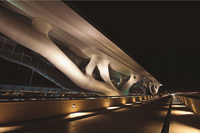
The QNCC ... unparalleled facility.
Qatar’s convention centre raises the bar
01 January 2012
THE iconic Qatar National Convention Centre (QNCC), which has been hailed as the 21st century model of urban planning, opened its doors last month in Doha, Qatar.
Part of Qatar Foundation for Education, Science and Community Development, the QNCC made its debut by hosting its first high-profile event, the 20th World Petroleum Congress (WPC), with some 5,000 delegates from December 4 to 8.
The convention facility, boasting iconic design and cutting-edge facilities in a world-first green-technology venue, has set new standards in terms of its size and sensational spaces over three levels and high-tech solutions. It has 40,000 sq m of exhibition space, a conference hall for 4,000 delegates, a 2,300-seat lyric theatre, three tiered auditoriums, theatre-style seating, banquet space for up to 10,000 people in exhibition halls and a total of 52 meeting rooms.
Saad Al Muhannadi, vice-president of capital projects at Qatar Foundation, and Ali Al Khalifa, chief executive officer of ASTAD Project Management, revealed the inspiration and details behind construction of the sustainable and environment-friendly building.
The project received the go-ahead in 2004 and construction work commenced in 2006.
 |
|
Al Khalifa and Al Muhannadi (right) |
Successfully bringing together scientists and researchers from around the world, Al Muhannadi and his team completed the centre, which will further Qatar Foundation’s goal to enhance education, science and technology, and community development on a global scale.
“Its sheer size, sensational spaces over three levels, and high-tech solutions will undoubtedly set new standards for international competition, placing Doha in the lead,” he said.
Designed by leading Japanese architect Arata Isozaki, the QNCC features a spectacular facade resembling two intertwined trees supporting the building’s exterior canopy. The 250-m-long, curved steel tree structure forms the signature entrance to the QNCC, portraying specifically the sidra, an icon in Qatari culture.
UK engineering firm Buro Happold undertook the design and fabrication challenges posed by the complex and unusual tree structure. The electronic data generated by the team was sent to the Belgium-based contractor, Victor Buyck Construction. The fabrication took place in Malaysia, with final assembly in Doha.
The tree structure has two main components. The visible exterior skin is a complex curved form. Underneath it is a structural core of octagonal tubes, each tube itself composed of flat steel plates. The whole tree is made up of 70 per cent single curvature panels and 30 per cent double curvature panels.
“The construction of the QNCC and its advanced facilities will undoubtedly continue Qatar’s legacy of educational and scientific achievement by offering a place where the world’s best minds can come together,” said Al Khalifa.
Additionally, the 177,000-sq-m facility successfully meets the gold standard in the Leadership in Energy and Environment Design (Leed), the US Green Building Council green building rating system, which makes it the first conference destination in the world to achieve such an accolade.
“Sustainability was our focus when developing the construction plans. The building operates efficiently with over 3,500 sq m of solar panels that provide 12.5 per cent of QNCC’s energy needs while still offering the latest in communication technology,” said Al Muhannadi.
To test out the building’s performance, the centre hosted a number of successful soft launch events, including the World Innovation Summit for Education, The Hague International United Nations, the Qatar Foundation Annual Research Forum, and the Arab Expatriate Scientists Symposium.
The QNCC provides the latest in communications technology with spacious foyers, luxury lounges, and the best in hospitality, placing Doha on the map as a premiere destination for conferences and events in the future.
Located alongside elite universities and research institutions in Education City, QNCC is furthering Qatar Foundation’s mission to turn Qatar into one of the most vibrant economies in the world by becoming the convention venue of the future, culminating values of education, research, and technology into a global hub for ideas and innovation.
- Qatar’s convention centre raises the bar
- Saudi Arabia kicks off world’s largest IPP
- EMCO, SGB-PCM win award
- Update
- JV secures $650m contract at Msheireb
- $533m urea plant deal
- Siemens ready to deliver on Saudi power plant
- DSI wins key MEP contracts
- Saudis plan ‘special’ $66bn housing project
- Alargan launches Qurm Hills
- Haramain railway final phase to be flagged off
- MAN secures Damac contract
