

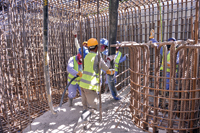
The first concrete pour being carried out for the pier and (below) the museum site.
First concrete pour for Louvre Abu Dhabi
01 June 2013
LOUVRE Abu Dhabi, the first of three iconic museums on Saadiyat Island in Abu Dhabi, achieved its first major construction milestone when the first concrete pour was carried out for one of the four piers that are to hold the dome of the structure.
Being developed by Tourism Development and Investment Company (TDIC), master developer of major tourism, cultural and residential destinations in Abu Dhabi, Louvre Abu Dhabi is set to open in Saadiyat Cultural District in 2015, with work on the dome expected to be complete by the end of 2014.
The dome, which has a diameter of 180 m and is expected to weigh more than 7,000 tonnes – almost the weight of the Eiffel Tower in Paris, France – will be supported at four points only. The dome will rest 9 m high at the entrance of the museum and will reach up to 30 m high on the inside. The design concept behind the laced dome is to reflect the interlaced palm trees traditionally used as roofing material in the region, allowing the sun to shine through like “a rain of light”. It was designed in such a way that the roof primarily acts as a shading canopy to protect the outside plaza and building below from the radiant heat of the sun, providing local comfort and reducing building energy consumption.
The museum, which will be surrounded by water, gives the illusion of a floating structure.
 |
|
|
The concrete pour was witnessed by Sheikh Sultan bin Tahnoon Al Nahyan, chairman of TDIC and Abu Dhabi Tourism and Culture Authority (TCA Abu Dhabi), alongside senior members of the TDIC management.
The construction of Louvre Abu Dhabi was awarded to the Arabtec-led joint venture with Constructora San Jose and Oger Abu Dhabi in January this year. The project has achieved major developmental milestones with the finishing of the building’s detailed design and the completion of the infrastructure, which encompassed marine, excavation, piling and substructure works.
Mubarak Hamad Al Muhairi, managing director of TDIC, said: “We’re delighted to witness the first concrete pour for the foundation that is going to hold up the unique dome of Louvre Abu Dhabi. This is an important time for us because it’s symbolic of moving into a new construction stage and most importantly taking another step closer towards realising our landmark project. This is a world-class museum with a one-of-its-kind design and TDIC is closely monitoring its development.”
A temporary platform in the sea, on which the entire building will be constructed, was built in 2009 to allow all works to take place in a dry environment. Upon completion of the building, including the marine works, the 40-m-high concrete walls currently built in the sand will be removed to allow seawater to flow in gradually. More than 4,000 steel and reinforced concrete piles – involving a total volume of 21,000 cu m of concrete – were driven into the ground to serve as a base for the Louvre Abu Dhabi building. The final stage includes marine works and removal of temporary land platforms which will be completed in 2015 when this world-class building transforms into an island of its own.
Designed by Pritzker-prize winning architect Jean Nouvel, the Louvre Abu Dhabi will encompass 9,200 sq m of art galleries. The 6,681-sq-m permanent gallery will house the museum’s permanent collection taking the visitor through a universal journey from the most ancient to contemporary through art works from different civilisations. The temporary gallery will be a 2,364-sq-m dedicated space presenting temporary exhibitions of international standards.
Besides the Louvre Abu Dhabi, the Saadiyat Cultural District will also feature Zayed National Museum, which will open in 2016, and Guggenheim Abu Dhabi, which will open in 2017 – both designed by world-renowned Pritzker-prize winning architects as well.
The museums are expected to enhance the appeal of Saadiyat which promises an exclusive lifestyle through the island’s high-end residential, leisure, cultural and tourism facilities.
- First concrete pour for Louvre Abu Dhabi
- Bids invited for traditional suq project in Abu Dhabi
- Bechtel to open global engineering centre in UAE
- IMG showcases adventure park
- Damac launches golf community project
- Update
- RTA approves plan to build 17 footbridges in Dubai
- $13m Nakheel deals awarded
- Skai to construct $1bn hotel on Palm Jumeirah
- DWC building fourth warehouse complex
- UAE’s largest data centre on way
